

The Electric Revolution and Your Business: Unlocking Growth with Commercial EV Charging Incentives
California stands at the forefront of the electric vehicle (EV) revolution, leading the nation in EV adoption and setting ambitious goals for a cleaner transportation future. For businesses across the Golden State, this seismic shift isn't just a matter of environmental responsibility; it's a profound opportunity for strategic growth, enhanced employee and customer satisfaction, and significant financial savings. Installing commercial EV charging infrastructure, once seen as a luxury, is now becoming a competitive necessity. However, the initial investment can seem daunting.
This is where California's robust landscape of commercial EV charging incentives comes into play. From state-level grants and utility rebates to federal tax credits, a wealth of programs exist to significantly offset the costs of planning, purchasing, and installing EV charging stations. Navigating this intricate web of opportunities requires expertise and foresight. That's where Powercore Inc, a dual-licensed General B & C-10 Electrical Contractor based in Roseville, CA, with statewide service, emerges as your indispensable partner.
In this comprehensive guide, we'll dive deep into the world of California commercial EV charging incentives, helping you understand how to leverage these programs to future-proof your business, attract top talent, enhance your brand image, and contribute to a sustainable future, all while maximizing your return on investment.
Why Commercial EV Charging is Essential for California Businesses
Beyond environmental stewardship, establishing EV charging infrastructure at your business offers a myriad of tangible benefits that directly impact your bottom line and long-term viability in the Californian market.
Attracting Talent and Customers in a Green Economy
As EV ownership surges, prospective employees and customers increasingly seek amenities that align with their sustainable lifestyles. Offering on-site EV charging isn't just a convenience; it's a powerful statement about your company's values and commitment to the future. For employees, it can be a deciding factor in job acceptance and retention, reducing range anxiety and enhancing their daily commute. For customers, especially those with longer dwell times (e.g., retail, hospitality, healthcare), accessible charging can significantly influence their choice of business, translating directly into increased foot traffic and loyalty. Businesses that provide this amenity are often perceived as modern, forward-thinking, and environmentally conscious.
Fueling Fleet Electrification and Operational Efficiency
Many California businesses are exploring or actively transitioning their fleets to electric vehicles to comply with evolving regulations, reduce fuel costs, and minimize their carbon footprint. Whether you operate delivery vans, service vehicles, or shuttle buses, dedicated on-site commercial EV charging infrastructure is non-negotiable for efficient fleet operations. It ensures vehicles are charged during off-peak hours, ready for their routes, and reduces reliance on public charging networks, which can be less predictable and more expensive. Furthermore, the operational cost savings of electric fleets (lower “fuel” and maintenance) are maximized when charging infrastructure is optimized and managed correctly.
Boosting Your Green Credentials and Brand Image
In environmentally-conscious California, a strong commitment to sustainability is a significant brand asset. Investing in EV charging solutions signals your dedication to reducing emissions and supporting green initiatives, resonating positively with stakeholders, investors, and the wider community. This enhanced brand image can lead to improved public relations, increased market share, and differentiation from competitors. It also positions your business as a leader in corporate social responsibility, which is increasingly important for attracting ethically-minded consumers and partners.
Future-Proofing Your Operations and Regulatory Compliance
California continues to set ambitious EV targets, including mandating all new car sales to be zero-emission by 2035. This trajectory indicates that EV charging will transition from an advantage to a fundamental expectation, and potentially, a regulatory requirement for certain business types or new constructions. By proactively installing EV charging infrastructure now, with the aid of incentives, your business avoids future retrofit costs, stays ahead of potential mandates, and ensures readiness for an increasingly electrified world. It's a proactive step towards long-term operational resilience and competitive advantage.
Navigating California's Commercial EV Charging Incentive Landscape
California’s commitment to accelerating EV adoption has resulted in a dynamic and multi-layered incentive framework. This ecosystem includes state-level programs, regional initiatives, and utility-specific offerings, all designed to make EV charging infrastructure more accessible and affordable for businesses. Understanding which programs apply to your specific project and how to effectively combine them is key to maximizing your savings. Powercore Inc specializes in helping businesses navigate this complexity, ensuring you don't miss out on valuable funding opportunities.
Key State-Level Commercial EV Charging Incentives
California’s state agencies offer several cornerstone programs to support commercial EV charging deployment:
-
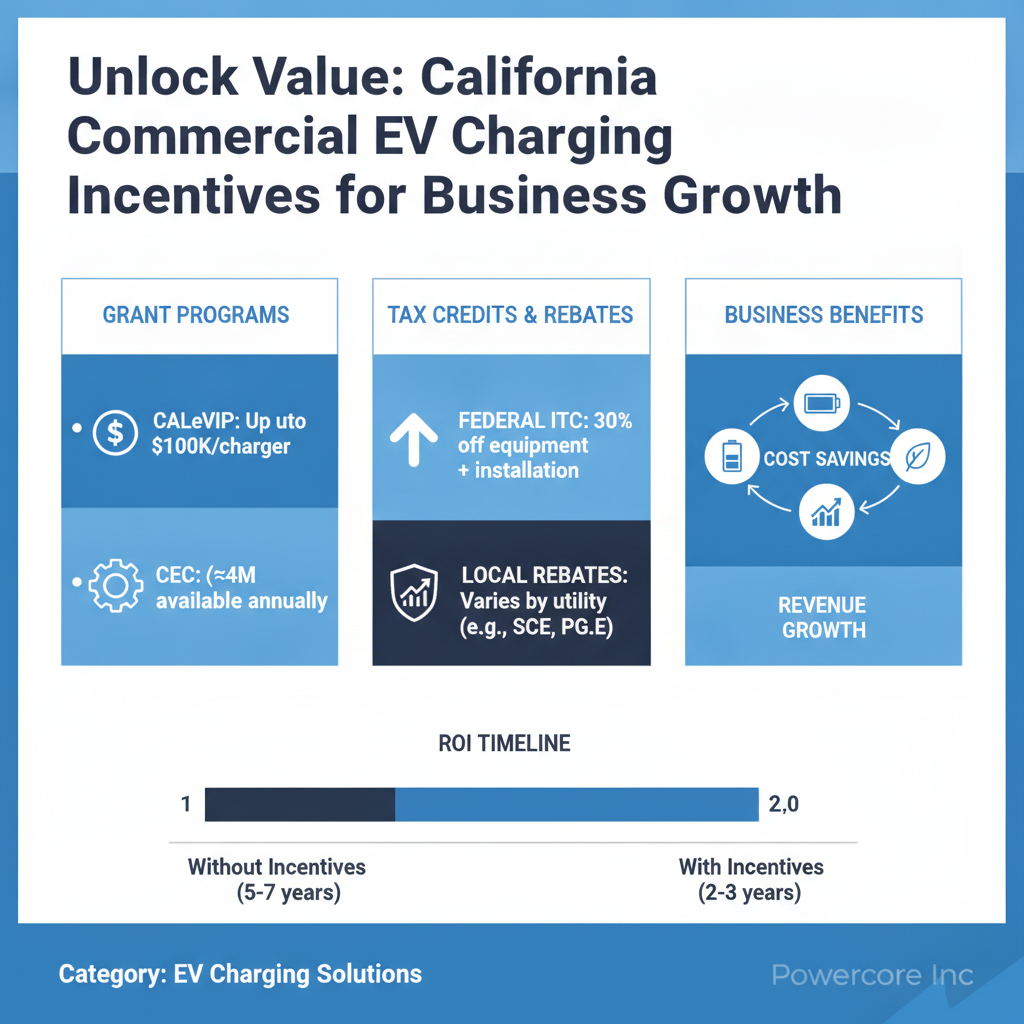
CALeVIP (California Electric Vehicle Infrastructure Project): Administered by the California Energy Commission (CEC) and local air districts, CALeVIP is arguably the most significant state-level program for commercial EV charging. It provides rebates for the purchase and installation of eligible Level 2 and DC Fast Chargers. The program operates through regional projects, each with specific funding pools and eligibility requirements, often prioritizing sites in disadvantaged communities or those serving specific types of vehicles (e.g., multi-unit dwellings, workplaces, public access). Rebate amounts can vary significantly by region and charger type, often covering a substantial portion of hardware and installation costs.
-
Clean Transportation Program (CTP): Also managed by the CEC, the CTP invests billions in clean transportation and fuel infrastructure development. While broader than just charging, it funds projects that advance zero-emission vehicle technologies, including charging infrastructure for fleets, transit, and heavy-duty applications. Businesses can explore various solicitations and grant opportunities that emerge under this umbrella, often targeting innovative or large-scale deployments.
-
California Air Resources Board (CARB) Programs: CARB spearheads California’s efforts to reduce air pollution, and several of its programs indirectly or directly support commercial EV charging, particularly for fleets. The Hybrid and Zero-Emission Truck and Bus Voucher Incentive Project (HVIP), for instance, offers point-of-sale vouchers for clean vehicles, and related programs may support the necessary charging infrastructure for these vehicles, especially for heavy-duty applications. Businesses electrifying their fleets should always consult CARB’s latest offerings.
Utility-Specific Incentive Programs in California
California’s major investor-owned utilities (IOUs) – PG&E, SCE, and SDG&E – play a critical role in incentivizing EV charging infrastructure through their own programs. These programs are often designed to support grid stability, encourage off-peak charging, and accelerate EV adoption within their service territories. Eligibility and specific offerings vary considerably, making it essential to consult your local utility.
-
Pacific Gas & Electric (PG&E):
- EV Fleet Program: Supports medium- and heavy-duty fleet electrification by providing make-ready infrastructure (upgrades to the electrical service up to the charger) for Level 2 and DC Fast Chargers. This can significantly reduce the most expensive part of EV charger installation.
- EV Charge Network: Focused on public charging, workplace charging, and multi-unit dwelling (MUD) charging, this program provides rebates for Level 2 charging stations and associated infrastructure.
-
Southern California Edison (SCE):
- Charge Ready Program (Business & Transport): SCE’s flagship program, offering incentives for Level 2 and DC fast charging infrastructure. Charge Ready Business targets workplaces, public destinations, and MUDs, while Charge Ready Transport focuses on medium- and heavy-duty fleets. Both programs often cover a significant portion of infrastructure costs, including trenching, wiring, and panel upgrades, with higher incentives for sites in disadvantaged communities.
- Clean Fuel Reward: While primarily for EV drivers, businesses managing fleets can benefit from reduced operating costs due to the lower effective cost of electricity for charging, which is subsidized through this program.
-
San Diego Gas & Electric (SDG&E):
- Power Your Drive: Similar to other utility programs, Power Your Drive assists businesses, workplaces, and multi-unit dwellings with the installation of Level 2 charging stations by covering a significant portion of the infrastructure costs.
- Electric Fleet Program: Designed to support the electrification of commercial and public fleets, this program provides incentives for make-ready infrastructure for both Level 2 and DC Fast Chargers.
It is crucial for businesses to identify their specific utility provider and explore their current incentive offerings, as these programs are regularly updated and may have specific application windows or eligibility criteria. Powercore Inc has extensive experience working with all major California utilities, streamlining the process of identifying and applying for these vital incentives.
Federal Incentives and Tax Credits: A National Boost for Commercial EV Charging
Beyond California-specific programs, federal incentives offer another powerful layer of financial support for businesses investing in EV charging infrastructure. These national programs can often be combined with state and utility incentives, a practice known as “stacking,” to maximize your overall savings.
Alternative Fuel Infrastructure Tax Credit (30C)
One of the most impactful federal incentives is the Alternative Fuel Vehicle Refueling Property Credit, often referred to as the 30C tax credit. This program offers a tax credit for the cost of qualified alternative fuel vehicle refueling property, which includes EV charging stations. Key features include:
- Credit Amount: The credit generally covers 30% of the cost of eligible property.
- Cap: For property placed in service after December 31, 2022, the credit is capped at $100,000 per item of property. This means for a single charging station (or a collection of chargers at one location considered a single property), the maximum credit is $100,000.
- Eligibility: The charging equipment must be placed in service in a qualified census tract (i.e., not an urban area) and meet certain prevailing wage and apprenticeship requirements if the project began construction after January 28, 2023. This is a crucial detail for maximizing the credit.
- Qualified Property: Includes equipment used to recharge electric vehicles, including Level 2 and DC Fast Chargers.
This tax credit can significantly reduce the net cost of your EV charging installation, making it a cornerstone of any strategic incentive plan. Consulting with a tax professional and an experienced installer like Powercore Inc is essential to ensure your project qualifies for the maximum allowable credit.
Inflation Reduction Act (IRA) Impact on EV Charging
The Inflation Reduction Act (IRA) of 2022 brought significant expansions and extensions to clean energy tax credits, including those for EV charging infrastructure. The IRA extended the 30C tax credit through 2032 and made important modifications to its structure, such as the aforementioned prevailing wage and apprenticeship requirements for projects above a certain capacity. For businesses, the IRA solidified long-term federal support for sustainable investments, providing greater certainty and incentive to commit to electrification. Understanding the nuances of the IRA’s provisions is vital for comprehensive financial planning.
Understanding Charger Types, Costs, and Incentive Eligibility
The type of EV charger you choose for your business will depend on various factors, including your specific needs, desired charging speed, available electrical capacity, and budget. Each type also has different implications for incentive eligibility and overall project costs.
Level 2 (AC) Chargers: Versatility for Workplaces and Public Destinations
Level 2 chargers are the most common type for commercial applications, offering a balance of speed and affordability. They use a 240-volt AC circuit, similar to a clothes dryer or electric oven, and can add roughly 20-30 miles of range per hour of charging. They are ideal for:
- Workplace Charging: Employees can charge their vehicles throughout the workday.
- Public Destinations: Retail centers, restaurants, hotels, and entertainment venues where vehicles are parked for several hours.
- Multi-Unit Dwellings (MUDs): Providing residents with convenient overnight charging.
Costs: Hardware typically ranges from $500 - $2,500 per port. Installation costs, however, can vary widely from $1,000 to $6,000+ per port, depending on electrical panel upgrades, trenching, conduit runs, and permitting requirements.
Incentive Eligibility: Most state and utility programs, as well as the federal 30C tax credit, heavily incentivize Level 2 chargers due to their widespread applicability and lower impact on grid infrastructure compared to DCFC.
DC Fast Chargers (DCFC): High-Speed Solutions for Fleets and Corridors
DC Fast Chargers (also known as Level 3 chargers) provide rapid charging by converting AC power directly to DC power, bypassing the vehicle's onboard charger. They can deliver hundreds of miles of range in under an hour, making them suitable for situations where quick turnaround is essential.
- Fleet Depots: Ensuring electric trucks, buses, or heavy-duty vehicles can be rapidly charged between shifts or routes.
- Highway Corridors: Public charging along major routes to facilitate long-distance EV travel.
- High-Traffic Retail/Convenience: Locations where customers need a quick top-off.
Costs: DCFC units are significantly more expensive, with hardware costs ranging from $20,000 to $100,000+ per unit. Installation costs are also higher, often requiring substantial electrical service upgrades, dedicated transformers, and extensive trenching, potentially reaching tens of thousands to hundreds of thousands of dollars.
Incentive Eligibility: While DCFCs are more expensive, many state, utility, and federal programs offer higher rebate amounts or larger percentage coverage for these units, recognizing their critical role in supporting fleet electrification and public charging networks. However, the total eligible cost can still be considerable.
Unveiling Installation Costs and What Incentives Cover
It’s crucial to understand that hardware is only one component of the total cost. Installation involves a complex array of expenses:
- Electrical Service Upgrades: Often the most significant cost, especially for DCFC, requiring new transformers, panels, and service lines.
- Trenching and Conduit: Laying underground wiring from the electrical source to the charging stations.
- Permitting and Engineering: Navigating local building codes and electrical requirements.
- Design and Site Preparation: Planning layout, ADA compliance, and potential civil work.
- Network Fees/Software: For smart chargers, ongoing operational costs for monitoring and billing.
Many incentives are structured to cover a portion of both the hardware and eligible installation costs, or specifically target the “make-ready” infrastructure (e.g., trenching, wiring, panel upgrades) that precedes the actual charger installation. This comprehensive coverage is vital for making projects economically feasible.
Strategic Planning for Maximizing Your Incentives
Securing the maximum available incentives for your commercial EV charging project requires more than just filling out forms. It demands a strategic, well-planned approach, ideally with the guidance of experienced professionals.
The Power of Early Planning and Site Assessment
Starting early is perhaps the most critical factor. Many incentive programs operate on a first-come, first-served basis or have specific application windows and deadlines. Furthermore, a thorough site assessment by a qualified electrical contractor like Powercore Inc is essential before you even apply. This assessment should evaluate:
- Existing Electrical Capacity: Determine if your current service can support the desired number and type of chargers or if costly upgrades are needed.
- Optimal Placement: Identify the best locations for chargers considering user convenience, future expansion, and potential trenching costs.
- Permitting Requirements: Understand local zoning, building, and electrical codes specific to your California location.
Early planning allows for accurate cost estimation, identifies potential hurdles, and ensures you're ready to submit a robust application as soon as funding becomes available.
Navigating Eligibility and Stacking Incentives
Each incentive program has unique eligibility criteria, which can include:
- Geographic Location: Some programs are region-specific (e.g., CALeVIP regional projects, utility service territories).
- Charger Type and Network: Specific Level 2 or DCFC models may be required, often needing to be “networked” (smart chargers) for data collection and load management.
- Applicant Type: Eligibility might differ for private businesses, public entities, non-profits, or multi-unit dwellings.
- Disadvantaged Communities: Many California programs offer higher incentive levels for projects located in designated disadvantaged communities, furthering environmental equity goals.
The ability to “stack” incentives – combining federal, state, and utility programs – is where significant savings are realized. However, rules around stacking can be complex, with some programs explicitly stating they cannot be combined with others, while many allow it up to a certain percentage of the total project cost. Expert guidance is invaluable here to prevent errors that could jeopardize your funding.
The Role of an Expert Partner: Powercore Inc
Given the complexity of California’s incentive landscape, partnering with a knowledgeable and experienced electrical contractor is paramount. Powercore Inc acts as your single point of contact, offering comprehensive services that extend far beyond just installation:
- Incentive Identification and Application Assistance: We stay up-to-date on all federal, state, and utility programs across California, helping you identify every applicable incentive and assisting with the often-tedious application process.
- Site Assessment and Design: Our team conducts thorough evaluations to design an EV charging solution optimized for your business needs and electrical infrastructure, ensuring compliance and efficiency.
- Permitting and Interconnection Navigation: We handle all necessary permits and liaise with utility companies for interconnection agreements, navigating California’s stringent regulations.
- Professional Installation: As a dual-licensed General B and C-10 Electrical Contractor (CSLB #1134334 and #1098175), Powercore Inc provides certified, high-quality installation services, ensuring safety, reliability, and adherence to all codes.
- Project Management: From start to finish, we manage your project, coordinating all aspects to ensure a smooth, on-time, and on-budget deployment.
Our expertise transforms the daunting task of securing and implementing commercial EV charging into a streamlined, cost-effective investment for your business.
Real-World Impact: Success Stories Through Strategic Incentives
Imagine a California hospitality business that leverages CALeVIP rebates and federal tax credits to install 10 Level 2 chargers for its guests. The initial investment, potentially $50,000-$80,000, could be slashed by 50-70% through stacked incentives, making the project highly profitable. Guests enjoy the convenience, leading to increased bookings and positive reviews, while the business positions itself as an eco-friendly leader.
Consider a logistics company in Southern California looking to electrify its delivery fleet. Partnering with Powercore Inc, they navigate SCE's Charge Ready Transport program for make-ready infrastructure, combine it with a CARB HVIP voucher for their electric trucks, and utilize the 30C federal tax credit for DC Fast Chargers. This multi-layered approach turns a multi-million dollar electrification project into a financially viable and strategically advantageous move, dramatically reducing fuel and maintenance costs over the long term and ensuring compliance with future emission standards.
These are not isolated anecdotes but common outcomes when businesses strategically leverage the wealth of incentives available. The key is understanding the landscape and having a trusted partner to guide you through it.
Common Pitfalls to Avoid in Your EV Charging Project
While incentives offer incredible opportunities, there's also potential for missteps that can lead to delays, cost overruns, or missed funding. Being aware of these common pitfalls can help you navigate your project more smoothly:
- Missing Application Deadlines: Many programs have strict, often short, application windows or operate on a first-come, first-served basis until funds are depleted. Missing a deadline can mean waiting months or even a year for the next opportunity.
- Incorrect or Incomplete Paperwork: Incentive applications are often complex and require detailed documentation, including quotes, site plans, and financial information. Errors or omissions can lead to delays or outright rejection.
- Choosing Ineligible Equipment: Not all charging stations qualify for all incentives. Some programs require specific certifications, networking capabilities, or power levels. Purchasing equipment before confirming eligibility can be a costly mistake.
- Underestimating Infrastructure Upgrades: The cost of upgrading your electrical service, trenching, and other “behind-the-meter” infrastructure is frequently underestimated and can eclipse the cost of the chargers themselves. A thorough site assessment is crucial.
- Ignoring Ongoing Operational Costs: Beyond installation, consider costs like network fees, maintenance, and demand charges from your utility. While incentives focus on upfront costs, a holistic financial plan is essential.
- Not Stacking Incentives Effectively: Failing to identify and correctly combine multiple incentive programs leaves significant money on the table. Understanding which programs can be stacked is a specialist's job.
Powercore Inc helps businesses avoid these pitfalls by providing expert guidance from the initial consultation through project completion, ensuring a seamless and financially optimized deployment.
Conclusion: Powering Your Future with Powercore Inc
The transition to electric vehicles is not just an environmental imperative; it's a monumental economic opportunity for California businesses. By strategically investing in commercial EV charging infrastructure, you're not just providing a service; you're attracting talent, delighting customers, bolstering your brand, and future-proofing your operations against an evolving market and regulatory landscape.
The vast array of federal, state, and utility incentives available throughout California makes this investment more accessible than ever before. However, successfully navigating this complex ecosystem requires specialized knowledge and execution. That's precisely where Powercore Inc excels.
As California’s trusted dual-licensed General B & C-10 Electrical Contractor, Powercore Inc brings unparalleled expertise in designing, installing, and optimizing commercial EV charging solutions. We don’t just install chargers; we empower your business to unlock maximum value from every available incentive, transforming potential costs into strategic investments. Our comprehensive approach ensures your project is not only technically sound but also financially intelligent, allowing you to focus on what you do best – running your business.
Don't let the complexity of incentives deter you from seizing this powerful opportunity. Partner with the experts who understand California’s unique EV landscape. Contact Powercore Inc today for a no-obligation consultation and discover how we can help your business thrive in the electric future. Call us at 916-699-8778 to start your journey towards a more sustainable and profitable operation.