

Understanding EV Charger Installation Costs in California: A Strategic Approach
As electric vehicles (EVs) continue to gain traction across California, the convenience of charging at home has become a compelling draw for many homeowners. However, the prospect of installing an EV charger often brings with it questions about cost. While the upfront EV charger installation costs California homeowners face can vary significantly, approaching this investment strategically can lead to substantial long-term savings and enhanced property value. At Powercore Inc, we understand that this isn't just about plugging in a car; it's about integrating a vital piece of infrastructure into your home's energy ecosystem.
This comprehensive guide will go beyond a simple breakdown of expenses. We'll explore the multifaceted factors that influence installation costs, highlight strategic opportunities for savings through incentives, and emphasize the importance of choosing a qualified, dual-licensed contractor like Powercore Inc to ensure a safe, efficient, and future-proof installation. By the end, you'll have a clear roadmap to maximizing the value of your EV charging investment in the Golden State.
Core Components of EV Charger Installation Expenses
To truly understand the cost of installing an EV charger, it's essential to break down the primary elements that contribute to the overall expense. These components encompass everything from the charging unit itself to the intricate electrical work required to power it safely and efficiently.
The Charger Unit Itself: Level 1 vs. Level 2
The first and most obvious cost is the charging equipment. While Level 1 chargers (standard 120V outlet) are typically included with your EV and require minimal installation cost, they offer very slow charging speeds. For most homeowners, a Level 2 (240V) charger is the preferred choice, providing significantly faster charging and a much better daily driving experience. The cost of a Level 2 unit can range from $300 to over $1,000, depending on several factors:
- Power Output (kW): Higher kilowatt ratings mean faster charging but can sometimes require more robust electrical infrastructure.
- Brand and Features: Premium brands or chargers with smart features (Wi-Fi connectivity, app control, scheduling, energy monitoring) often come at a higher price point.
- Cable Length and Durability: Longer cables or those designed for extreme weather can add to the cost.
- Universal vs. Specific: While most EVs use the J1772 connector, Tesla vehicles often come with their own proprietary Wall Connector, though adapters are available.
Electrical Infrastructure Upgrades: The Hidden Costs
Often, the most significant portion of EV charger installation costs California homeowners face comes from necessary electrical system upgrades. Your home's existing electrical panel and wiring might not be sufficient to handle the additional load of a Level 2 charger, which typically requires a dedicated 240V circuit and a 40-amp or 50-amp breaker.
- Main Service Panel Upgrades: Older homes, or those with smaller (e.g., 100-amp) electrical panels, may require a full panel upgrade to a 200-amp service. This is a substantial project that can add thousands to the overall cost, but it's often a valuable upgrade for the entire home, not just the EV charger.
- Subpanel Installation: In some cases, a dedicated subpanel might be installed closer to the charging location if the main panel is far or at capacity.
- Circuit Breaker and Wiring: Even if your panel has sufficient capacity, a new dedicated circuit, appropriate gauge wiring, and conduit (especially for outdoor runs) will be needed. The longer the distance from the panel to the charging location, the higher these material and labor costs.
- Load Calculations: A licensed electrician must perform a load calculation to ensure your home's electrical system can safely support the new charger without overloading the existing infrastructure.
Powercore Inc, with our C-10 Electrical Contractor license, is uniquely qualified to assess your home's electrical needs and perform any necessary upgrades, ensuring safety and compliance with all California electrical codes.
Labor Costs: The Expertise Factor
The cost of hiring a licensed and experienced electrician is a critical factor. Labor rates vary by region within California and by the complexity of the job. A straightforward installation where a 240V circuit is easily accessible will naturally cost less than one requiring extensive wiring runs, trenching, or a panel upgrade.
- Complexity of Installation: Simple jobs might take a few hours, while complex ones could span multiple days.
- Permitting and Inspections: Most EV charger installations require permits from your local building department. A reputable contractor will handle the permitting process and ensure the installation passes all necessary inspections, which adds to the administrative and labor overhead.
- Geographic Variations: Labor costs can be higher in metropolitan areas compared to more rural parts of California.
Key Factors Influencing Your EV Charger Installation Costs in California
Beyond the core components, several specific elements can significantly swing the total price tag of your EV charger installation. Understanding these can help you better anticipate and manage your budget.
Type of Charger: Level 1 vs. Level 2
As mentioned, Level 1 chargers are plug-and-play, incurring virtually no installation cost unless you need a new standard outlet installed. However, for practical daily use, especially for longer commutes, a Level 2 charger is almost always recommended. While the initial investment is higher, the time savings and convenience far outweigh it for most EV owners.
Electrical Panel Capacity and Location
This is arguably the most impactful cost driver. If your existing electrical panel is full, old, or has insufficient amperage (e.g., less than 200 amps), you'll likely need an upgrade. The cost of a full panel upgrade can range from $2,000 to $6,000 or more, depending on the complexity and local regulations. The farther your desired charging location is from your electrical panel, the more extensive the wiring run will be, leading to higher material and labor costs. For complex remodels and new construction, Powercore Inc's General B license allows us to seamlessly integrate these electrical upgrades into a larger project.
Distance and Path from Electrical Panel to Charging Location
Running new electrical lines can be straightforward if the panel is in the garage and the charger is mounted nearby. However, if the charger needs to be on an exterior wall, across the house, or even in a detached garage or carport, the work becomes more involved. This can include:
- Longer Wire Runs: More expensive copper wiring and conduit.
- Wall Penetrations: Cutting and repairing drywall or exterior finishes.
- Trenching: If the wire needs to go underground to a detached structure, significant excavation and restoration work will be required.
Local Permitting and Inspection Requirements
In California, most jurisdictions require a permit for EV charger installations to ensure they meet safety and electrical code standards. The permit fees themselves are usually a few hundred dollars, but the process involves drawings, applications, and scheduling inspections, which add to the project's timeline and the contractor's administrative labor. Skipping permits is not advisable, as it can lead to safety hazards, insurance issues, and difficulties when selling your home.
Home Age and Existing Infrastructure
Newer homes are often built with modern electrical capacities and may even have pre-wired conduits for EV charging, significantly reducing installation costs. Older homes, however, are more likely to require extensive upgrades to their electrical systems, including panel replacements, to accommodate the demands of an EV charger.
Strategic Savings: Unlocking Incentives and Rebates in California
One of the most effective ways to offset EV charger installation costs California homeowners face is by taking advantage of the numerous incentives available at federal, state, and local levels. California is a leader in EV adoption, and its programs reflect a strong commitment to supporting clean transportation.
Federal Tax Credit: Residential Clean Energy Credit
The U.S. federal government offers a tax credit for alternative fuel vehicle refueling property. Homeowners can claim 30% of the cost of qualified EV charging equipment, up to a maximum of $1,000. This credit applies to both the charger unit and associated installation costs. Be sure to consult with a tax professional to ensure eligibility and proper filing. You can find more information from the IRS website.
California State and Local Programs
California is rich with incentives from utility companies, regional air quality management districts, and local governments. These programs are often dynamic, so it's crucial to check what's available in your specific area:
- Utility Provider Rebates: Major utilities like PG&E, SCE (Southern California Edison), and SDG&E (San Diego Gas & Electric) frequently offer rebates for residential Level 2 EV charger installations. These programs, such as PG&E's EV Instant Rebate or SCE's Charge Ready Home Program, can significantly reduce your out-of-pocket expenses.
- Air Quality Management Districts (AQMDs): Various AQMDs across California (e.g., South Coast AQMD, Bay Area AQMD) offer grants or rebates for clean vehicle technologies, which can sometimes include charging infrastructure.
- Local City/County Programs: Some cities or counties may have their own specific incentives to encourage EV adoption.
Powercore Inc can help guide you on potential incentives available in your region when you explore our EV Charging Solutions.
Time-of-Use (TOU) Rate Optimization
While not an upfront installation cost saving, optimizing your charging habits with California's Time-of-Use (TOU) electricity rates can lead to substantial long-term operational savings. TOU rates charge different prices for electricity based on the time of day, with off-peak hours (often overnight) being the cheapest. Smart chargers can be programmed to charge during these low-cost periods, drastically reducing your electricity bill for fueling your EV. Combining this with solar and battery storage further amplifies savings, allowing you to charge your EV with self-generated, clean energy. For a deeper dive into managing these rates, consider reading our article on Mastering California's ToU Rates: Your Strategic Solar & Battery Guide.
The Powercore Advantage: Why a Dual-Licensed Contractor Matters
When considering EV charger installation costs California, the choice of contractor is paramount. Powercore Inc stands out as a leading expert in California, holding both a General B (CSLB #1134334) and a C-10 Electrical Contractor (CSLB #1098175) license. This dual licensure offers significant advantages:
- Comprehensive Expertise: Our General B license signifies our broad construction knowledge, enabling us to handle any structural or remodeling aspects of the installation. Our C-10 Electrical license confirms our specialized expertise in all electrical work, from panel upgrades to wiring and final connections.
- Streamlined Projects: You won't need to hire multiple contractors. Powercore Inc can manage the entire project, from initial assessment and permitting to electrical upgrades and charger installation, ensuring seamless coordination and accountability. This often results in faster project completion and reduced administrative hassle.
- Unwavering Compliance and Safety: We have an in-depth understanding of California's stringent building codes, electrical standards, and permitting requirements. Our installations are not just functional; they are safe, compliant, and built to last.
- Integrated Solutions: Beyond just EV charging, our expertise extends to residential solar, battery storage, and other home energy solutions. We can design an integrated system that not only powers your EV but also optimizes your home's overall energy consumption and resilience.
- Peace of Mind: With Powercore Inc, you're working with a reputable, fully licensed, and insured California contractor. This protects your investment and ensures high-quality workmanship across the state.
The Installation Process: What to Expect
Understanding the typical steps involved in an EV charger installation can help demystify the process and prepare you for what's ahead:
- Initial Consultation & Site Assessment: A Powercore Inc expert will visit your home to evaluate your existing electrical panel, assess its capacity, identify the best location for your charger, and discuss your charging needs and preferences. This is where we conduct crucial load calculations and determine if a panel upgrade or subpanel is necessary.
- Proposal & Permitting: Based on the assessment, we'll provide a detailed quote outlining all costs. Once approved, we'll handle the necessary permit applications with your local building department, ensuring all plans comply with California codes.
- Electrical Work & Installation: Our licensed electricians will perform any required electrical panel upgrades, run new wiring and conduit to the chosen charging location, install the dedicated circuit breaker, and securely mount the EV charging unit.
- Testing & Final Inspection: After installation, the charger will be thoroughly tested to ensure it's functioning correctly and safely. We'll then coordinate the final inspection with your local building authority to officially approve the installation.
- Client Walkthrough: We'll walk you through the operation of your new charger, answer any questions, and ensure you're comfortable using your new home charging station.
Understanding the Numbers: A Range of EV Charger Installation Costs in California
While providing an exact figure for EV charger installation costs California-wide is challenging due to the variables discussed, we can offer a general range for common scenarios. These estimates typically do not include the cost of the charger unit itself, which, as mentioned, can range from $300 to $1,000+.
- Basic Installation (Approx. $800 - $1,500): This scenario assumes an existing 240V outlet is already available and properly wired in the desired location (e.g., a laundry outlet in the garage), or the electrical panel is in the garage and has ample spare capacity for a new circuit, with the charger mounted very close by. Minimal wiring and no panel upgrades needed.
- Standard Installation (Approx. $1,500 - $3,000): This is the most common scenario. It involves installing a new dedicated 240V circuit from an adequately sized electrical panel (often in the garage or basement) to a nearby charging location. It may include minor conduit runs and the installation of a new circuit breaker.
- Complex Installation (Approx. $3,000 - $6,000+): This category includes projects requiring significant electrical panel upgrades (e.g., from 100-amp to 200-amp service), long wiring runs (especially to detached garages or outdoor locations), trenching for underground wiring, or extensive drywall repair. These are often necessary in older homes or when the desired charging spot is far from the main electrical service.
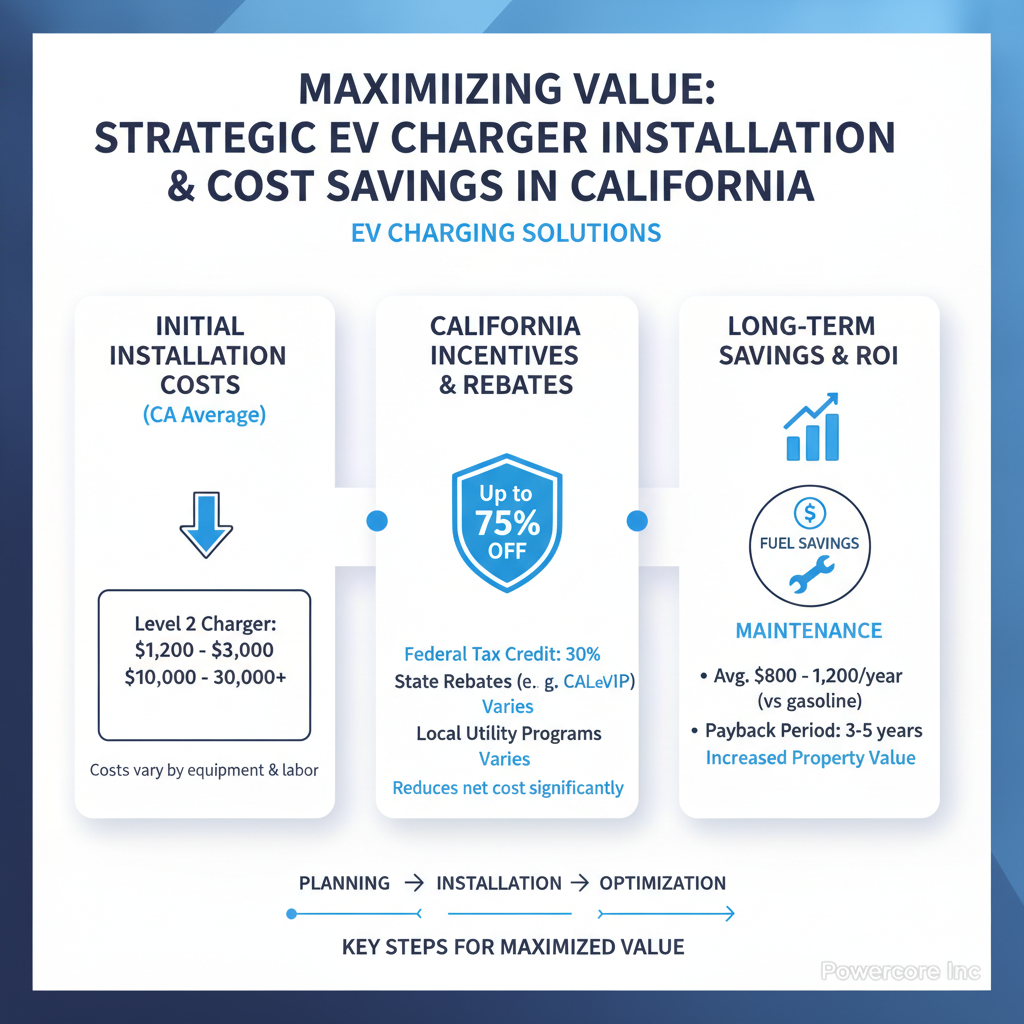
It's important to remember these are estimates. Your actual costs will depend on a detailed site assessment by a qualified electrician. Powercore Inc provides transparent, detailed quotes so you know exactly what to expect.
Investing Beyond the Charger: Future-Proofing Your California Home
Installing an EV charger is more than just adding a convenience; it's an investment in your home's future and its energy independence. Powercore Inc specializes in integrated home energy solutions that can maximize this investment:
- Solar Integration: Imagine powering your EV with clean, free energy generated right from your rooftop. Integrating your EV charger with a residential solar system can dramatically reduce your electricity bills and carbon footprint, making your home truly self-sufficient.
- Battery Storage: Pairing your EV charger with a home battery storage system allows you to store excess solar energy or charge during off-peak utility hours. This stored energy can then be used to power your EV or your home during peak rates or even during a power outage, providing ultimate energy security. California also offers various California battery storage incentives to make this even more accessible.
- Increased Home Value: As EVs become mainstream, a dedicated home charging station is increasingly seen as a desirable amenity, adding tangible value to your property.
Conclusion: Strategic Charging for a Brighter California Future
Navigating the world of EV charger installation costs California homeowners face doesn't have to be overwhelming. By understanding the core cost components, leveraging available incentives, and most importantly, partnering with a knowledgeable and dual-licensed contractor like Powercore Inc, you can make a strategic investment that pays dividends for years to come.
Our commitment to safety, efficiency, and customer satisfaction, backed by our General B and C-10 Electrical licenses, ensures that your EV charging solution is not just installed, but expertly integrated into your home's energy future. Ready to explore the best EV charging solution for your California home? Contact Powercore Inc today for a comprehensive consultation and a detailed quote. Call us at 916-699-8778 or visit our website to learn more about our EV Charging Solutions.