

The EV Revolution: Why California Leads the Charge
California has long been at the forefront of environmental innovation, and its commitment to a greener future is perhaps nowhere more evident than in its aggressive push for electric vehicle (EV) adoption. With ambitious goals to phase out gasoline-powered vehicle sales, the Golden State is rapidly transforming its transportation landscape. This shift isn't just about cars; it's about fundamentally reshaping our infrastructure, especially within our homes. As more Californians embrace electric vehicles, the demand for accessible, efficient, and compliant home charging solutions has skyrocketed.
For homeowners, builders, and developers across California, this presents both an exciting opportunity and a complex challenge. How do you ensure your property is ready for the EV era? How do you comply with evolving regulations while also maximizing convenience and value? The answer lies in understanding key legislation, making strategic choices, and partnering with experienced professionals.
At Powercore Inc, a dual-licensed General B and C-10 Electrical Contractor based in Roseville, CA, we understand the intricate landscape of California's energy future. We specialize in providing comprehensive, future-proof EV charging solutions that not only meet regulatory requirements but also enhance your property's value and your daily convenience. We serve all of California, ensuring every homeowner has access to expert guidance.
What is California AB 2127 and Why Does It Matter?
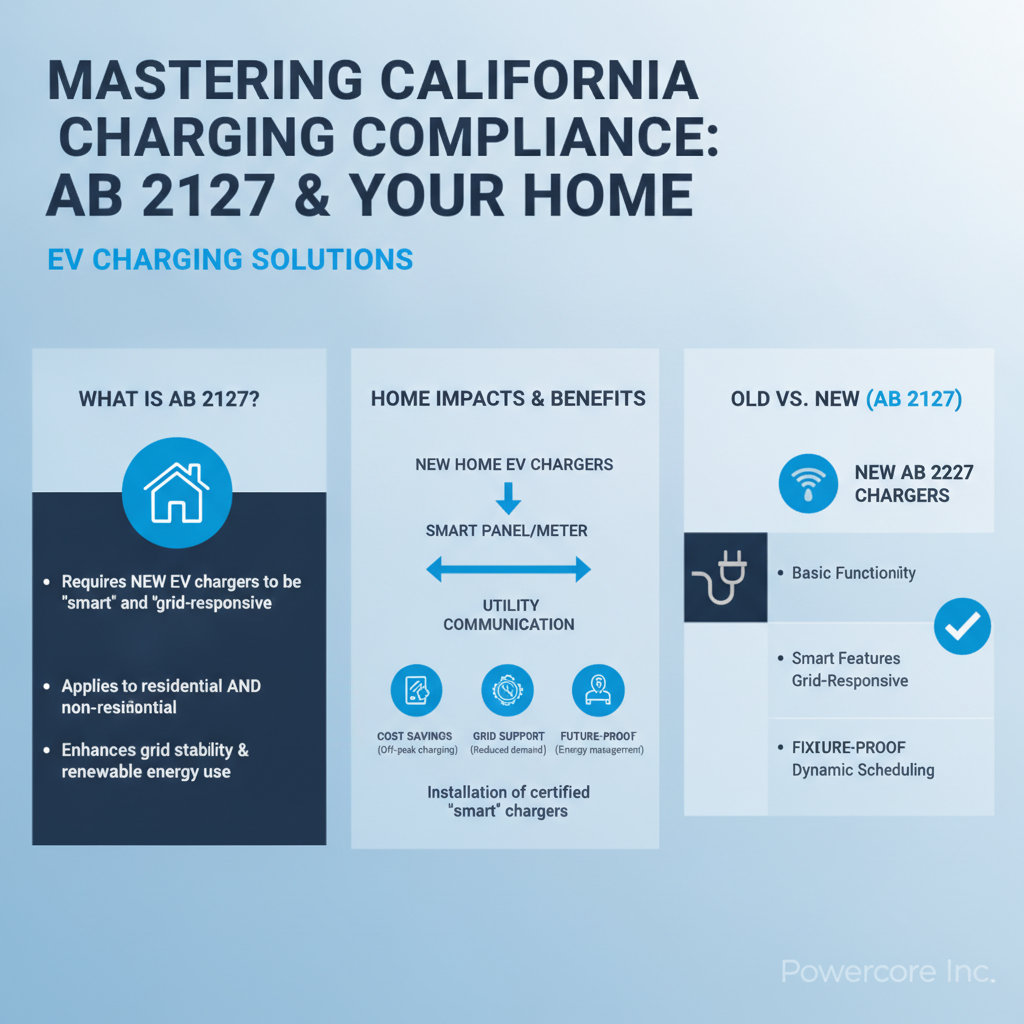
At the heart of California's residential EV infrastructure push is Assembly Bill 2127 (AB 2127). Enacted to accelerate the build-out of EV charging capabilities, AB 2127 sets forth specific requirements for new construction and significant renovations across the state. It's more than just a recommendation; it's a mandate designed to ensure that as California homes are built or upgraded, they are inherently ready for the electric vehicle future.
Key Provisions and Mandates of AB 2127
AB 2127, along with subsequent updates to the California Green Building Standards Code (CALGreen), generally requires new residential construction and certain renovations to include EV charging infrastructure. The specific mandates can vary based on the type of dwelling (single-family, multi-family) and the scale of the project, but the underlying principle remains the same: prepare properties for electric vehicles.
- New Single-Family Homes: Typically require at least one "EV capable" space. This means conduit, wiring, and panel capacity are installed to support a Level 2 charger, even if the charger itself isn't present initially.
- New Multi-Family Dwellings (MUDs): Often have more stringent requirements, mandating a percentage of parking spaces to be "EV capable" or "EV ready," and sometimes even requiring actual EV supply equipment (EVSE) installation.
- Significant Renovations: Depending on the scope and cost of a renovation project (e.g., major electrical panel upgrades, additions), existing homes may also trigger AB 2127 compliance requirements for EV charging infrastructure.
The goal is to eliminate the costly and disruptive process of retrofitting homes with EV infrastructure after construction, making EV ownership more accessible and affordable for future residents from day one.
Who Does AB 2127 Affect?
The reach of AB 2127 extends beyond just the EV owner. It directly impacts:
- Homeowners: If you're building a new home or undertaking a major remodel, you'll need to factor EV charging infrastructure into your plans and budget. Understanding these requirements can save you headaches and costs down the line.
- Builders and Developers: Compliance is non-negotiable for obtaining permits and ensuring projects meet state building codes. Integrating EV infrastructure efficiently is key to project success.
- Electricians and Contractors: Expertise in EV charging installation, electrical load calculations, and knowledge of AB 2127's nuances are crucial for delivering compliant and effective solutions.
The "EV Capable" vs. "EV Ready" Distinction
These terms are critical when navigating AB 2127 compliance:
- EV Capable: This signifies that the necessary electrical conduit and wiring are installed from the main service panel or subpanel to the designated parking space, along with adequate electrical panel capacity, to support a future Level 2 EV charger. The actual charger and dedicated circuit breaker are not yet installed. It's the foundational "rough-in" work.
- EV Ready: This goes a step further than "EV Capable." An EV Ready space includes all the components of an EV Capable space, plus a dedicated 240-volt branch circuit and an appropriate receptacle or hardwired connection point for an EV charger. The space is ready for a Level 2 EV charger to be plugged in or hardwired immediately, though the charger itself might not be included.
Understanding which level of readiness your project requires is paramount for compliance and for ensuring your property is genuinely prepared for the future of transportation.
Beyond the Mandate: Strategic Benefits of Proactive EV Charging
While compliance with AB 2127 is a legal necessity for many projects, viewing EV charging infrastructure purely as a regulatory burden misses a significant opportunity. Proactively integrating advanced EV charging solutions offers a multitude of strategic benefits for California homeowners.
Enhancing Property Value and Appeal
In a state where EV adoption rates are among the highest in the nation, an integrated home EV charging system is rapidly becoming a desirable, if not expected, feature for potential homebuyers. Properties equipped with convenient, high-speed charging solutions stand out in the market. It signals a modern, future-oriented home that caters to the evolving needs of environmentally conscious buyers, potentially increasing resale value and reducing time on the market. Think of it like central air conditioning or high-speed internet – once a luxury, now a standard expectation.
Future-Proofing Your Home and Lifestyle
The shift to EVs is not a passing fad; it's a fundamental transformation of our personal transportation. By installing EV charging infrastructure now, you're not just complying with a law; you're safeguarding your home against obsolescence. As EV technology advances and charging speeds increase, having the robust electrical backbone already in place makes future upgrades simpler and less costly. It ensures your home remains a convenient hub for your family's evolving mobility needs, avoiding disruptive and expensive electrical overhauls years down the line.
Maximizing Energy Efficiency and Savings
Integrating EV charging with other home energy systems, especially solar and battery storage, unlocks unparalleled energy efficiency and cost savings. Powercore Inc, with our expertise in solar and battery storage solutions, can design a holistic energy ecosystem:
- Solar Integration: Charge your EV directly from the clean, renewable energy generated by your rooftop solar panels. This dramatically reduces your reliance on grid electricity for transportation, lowering your carbon footprint and fuel costs to near zero.
- Battery Storage: Store excess solar energy during the day in a home battery and use it to charge your EV during peak utility rate hours or overnight. This allows you to avoid expensive peak-time electricity charges and maximize your solar investment.
- Time-of-Use (TOU) Rate Optimization: Smart EV chargers can be programmed to charge during off-peak hours when electricity rates are lowest, whether from the grid or from your stored battery power, leading to significant savings.
Unmatched Convenience and Cost Savings for EV Owners
The ultimate benefit of a home EV charging station is unparalleled convenience. No more detours to public charging stations, waiting in line, or worrying about charger availability. Wake up every morning to a "full tank" right in your garage. Beyond convenience, charging at home, especially with a Level 2 charger, is often significantly cheaper than using public fast chargers, particularly when combined with off-peak utility rates or solar power. Over the lifespan of your EV, these savings can amount to thousands of dollars.
Designing Your Optimal EV Charging System in California
Creating an efficient, compliant, and future-ready EV charging system involves several critical considerations. It's not a one-size-fits-all solution; it requires careful planning tailored to your home's specific needs and electrical infrastructure.
Assessing Your Home's Electrical Capacity
The first and most crucial step is evaluating your existing electrical panel. Level 2 EV chargers require a dedicated 240-volt circuit, often drawing between 30 to 80 amps. Many older California homes, or even newer ones not built with EV readiness in mind, may have 100-amp service panels that are already nearing their capacity. Adding a significant load like an EV charger can necessitate a service upgrade to a 200-amp panel or higher.
Powercore Inc's certified electricians perform thorough load calculations to determine if your current electrical system can safely and efficiently support a new EV charger. If an upgrade is needed, we handle the entire process, from permitting to installation, ensuring your home's electrical backbone is robust enough for present and future demands.
Choosing the Right Charger Level: Level 1, 2, or DC Fast?
The type of EV charger you choose will impact charging speed, cost, and installation complexity:
- Level 1 Charging (120V AC): Uses a standard wall outlet. Slowest option, adding only 2-5 miles of range per hour. Best for plug-in hybrids or EVs with small batteries, or as an emergency backup. No special installation typically needed.
- Level 2 Charging (240V AC): The most common and recommended home charging solution. Adds 20-60 miles of range per hour, fully charging most EVs overnight. Requires a dedicated 240V circuit and professional installation. This is what AB 2127 primarily focuses on enabling.
- DC Fast Charging (DCFC): Extremely fast charging, adding hundreds of miles of range in minutes. Primarily found in public and commercial settings due to very high power requirements and cost. Generally not feasible or necessary for residential installation.
For most California homeowners, a Level 2 charger provides the optimal balance of speed, convenience, and cost-effectiveness. The choice often depends on your daily driving habits, EV battery size, and budget.
Smart Charging Features and Integration
Modern EV chargers offer "smart" features that enhance convenience and savings:
- Wi-Fi Connectivity: Allows for remote control, scheduling, and monitoring via a smartphone app.
- Load Management: Prevents overloading your electrical panel by dynamically adjusting charging speed based on other household electricity consumption.
- Time-of-Use (TOU) Optimization: Automatically schedules charging during off-peak hours to take advantage of lower electricity rates.
- Solar Integration: Prioritizes charging from excess solar energy generated by your home, further reducing utility bills.
Integrating these features into your home energy management system is a Powercore Inc specialty, ensuring your EV charging is as efficient and intelligent as possible.
Permitting and Inspections: Navigating California's Bureaucracy
Installing an EV charger, especially a Level 2 system, almost always requires electrical permits and inspections to ensure safety and compliance with local and state building codes. Navigating the permitting process can be complex and time-consuming for homeowners. As a licensed C-10 Electrical Contractor, Powercore Inc handles all aspects of permitting, inspections, and adherence to California's strict electrical codes, including those related to AB 2127. We ensure your installation is fully compliant, safe, and passes all necessary checks without hassle.
Seamless Installation with Powercore Inc: Your Trusted Partner
When it comes to something as vital as your home's electrical system and EV charging infrastructure, expertise and reliability are non-negotiable. Powercore Inc stands as California's premier choice for comprehensive EV charging solutions, combining deep technical knowledge with unparalleled customer service.
Powercore Inc's Expertise: Dual-Licensed Advantage
What sets Powercore Inc apart is our unique dual licensing: California CSLB #1134334 (General B) and #1098175 (C-10 Electrical Contractor). This means we're not just electricians; we're general contractors with a holistic understanding of home construction and renovation. This dual expertise is invaluable for EV charging installations, especially when:
- Panel Upgrades Are Needed: We can manage the entire electrical service upgrade, which often involves coordination with utility companies and local authorities.
- Trenching or Structural Work is Required: For outdoor chargers or long conduit runs, our General B license allows us to handle any necessary trenching, concrete work, or other structural modifications efficiently.
- Integrating with Other Home Systems: Our broad experience across solar, battery storage, HVAC, and remodels means we can seamlessly integrate your EV charging solution into your home's broader energy strategy or renovation plans.
This comprehensive capability ensures a smooth, single-source project experience, avoiding the complexities of coordinating multiple contractors.
Holistic Home Energy Solutions
At Powercore Inc, we believe in a holistic approach to home energy. Your EV charger isn't an isolated component; it's part of a larger ecosystem. We specialize in integrating EV charging with:
- Solar Power Systems: Harnessing the California sun to power your commute.
- Battery Storage: Optimizing energy use and providing backup power.
- Smart Home Automation: Automating charging schedules for maximum efficiency.
This integrated approach maximizes your energy independence, reduces utility bills, and significantly lowers your carbon footprint, all while future-proofing your home against rising energy costs and grid instability.
Ensuring Safety and Code Compliance
Electrical work, especially high-voltage installations like EV chargers, demands strict adherence to safety protocols and local/national electrical codes. Our licensed and highly trained electricians prioritize safety above all else. We ensure every installation meets or exceeds:
- National Electrical Code (NEC) standards.
- California Building Standards Code (CALGreen) requirements.
- Local jurisdictional amendments and specific AB 2127 mandates.
Our commitment to quality workmanship and meticulous attention to detail guarantees an EV charging system that is not only efficient but also supremely safe and fully compliant.
Unlocking California Incentives and Understanding Costs
Investing in home EV charging infrastructure in California can be made more affordable through a variety of state, local, and federal incentives. Understanding these programs is key to maximizing your return on investment.
State and Local Rebates for EV Charging Infrastructure
California actively promotes EV adoption and charging infrastructure. Programs like the California Electric Vehicle Infrastructure Project (CALeVIP) offer rebates for the purchase and installation of EV charging equipment. Many local utility companies (e.g., PG&E, SCE, SDG&E) also offer their own rebate programs for residential EV charger installations, sometimes including incentives for panel upgrades or smart charging features. These rebates can significantly offset the upfront costs of your system.
Navigating these various programs can be complex, but Powercore Inc can help you identify eligible incentives and guide you through the application process to ensure you capitalize on all available savings.
Federal Tax Credits
The federal government also offers tax credits for qualified home charging equipment. The Alternative Fuel Vehicle Refueling Property Credit can provide a tax credit for a percentage of the cost of eligible charging equipment and installation costs. It's crucial to consult with a tax professional for the most current information and eligibility requirements.
Typical Installation Costs in California
The cost of installing a Level 2 EV charger in California can vary widely, typically ranging from $800 to $3,000+, depending on several factors:
- Electrical Panel Capacity: If a service upgrade (e.g., from 100-amp to 200-amp) is required, this will be the most significant cost factor, potentially adding several thousand dollars.
- Distance from Panel to Charger: Longer wire runs require more materials and labor, increasing costs.
- Type of Charger: More advanced smart chargers with additional features may cost more than basic models.
- Mounting Location: Wall-mounted vs. pedestal-mounted chargers, indoor vs. outdoor installation.
- Local Permitting Fees: These vary by jurisdiction.
Despite the initial investment, the long-term savings on fuel costs, combined with potential property value appreciation and incentives, often make home EV charging a financially sound decision.
ROI: The Long-Term Value Proposition
The return on investment for a home EV charging system extends beyond immediate savings. It encompasses:
- Increased Property Value: A modern, EV-ready home is more attractive to buyers.
- Reduced Fuel Costs: Charging at home is significantly cheaper than gasoline.
- Time Savings: No more trips to the gas station or public charging stations.
- Environmental Impact: Contributing to cleaner air and a sustainable future.
- Future-Proofing: Avoiding costly retrofits as EV adoption grows.
Addressing Common Challenges in EV Charging Installation
While the benefits are clear, homeowners may encounter a few common hurdles when planning their EV charging installation. Powercore Inc is adept at navigating these challenges to provide seamless solutions.
Electrical Panel Limitations
As mentioned, older homes often have electrical panels that lack the spare capacity for a dedicated Level 2 EV charger. Upgrading the main service panel can seem daunting, but it's often a worthwhile investment that improves overall home electrical safety and prepares your home for other modern appliances. Powercore Inc specializes in safe, efficient panel upgrades, ensuring your home's electrical system can handle current and future demands.
HOAs and Multi-Unit Dwellings (MUDs)
For residents in condominiums, townhouses, or other multi-unit dwellings governed by Homeowners Associations (HOAs), installing a personal EV charger can present unique challenges related to common property, electrical infrastructure, and HOA rules. California law (specifically Civil Code Section 4745 for HOAs) generally supports a homeowner's right to install EV charging stations, with reasonable restrictions. Powercore Inc has experience working with HOAs and MUD property managers to ensure installations comply with both state law and community guidelines, facilitating a smoother process for residents.
Future-Proofing for Faster Charging Technology
EV technology is evolving rapidly, with vehicles capable of faster charging speeds appearing regularly. When installing your infrastructure, it's wise to consider future needs. For instance, even if your current EV only draws 32 amps, installing a circuit capable of 40, 50, or even 80 amps (using appropriate wire gauges and breakers) provides headroom for future EVs that can accept higher charging rates. This strategic planning prevents the need for another costly electrical upgrade down the road.
Conclusion: The Powercore Inc Advantage in California EV Charging Compliance
Navigating the requirements of California AB 2127 and planning for optimal EV charging solutions can feel complex, but it doesn't have to be. By taking a proactive and strategic approach, you can transform a regulatory mandate into an opportunity to enhance your home's value, embrace energy independence, and enjoy the unparalleled convenience of home EV charging.
Powercore Inc is your trusted, dual-licensed partner across all of California, from Roseville to San Diego, for mastering your home's EV charging needs. With our General B and C-10 Electrical Contractor licenses, we offer comprehensive services that span everything from electrical panel upgrades and smart EV charger installations to full solar and battery storage integrations. We ensure your project is compliant, safe, efficient, and perfectly tailored to your lifestyle.
Don't just meet compliance; exceed expectations. Future-proof your California home with the experts at Powercore Inc. Contact us today for a consultation and discover how seamless and beneficial your EV charging solution can be.
Ready to power your electric future? Call Powercore Inc at 916-699-8778 to discuss your California EV charging compliance and installation needs. Our expert team is ready to help you build a smarter, greener home.