

The Electric Vehicle Revolution and Its Hidden Complexities
California is at the forefront of the electric vehicle (EV) revolution, with aggressive goals to transition to an all-electric future. From bustling city streets to serene suburban neighborhoods, EVs are becoming an increasingly common sight, driven by environmental consciousness, technological advancements, and compelling economic benefits. However, as more Californians embrace electric transportation, a critical question arises: Is our electrical infrastructure ready to support this seismic shift?
Installing an EV charger, especially a high-powered Level 2 or Level 3 system, isn't always as simple as plugging it in. Beyond the charger itself, the process often involves significant electrical upgrades, local permitting, and, crucially, navigating the complex web of utility regulations. One such regulation, often overlooked but profoundly impactful for significant EV charging installations, is CPUC Rule 29.
For many homeowners and businesses planning to invest in robust EV charging solutions, the journey can hit unexpected roadblocks when dealing with utility service upgrades, new connections, or extensions. This is precisely where understanding CPUC Rule 29, specifically regarding Electric Service Extensions, becomes indispensable. It’s the regulatory framework that dictates how new or expanded electrical service is brought to your property, defining responsibilities, costs, and timelines.
At Powercore Inc, a dual-licensed General B & C-10 Electrical Contractor based in Roseville, CA, we understand that successful EV charging infrastructure projects require more than just technical expertise; they demand a deep understanding of California's regulatory landscape. We’re here to demystify CPUC Rule 29, guiding you through its intricacies to ensure your EV charging installation is not only powerful and efficient but also fully compliant and seamlessly integrated with your utility service.
What is CPUC Rule 29 and Why It Matters for EV Charging?
Demystifying the California Public Utilities Commission (CPUC)
The California Public Utilities Commission (CPUC) is a state agency that regulates privately owned electric, natural gas, telecommunications, water, and transportation companies in California. Its primary mission is to ensure that Californians have safe, reliable utility services at reasonable rates, while also promoting competition and protecting the environment. The CPUC achieves this through a comprehensive set of rules, tariffs, and decisions that govern how utilities operate and interact with their customers.
Each major utility in California (such as Pacific Gas and Electric Company (PG&E), Southern California Edison (SCE), and San Diego Gas & Electric (SDG&E)) operates under a set of tariffs approved by the CPUC. These tariffs contain detailed rules and regulations, often numbered, that dictate everything from billing practices to service connections.
The Core of Rule 29: Electric Service Extensions
While various CPUC rules cover different aspects of utility operations, Rule 29 within the tariffs of California's investor-owned utilities (IOUs) specifically addresses Electric Service Extensions. This rule outlines the conditions under which a utility will extend its electrical distribution system to provide new or increased service to a customer. It details:
- Applicant Eligibility: Who can request an extension (e.g., property owners, developers).
- Application Procedures: The steps required to apply for a service extension.
- Cost Responsibility: How the costs of new facilities (e.g., poles, wires, transformers, trenching) are allocated between the utility and the applicant.
- Advance Payments/Deposits: Requirements for customers to pay for the extension in advance.
- Refunds: Conditions under which a customer may receive a refund for their contribution if additional customers later connect to the extended facilities.
- Ownership and Maintenance: Who owns and maintains the extended facilities once installed.
In essence, Rule 29 is the blueprint for how new electrical infrastructure is built to serve new loads. It's not a rule specifically *for* EV charging, but rather a fundamental utility regulation that becomes critically important *because* of the significant electrical demands that modern EV charging solutions can place on existing infrastructure.
Beyond the Breaker Box: When Rule 29 Comes Into Play for EV Charging
For a basic Level 1 or even a simple Level 2 EV charger that can be accommodated by an existing circuit with minor panel work, Rule 29 typically won't be a primary concern. However, as the demand for faster, more powerful charging grows, so does the likelihood of triggering Rule 29 considerations:
- Residential Upgrades: If your home's existing main electrical panel is at capacity, and installing a new 40-amp or 60-amp circuit for a Level 2 charger would require a main panel upgrade (MPU), you might need to coordinate with the utility if the upgrade involves increasing your service size beyond what the existing transformer or service drop can handle. For example, upgrading from 100-amp to 200-amp service often necessitates utility involvement under Rule 29 if existing utility infrastructure needs modification.
- Multi-Unit Dwellings (MUDs) and Commercial Properties: This is where Rule 29 becomes particularly critical. Installing multiple Level 2 chargers for residents or employees, or deploying high-power DC fast chargers (Level 3) for public use or commercial fleets, almost always requires a substantial increase in electrical service. This could involve installing new transformers, extending primary lines, or even running entirely new service laterals from the street to the building. In these scenarios, the utility's Rule 29 is the guiding document for the entire extension process, from initial application to final energization.
- New Construction: Developers building new homes or commercial complexes often need to extend utility service to previously undeveloped land. With California's CALGreen code now requiring EV-ready infrastructure in new construction, planning for future EV charging loads from the outset makes Rule 29 a foundational consideration for the electrical design.
Ignoring or misunderstanding Rule 29 can lead to significant project delays, unexpected costs, and even the inability to energize your new EV charging infrastructure. Proactive engagement with this regulation is key to a smooth and successful project.
The Interconnection Journey: How Rule 29 Guides Your EV Charging Project
Navigating an electric service extension under CPUC Rule 29 is a multi-step process that requires careful planning and coordination. While the specific details can vary slightly between utilities, the general journey follows a common path:
Initial Assessment: Understanding Your Current Electrical Service
Before any significant EV charging installation, a thorough assessment of your existing electrical service is paramount. This includes:
- Service Size: What is your current main panel amperage (e.g., 100A, 200A)?
- Load Calculation: How much spare capacity do you have? A professional electrician can perform a load calculation to determine if your proposed EV charging load can be safely added.
- Transformer Capacity: Is the existing utility transformer serving your property sufficient for the increased load? This is a utility determination but informs the need for an extension.
- Service Drop/Lateral: Is the existing wiring from the utility pole or underground vault to your meter sufficient?
This initial assessment helps determine if your project will indeed trigger the need for a Rule 29 service extension.
The Application Process: Navigating Utility Paperwork
If a service extension is required, the next step is to formally apply to your utility. This typically involves:
- Submitting a detailed application form, often with site plans, proposed electrical designs, and load requirements for the EV chargers.
- Providing information on the type and quantity of EV chargers, desired charging speeds, and estimated daily/peak usage.
- Meeting with a utility representative or engineer to discuss the project scope.
The application is the formal initiation of the Rule 29 process, setting the stage for engineering review.
Engineering Review & Grid Impact Studies
Once the application is submitted, the utility's engineers will review your plans. They will assess:
- The impact of your proposed load increase on the local distribution grid.
- Whether existing transformers, power lines, and other infrastructure can handle the new demand.
- The optimal path and design for any necessary service extensions.
- Potential needs for new poles, underground conduits, or transformer upgrades.
This phase can be time-consuming, especially for large commercial projects or those in areas with constrained infrastructure.
Cost Allocation: Who Pays for Upgrades?
A core component of Rule 29 is the allocation of costs associated with the service extension. Generally, customers are responsible for costs related to facilities that exclusively serve their property. The utility may bear costs for facilities that benefit the broader grid or future customers, but this is often nuanced. Key considerations:
- Non-Refundable Contributions: Customers are typically responsible for the full cost of extending service if it's solely for their benefit and doesn't generate sufficient new revenue for the utility to justify its investment.
- Refundable Advances: In some cases, for larger extensions that *might* serve future customers, the utility may require a refundable advance. Portions of this advance may be refunded if other customers connect to the extension within a specified timeframe.
- Main Extension Contracts: For significant projects, a formal contract outlining cost responsibility, construction timelines, and refund provisions will be executed between the customer and the utility.
Understanding these cost implications early is crucial for budgeting your EV charging project.
Permitting and Inspection: Local and State Overlap
Beyond the utility's Rule 29 process, local building departments will require permits for the electrical work on your property, including the installation of the EV chargers, main panel upgrades, and any trenching. These local permits ensure compliance with the California Electrical Code (CEC) and other building standards. Once the utility completes its extension work and the customer's electrician completes the on-site work, both aspects will undergo inspection – utility inspection for their facilities and local building inspection for the customer's facilities – before final energization.
Key Scenarios Where CPUC Rule 29 Becomes Critical for EV Charging
To illustrate the practical impact of Rule 29, let's explore common scenarios in California where this regulation comes into play:
Residential Main Panel Upgrades (MPU) for High-Power EV Chargers
Many older California homes have 100-amp electrical service. While this might suffice for basic household needs, adding a dedicated 40-amp or 60-amp circuit for a Level 2 EV charger can push the existing panel beyond its safe capacity. A Main Panel Upgrade (MPU) to 200-amp service is often the solution. If the utility's existing service drop or transformer is undersized for the new 200-amp load, Rule 29 dictates the process for upgrading these utility-owned components and how the costs are shared.
Multi-Unit Dwellings (MUDs) and Shared EV Infrastructure
For apartment complexes, condos, or HOAs looking to provide EV charging for residents, the electrical demands can be immense. Installing multiple chargers, even Level 2, can require a significant upgrade to the building's main service or even an entirely new utility service connection. Rule 29 is central to planning and executing these projects, defining how the utility extends or upgrades its infrastructure to support the new, aggregated load from dozens of EV chargers. Considerations include the need for new transformers, dedicated feeders, and the associated costs borne by the property owner or developer.
Commercial Fleets & Public Charging Stations
Businesses transitioning to electric fleets or installing public DC fast-charging stations face the most substantial electrical demands. A single DC fast charger can draw hundreds of amps, and a bank of them can easily require megawatts of power. These projects almost always necessitate extensive utility infrastructure upgrades, including new transformers, dedicated substations, or significant line extensions. Rule 29 governs the entire process, including detailed engineering studies, long lead times, and substantial cost contributions from the business for the necessary utility infrastructure. This is where strategic planning with a knowledgeable contractor like Powercore Inc is paramount.
New Construction and EV-Ready Requirements
California's CALGreen code mandates EV-ready infrastructure in new residential and commercial construction. While this ensures conduit and panel space are allocated, it doesn't always guarantee sufficient utility service for future high-power charging. Developers planning new communities or commercial centers must factor Rule 29 into their initial electrical design, coordinating with utilities early to ensure the grid infrastructure can support the aggregated EV charging loads across multiple properties from day one, avoiding costly retrofits later.
Avoiding Pitfalls: Strategic Planning for Rule 29 Compliance
Successfully navigating CPUC Rule 29 for your EV charging project requires foresight and expertise. Here's how to ensure a smooth journey:
Early Engagement with Experts
The single most critical step is to consult with experienced electrical contractors and energy solution providers early in your planning process. Companies like Powercore Inc specialize in complex electrical installations and possess a deep understanding of California's utility regulations. Our team can perform initial load assessments, identify potential Rule 29 triggers, and help you understand the likely scope and cost of utility-side work.
Comprehensive Site Surveys and Load Calculations
A detailed site survey by a qualified electrician is essential. This survey will not only assess your existing electrical panel and wiring but also identify the path for new conduits, the best location for chargers, and potential challenges. Accurate load calculations are crucial for determining if your current service can handle the additional load or if an upgrade, triggering Rule 29, is inevitable.
Understanding Utility Tariffs and Service Agreements
Each utility's Rule 29, while similar in principle, will have specific nuances. Familiarize yourself with your utility's specific tariff documents or rely on experts who do. Understanding the clauses related to cost allocation, refundable advances, and timelines can prevent surprises down the line. Powercore Inc can help decipher these documents and advocate on your behalf.
Budgeting for Potential Utility Infrastructure Costs
Do not underestimate the potential costs associated with utility service extensions. While EV chargers and their installation are significant investments, the cost of new transformers, line extensions, or even undergrounding utility lines can sometimes exceed the cost of the charging equipment itself. Factor these potential costs, and the associated timelines, into your overall project budget and schedule from the outset.
Streamlining the Process with Integrated Solutions
Consider how your EV charging solution integrates with other energy systems. For instance, pairing EV charging with solar and battery storage can potentially reduce peak demand on the grid, minimizing the need for extensive utility upgrades or even enabling off-grid charging capabilities during peak hours or outages. Powercore Inc's expertise spans solar, battery storage, and comprehensive electrical services, allowing for a holistic approach to energy management.
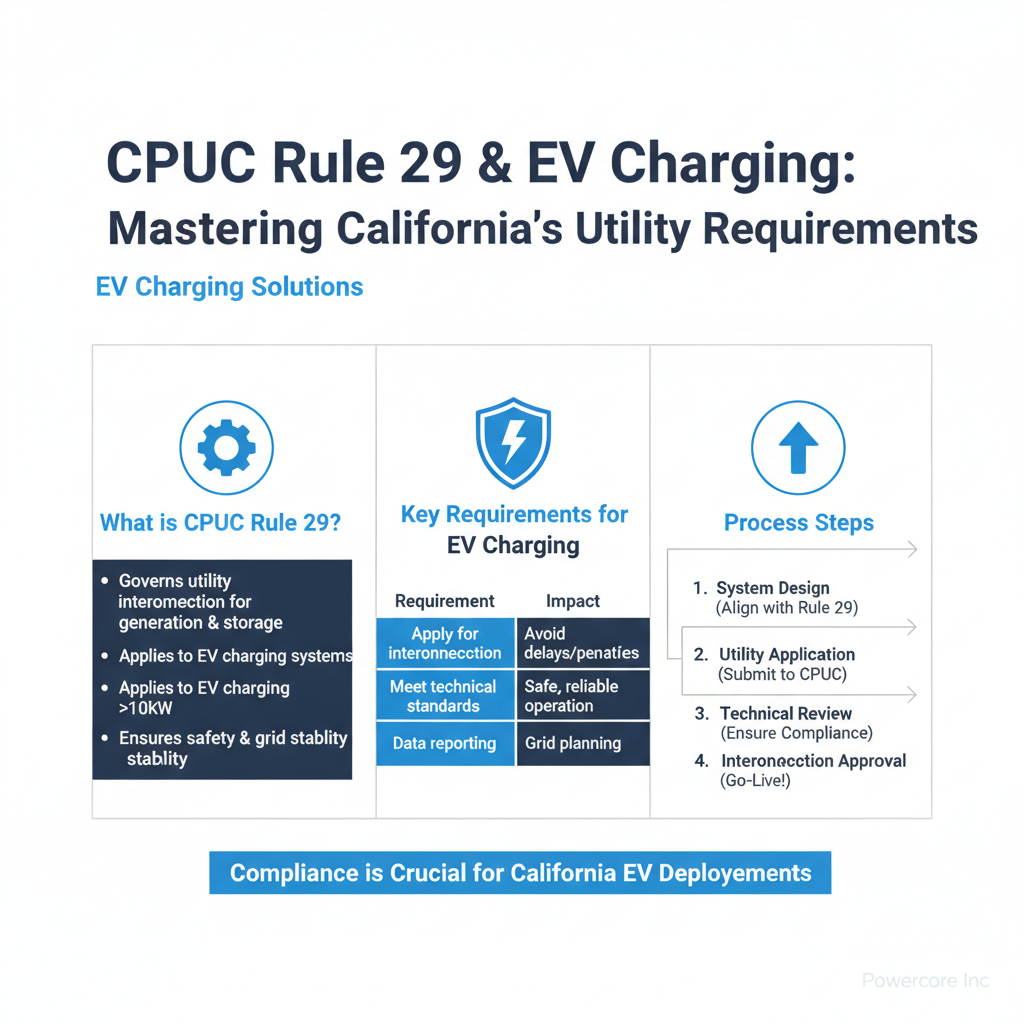
(Consider an infographic here showing a simplified flow chart of the Rule 29 process for EV charging: Assess Need -> Utility Application -> Engineering Review -> Cost Agreement -> Construction -> Energization.)
The Powercore Inc Advantage: Navigating California's EV Charging Landscape
Successfully implementing an EV charging solution in California, particularly one that requires navigating the complexities of CPUC Rule 29, demands a partner with unparalleled expertise and a comprehensive service offering. This is where Powercore Inc truly shines.
- Dual-Licensed Authority: As a California dual-licensed General B (#1134334) & C-10 Electrical Contractor (#1098175), Powercore Inc offers a unique advantage. Our General B license means we can manage your entire project, from ground-up construction of new EV charging facilities to integrating them into existing structures. Our C-10 Electrical license confirms our specialized expertise in all aspects of electrical systems, ensuring your EV charging installation is not only safe and compliant but also optimized for performance and longevity.
- Holistic Energy Solutions: Powercore Inc is more than just an electrical contractor. Our broad range of services includes Solar, Battery Storage, HVAC, Roofing, ADUs, Remodels, EV Charging, Siding, Decking, and Interior Remodeling. This integrated approach means we understand how EV charging fits into your broader home or business energy ecosystem, allowing us to design solutions that are efficient, sustainable, and future-proof. We can help you integrate EV charging with solar panels to reduce electricity costs or pair it with battery storage for resilience and demand charge management, further enhancing your energy independence.
- Expert Utility Liaison: Dealing with utility companies and understanding their specific Rule 29 requirements can be daunting. Our experienced team acts as your expert liaison, managing the application process, coordinating with utility engineers, and ensuring all necessary documentation is meticulously handled. We streamline the often-complex communication channels, saving you time, stress, and potential costly missteps.
- Seamless Project Execution: From initial consultation and design to permitting, utility coordination, installation, and final inspection, Powercore Inc provides end-to-end project management. We ensure every phase of your EV charging infrastructure project, including those impacted by CPUC Rule 29, is executed flawlessly, on time, and within budget, with minimal disruption to your daily operations or home life.
Whether you're a homeowner looking to upgrade your service for a new EV, a business planning a fleet charging depot, or a developer integrating EV infrastructure into new construction, Powercore Inc is your trusted partner. We bring clarity to complex regulations like CPUC Rule 29, combining our deep technical knowledge with a commitment to customer satisfaction across all of California.
Conclusion: Powering California's EV Future with Confidence
The surge in electric vehicles is an exciting development for California, promising a cleaner, more sustainable future. However, ensuring our homes and businesses are equipped with the necessary charging infrastructure requires more than just buying a charger; it demands an understanding of the underlying electrical and regulatory frameworks, particularly CPUC Rule 29 regarding Electric Service Extensions.
Ignoring the nuances of utility requirements can lead to unforeseen challenges, delays, and budget overruns. By proactively addressing Rule 29 considerations, you can ensure your EV charging project progresses smoothly, efficiently, and compliantly, future-proofing your property for the evolving energy landscape.
Don't let utility regulations hold back your EV future. Partner with Powercore Inc, California's premier General B & C-10 Electrical Contractor, to navigate the complexities of CPUC Rule 29 and beyond. Our expertise ensures your EV charging solution is seamlessly integrated, powerful, and ready for the road ahead. Contact us today for a consultation and let us help you electrify your world with confidence. Call us at 916-699-8778 to discuss your EV charging needs across California.