

Driving Value: Strategic EV Charging Solutions for California Multifamily Properties
California stands at the forefront of the electric vehicle (EV) revolution, with a rapidly accelerating adoption rate that is transforming both our transportation and energy landscapes. For owners and managers of multifamily properties across the state, this shift presents a unique blend of opportunities and challenges. Meeting the growing demand for EV charging isn't just about compliance; it's a strategic imperative that can significantly enhance property value, attract and retain discerning tenants, and position your asset for future success.
At Powercore Inc, a California dual-licensed General B & C-10 Electrical Contractor, we understand the complexities of integrating advanced infrastructure into existing and new developments. From Roseville to San Diego, our expertise spans the entire state, helping property owners navigate the evolving landscape of EV charging solutions. This comprehensive guide will explore California's specific multifamily EV charging requirements, outline strategic implementation approaches, and reveal how you can turn a regulatory necessity into a powerful competitive advantage.
The Unmistakable Rise of EVs and Its Impact on California Multifamily
California leads the nation in EV adoption, a trend driven by progressive state policies, increasing consumer awareness, and the undeniable environmental and economic benefits of electric transportation. As more Californians make the switch, the need for convenient, reliable charging infrastructure becomes paramount, especially where people live.
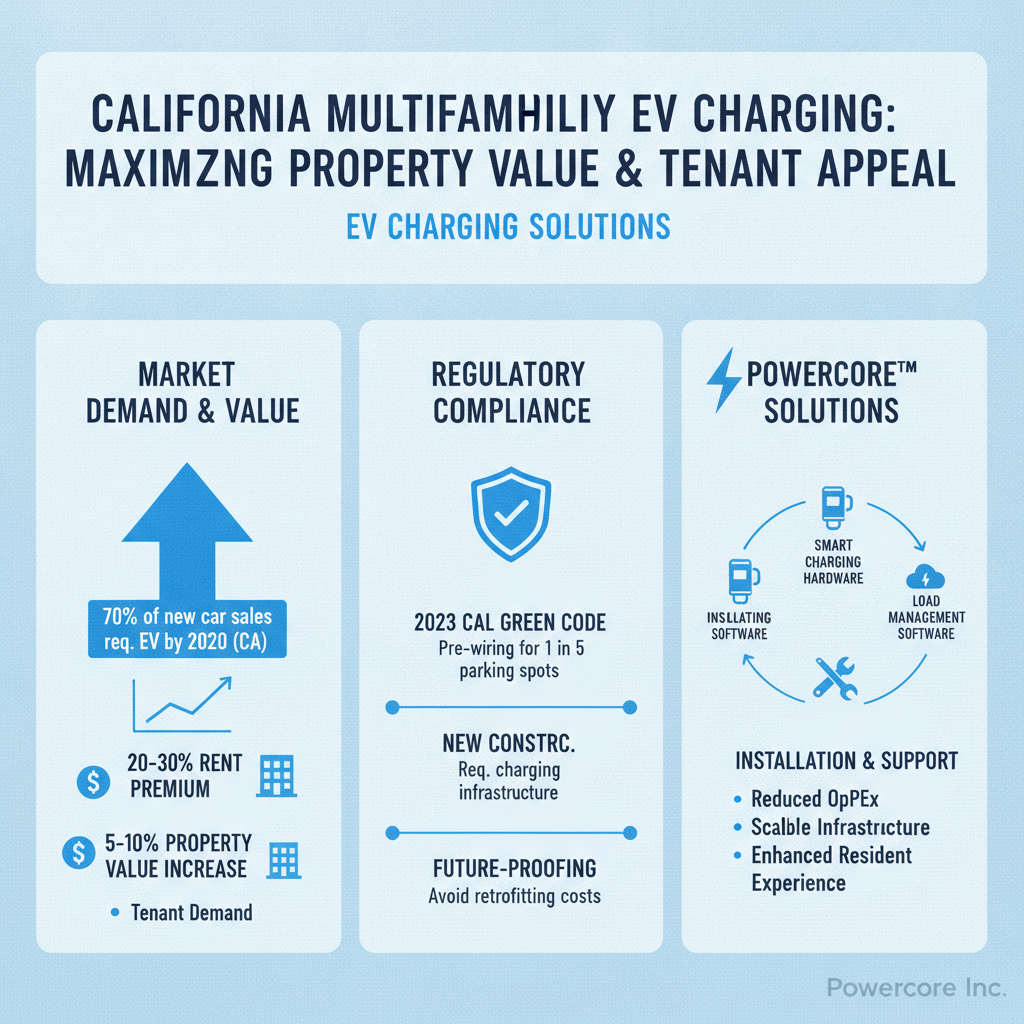
Multifamily properties, which house a significant portion of the state's population, are now at the epicenter of this demand. Tenants increasingly expect EV charging as a standard amenity, alongside pools, gyms, or pet-friendly policies. Properties that fail to provide adequate charging risk falling behind competitors, experiencing higher vacancy rates, or missing out on premium rental income. Conversely, properties that proactively embrace and strategically implement EV charging solutions can:
- Attract a desirable tenant demographic: EV owners often represent a stable, environmentally conscious, and higher-income tenant base.
- Increase property value: Modern amenities, especially those related to sustainability and convenience, directly contribute to higher property valuations.
- Generate new revenue streams: Charging stations can be configured to generate income through usage fees.
- Enhance brand image and sustainability credentials: Positioning your property as eco-friendly resonates with modern values and attracts ESG-focused investors.
- Future-proof your investment: As EV adoption continues to soar, properties with robust charging infrastructure will remain relevant and desirable.
Decoding California's Multifamily EV Charging Requirements
California's building codes and state legislation have progressively mandated EV charging infrastructure in both new construction and, in some cases, substantial renovations. The goal is clear: ensure that the state's housing stock supports the transition to electric vehicles. Understanding these requirements is the first critical step for any property owner or developer.
CALGreen: The State's Green Building Standards Code
The California Green Building Standards Code (CALGreen), specifically Chapter 4 for residential buildings, outlines the minimum EV charging infrastructure requirements. These mandates are regularly updated, with the most recent significant revisions coming into effect to align with the state's ambitious climate goals. CALGreen typically categorizes parking spaces based on their level of EV readiness:
- EV Capable (EVC): This is the most basic requirement, mandating the installation of electrical conduit to a future EV charging space. It ensures that the necessary wiring can be easily pulled later without significant disruption or cost.
- EV Ready (EVR): Requires the installation of a dedicated 208/240-volt circuit and receptacle or panel capacity at the parking space, ready for the direct installation of an EV charger. This significantly reduces future installation costs.
- EV Supply Equipment (EVSE) Installed: This is the highest level, requiring a fully functional EV charging station to be installed at the parking space, ready for use.
The specific ratios (e.g., percentage of parking spaces required to be EVC, EVR, or EVSE) vary based on the building type, the total number of parking spaces, and whether it's new construction or an alteration. Local jurisdictions can also adopt more stringent requirements than CALGreen, making local code research essential.
Key Legislative Developments Affecting Multifamily
- Assembly Bill (AB) 1236: While primarily focused on new commercial and multifamily buildings, AB 1236 solidified the state's commitment to EV charging infrastructure.
- Local Ordinances: Many cities and counties throughout California have adopted their own specific EV charging ordinances, which often exceed state minimums. These can include higher percentages of EV-ready spaces, requirements for Level 2 or even DC fast chargers, and specific mandates for accessible charging.
Strategic Planning and Implementation for Maximum Impact
Simply meeting minimum requirements is a missed opportunity. A truly strategic approach considers tenant needs, property goals, and long-term infrastructure planning. Powercore Inc specializes in developing tailored EV charging strategies that go beyond compliance.
1. Comprehensive Needs Assessment
Before any installation, a thorough evaluation is crucial:
- Tenant Demographics: Understand your current and prospective tenants. Are they likely EV owners? What are their commuting patterns?
- Existing Electrical Infrastructure: A detailed assessment of your property's electrical capacity (main service panel, subpanels) is paramount. Older buildings, in particular, may require significant electrical upgrades to accommodate the additional load.
- Parking Layout: Identify optimal locations for charging stations, considering accessibility, visibility, and proximity to electrical infrastructure.
- Budget and ROI Goals: Define your financial parameters and what you hope to achieve—e.g., tenant retention, new revenue, property value increase.
2. Choosing the Right Charging Levels
Not all chargers are created equal. Matching the right charging level to tenant needs and property constraints is key:
- Level 1 Charging (120V AC): Uses a standard household outlet. Slowest charging, best for overnight charging for tenants with minimal daily driving. Low installation cost, but less convenient.
- Level 2 Charging (240V AC): The most common and practical solution for multifamily. Provides 20-25 miles of range per hour of charging. Ideal for overnight or workday charging. This is typically what California mandates refer to for EV Ready and EVSE Installed spaces.
- DC Fast Charging (DCFC): Offers rapid charging (80% in 20-60 minutes). While powerful, DCFC is significantly more expensive to install and operate, often requiring substantial electrical upgrades. Typically seen in commercial or public charging hubs, but can be strategic for larger properties or those with high transient traffic.
3. Load Management and Smart Charging Solutions
A major concern for multifamily properties is the potential strain on electrical infrastructure when multiple EVs charge simultaneously. Smart charging solutions are essential:
- Dynamic Load Management: These systems intelligently distribute available power among multiple charging stations, preventing overloads and maximizing efficiency without costly infrastructure upgrades.
- Time-of-Use (TOU) Optimization: Integrate charging with TOU utility rates to encourage charging during off-peak hours, reducing costs for both the property and tenants.
- Remote Monitoring and Control: Cloud-based platforms allow property managers to monitor usage, manage access, set pricing, and perform diagnostics remotely.
4. Integrating with Renewable Energy
California's energy future is increasingly clean. Pairing EV charging with solar and battery storage solutions offers profound benefits:
- Reduced Operating Costs: Generate your own electricity to power chargers, significantly lowering utility bills.
- Enhanced Resilience: Battery storage can provide backup power during grid outages and optimize energy use by charging during off-peak hours and discharging during peak times.
- Stronger Sustainability Profile: Offer truly green charging, appealing to eco-conscious tenants and enhancing your property's ESG metrics.
Overcoming Common Challenges and Finding Solutions
While the benefits are clear, implementing EV charging in multifamily settings can present hurdles. Powercore Inc has extensive experience in navigating these complexities:
- Infrastructure Limitations: Older buildings often lack the electrical panel capacity or conduit pathways for new charging circuits. This can necessitate significant electrical upgrades and trenching, which Powercore Inc's dual licensing as a General B and C-10 Electrical Contractor makes us uniquely qualified to manage from start to finish.
- High Upfront Costs: Installation, especially for multiple Level 2 or DC fast chargers, can be a substantial investment. However, understanding available incentives and leveraging smart planning can mitigate these costs.
- Billing and Access Management: Deciding how to manage billing (e.g., flat fee, per kWh, free for tenants) and access (RFID cards, apps) requires careful consideration. Modern charging networks offer robust solutions for this.
- Permitting and Regulatory Compliance: The permitting process in California can be intricate, involving multiple agencies and strict adherence to local and state codes. An experienced contractor like Powercore Inc can streamline this process.
Navigating California's EV Charging Incentives and Rebates
California is rich with incentives designed to accelerate EV infrastructure deployment. Tapping into these programs can significantly offset installation costs and improve your project's ROI.
- California Electric Vehicle Infrastructure Project (CALeVIP): Administered by the California Energy Commission, CALeVIP offers regional incentives for the purchase and installation of EV charging equipment at various locations, including multifamily properties. Eligibility and incentive amounts vary by region.
- Utility-Specific Programs: Major utilities like PG&E, SCE, and SDG&E often have their own incentive programs for EV charging infrastructure, sometimes offering rebates for hardware, installation, or both. These can be crucial for making projects viable.
- Federal Tax Credits: While often focused on individual EV purchases, federal incentives for commercial charging equipment or certain renewable energy components (like solar integration) can sometimes apply. For homeowners, the Residential Clean Energy Credit may apply to certain home energy improvements, though specific EVSE installations for multifamily properties should be reviewed for eligibility under commercial or business credits.
Navigating the myriad of state and local programs, application processes, and compliance requirements can be daunting. Powercore Inc's team stays current on all available incentives, helping you identify and apply for programs that maximize your savings and accelerate your return on investment.
The Powercore Advantage: Your Expert Partner in California
Choosing the right partner for your multifamily EV charging project is critical. Powercore Inc offers unparalleled expertise, combining a deep understanding of electrical systems with comprehensive construction capabilities across California.
- Dual-Licensed Expertise: As a General B (General Building Contractor) and C-10 (Electrical Contractor), Powercore Inc can handle all aspects of your project. This means seamless coordination between electrical work, trenching, structural modifications, and any other construction needs, eliminating the headaches of managing multiple contractors.
- Holistic Energy Solutions: Beyond EV charging, we offer integrated solar and battery storage solutions, enabling you to build a truly sustainable and resilient energy ecosystem for your property. We understand the energy consumption of electric vehicles and how to optimize your system.
- California-Wide Service: Based in Roseville, CA, our services extend throughout the entire state, ensuring consistent quality and expertise no matter your property's location.
- End-to-End Project Management: From initial site assessment and design to permitting, installation, and ongoing maintenance, Powercore Inc provides a complete turnkey solution, ensuring your project is delivered on time and within budget.
Conclusion: Future-Proof Your Property with Strategic EV Charging
The demand for EV charging in California's multifamily properties is not just a passing trend; it's a fundamental shift in tenant expectations and a critical component of modern property value. By proactively embracing strategic EV charging solutions, you can not only meet regulatory requirements but also significantly enhance your property's appeal, increase its market value, and secure its relevance in California's rapidly evolving real estate landscape.
Don't let the complexities of planning and installation deter you. Partner with Powercore Inc to transform your multifamily property into an EV-ready destination. Our expert team is ready to guide you through every step, ensuring a seamless and successful integration of cutting-edge EV charging infrastructure. Elevate your property and attract the tenants of tomorrow.
Ready to explore strategic EV charging solutions for your California multifamily property? Contact Powercore Inc today for a consultation. Call us directly at 916-699-8778 and let's build a greener, more valuable future for your investment.