

The Great Decking Dilemma: Composite vs. Hardwood for California Homes
California living is synonymous with outdoor enjoyment. From sun-drenched mornings to starlit evenings, your deck serves as a vital extension of your home, a space for relaxation, entertainment, and connection with the Golden State's unparalleled natural beauty. But when it comes to selecting the perfect material for this essential outdoor space, many homeowners find themselves at a crossroads: composite vs. hardwood decking. Each option presents a unique set of advantages and considerations, especially when navigating California's diverse climate, stringent regulations, and discerning aesthetic preferences.
At Powercore Inc, a dual-licensed General B & C-10 Electrical Contractor based in Roseville, CA, we understand that building or renovating a deck is more than just a construction project; it's a strategic investment in your lifestyle and property value. Serving homeowners across all of California, we guide our clients through complex decisions, ensuring their outdoor living spaces are not only beautiful but also built to last and optimized for performance.
This comprehensive guide delves deep into the nuances of composite and hardwood decking, offering a California-centric perspective on durability, cost, maintenance, sustainability, and aesthetic appeal. By the end, you'll be equipped with the knowledge to make an informed, strategic choice for your California home's outdoor oasis.
Why Your Decking Choice Matters in California
California's unique environment presents specific challenges and opportunities for decking materials. Your choice isn't just about curb appeal; it's about resilience, compliance, and long-term satisfaction.
- Climate Extremes: From the scorching inland heat to the damp coastal fog, and even the occasional snow in higher elevations, California's climate can wreak havoc on outdoor materials. UV exposure, temperature fluctuations, and moisture levels are critical factors.
- Wildfire Risk: Many parts of California are designated as Wildland-Urban Interface (WUI) zones, meaning building materials, including decking, must meet specific fire-resistant standards. This is a non-negotiable safety and compliance aspect.
- Sustainability Focus: California homeowners are increasingly eco-conscious, seeking sustainable building materials and practices that minimize environmental impact.
- Lifestyle & Aesthetics: California's outdoor-centric lifestyle demands durable, low-maintenance spaces that complement diverse architectural styles, from modern minimalist to rustic craftsman.
- Building Codes & Permits: Local and state regulations, including those related to structural integrity and fire safety, must be meticulously adhered to. A reputable contractor like Powercore Inc ensures all projects are up to code.
Hardwood Decking: The Timeless Elegance of Nature
For centuries, wood has been the material of choice for outdoor structures, revered for its natural beauty, strength, and ability to blend seamlessly with natural landscapes. In California, hardwood decking offers a classic appeal that many homeowners find irresistible.
Pros of Hardwood Decking for California Homes
- Unmatched Natural Beauty: Each plank of hardwood boasts unique grain patterns, rich colors, and a tactile warmth that composite materials struggle to replicate. Hardwood ages gracefully, developing a beautiful patina over time if left untreated.
- Strength & Durability: Dense hardwoods like Ipe, Tigerwood, and Mangaris are incredibly strong and naturally resistant to rot, insects, and decay, making them highly durable in California's varied conditions.
- High Resale Value: A well-maintained hardwood deck can significantly enhance your home's appeal and command a higher resale value, often seen as a premium feature.
- Repairability: Individual hardwood boards can often be sanded, stained, or replaced if damaged, extending the life of the entire deck.
- Sustainability (with caveats): Sustainably harvested hardwoods (FSC-certified) offer an environmentally responsible choice, providing a renewable resource.
Cons of Hardwood Decking in California
- Intensive Maintenance: Hardwood requires regular sealing, staining, and cleaning to protect it from California's sun, rain, and foot traffic. Without proper care, it can warp, crack, splinter, and fade. This is arguably the biggest deterrent for many homeowners.
- Higher Initial Cost & Installation Complexity: Exotic hardwoods can be significantly more expensive than many composite options. Installation also tends to be more labor-intensive, requiring specialized tools and expertise, particularly for dense tropical hardwoods.
- Wildfire Risk: While some hardwoods like Ipe offer natural fire resistance, many common species are combustible. In California's WUI zones, fire-retardant treatments or specific material choices might be mandated, adding to cost and complexity.
- Pest Vulnerability: While some hardwoods are naturally resistant, others can be susceptible to termites and other wood-boring insects, a concern in many parts of California.
- Environmental Concerns (without certification): Non-sustainably harvested hardwoods contribute to deforestation, which is a concern for eco-conscious Californians. Always look for FSC certification.
Popular Hardwood Options for California Decks
- Redwood: A classic California choice, locally sourced, naturally resistant to rot and insects. However, it's softer than tropical hardwoods and requires diligent maintenance. Its availability and cost have shifted over the years.
- Ipe: Often called 'ironwood,' Ipe is a Brazilian hardwood renowned for its extreme density, durability, and natural resistance to rot, insects, and fire. It's an excellent choice for longevity but comes at a premium price.
- Tigerwood: Known for its striking striped appearance, Tigerwood is another dense, durable tropical hardwood that holds up well in California's climate with proper sealing.
- Mangaris: A collection of South Pacific hardwoods, Mangaris offers a beautiful range of colors and good durability, often presenting a more cost-effective alternative to Ipe while maintaining strong performance.
Composite Decking: The Modern Solution for California Living
Composite decking has revolutionized outdoor living, offering a low-maintenance, durable alternative to traditional wood. Made from a blend of recycled plastic and wood fibers, composite materials are engineered for performance, making them increasingly popular in California.
Pros of Composite Decking for California Homes
- Exceptional Low Maintenance: This is arguably the biggest draw. Composite decks require no staining, sealing, or sanding. A simple cleaning with soap and water is typically all that's needed to maintain their appearance, freeing up valuable time for California homeowners.
- Superior Durability & Longevity: Engineered to resist fading, staining, scratching, warping, and splintering, composite decks are built to withstand California's harsh UV rays, moisture, and temperature fluctuations. Many come with impressive warranties (25+ years).
- Eco-Friendly Options: Many composite brands utilize a high percentage of recycled materials (plastic and wood waste), appealing to California's strong environmental consciousness. This reduces demand for virgin timber.
- Consistent Appearance: Unlike natural wood, composite decking offers uniform color and texture, providing a sleek, modern look. A wide array of colors and finishes are available, often mimicking exotic hardwoods.
- Pest & Rot Resistant: The plastic content in composite decking makes it impervious to termites, rot, and fungal decay, eliminating common issues faced by wood decks.
- Slip Resistance: Many composite boards are designed with textured surfaces, offering better slip resistance, even when wet, which is a safety advantage.
- Improved Fire Resistance: While not entirely fireproof, many composite products offer better fire ratings than untreated wood, and some meet specific WUI zone requirements.
Cons of Composite Decking in California
- Higher Initial Cost: Material costs for composite decking can be higher than some natural hardwoods, though this is often offset by lower long-term maintenance expenses.
- Heat Retention: Darker composite colors can absorb and retain significant heat, making the deck surface hot to the touch in direct California sun. Lighter colors or specific capstock technologies can mitigate this.
- Less Natural Feel: While advancements have made composites look more like wood, some homeowners still prefer the authentic look and feel of natural timber.
- Repair Limitations: Unlike wood, individual composite boards cannot be sanded or refinished. If a board is severely damaged, it typically needs to be replaced entirely.
- Material Expansion & Contraction: Composite materials expand and contract with temperature changes, requiring precise installation techniques to prevent buckling. This is where professional installation by experts like Powercore Inc becomes crucial.
Types of Composite Decking Relevant for California
- Capped Composite: This is the most common and recommended type. It features a durable, protective polymer 'cap' on all four sides or three sides (top and grooves), which enhances resistance to fading, staining, scratching, and moisture. This capstock is crucial for California's intense sun.
- Uncapped Composite: Older generations of composite decking lacked this protective cap. While still low maintenance, they were more susceptible to fading, mold, and staining. These are less common and less recommended for most California applications today.
- PVC Decking: While technically not a composite (it contains no wood fiber), PVC decking is often grouped with composites due to its similar low-maintenance properties. It's lighter, completely impervious to moisture, and often has superior heat dissipation and fire ratings, making it an excellent choice for WUI zones and areas with extreme heat.
Cost Comparison: Hardwood vs. Composite Decking in California
Understanding the financial implications is paramount for any strategic home improvement project. When comparing composite vs. hardwood decking in California, it's essential to look beyond the initial purchase price and consider the long-term investment.
Initial Costs: Materials and Installation
The upfront cost for decking can vary significantly based on material quality, brand, and regional labor rates in California.
- Hardwood Decking:
- Materials: Redwood can range from $4-$8 per linear foot. Tropical hardwoods like Ipe or Tigerwood can be significantly higher, often $8-$15+ per linear foot.
- Installation: Due to the density of tropical hardwoods and the meticulous nature of wood installation, labor costs can be higher, typically ranging from $10-$20+ per square foot for professional installation.
- Total Initial (Materials + Installation): For a standard 300 sq ft deck, expect to pay anywhere from $12,000 to $30,000+, depending on wood type and complexity.
- Composite Decking:
- Materials: Quality capped composite boards generally range from $5-$12 per linear foot, with premium lines or PVC options sometimes higher.
- Installation: Installation costs are often comparable to hardwood, ranging from $10-$20+ per square foot, though some specialized techniques for expansion/contraction might add to it.
- Total Initial (Materials + Installation): For a standard 300 sq ft deck, expect to pay from $15,000 to $35,000+.
Long-Term Costs: Maintenance and Lifespan
This is where the true cost difference often becomes apparent.
- Hardwood Decking:
- Annual Maintenance: Expect to spend $300-$800 per year on cleaning, sanding, sealing, and staining supplies or professional services. Over 20 years, this can add $6,000-$16,000 to the total cost.
- Lifespan: With diligent maintenance, high-quality hardwoods can last 20-30 years or even longer.
- Composite Decking:
- Annual Maintenance: Minimal, usually just soap and water cleaning, costing $50-$150 per year. Over 20 years, this might be $1,000-$3,000.
- Lifespan: Most composite decks come with 25-year warranties, and many can last 30+ years with minimal issues.
When considering the 20-year total cost of ownership for a 300 sq ft deck, the initial higher cost of composite often evens out, or even becomes more economical, than hardwood due to significantly lower maintenance. This makes composite a strong strategic investment for California homeowners looking for long-term value.
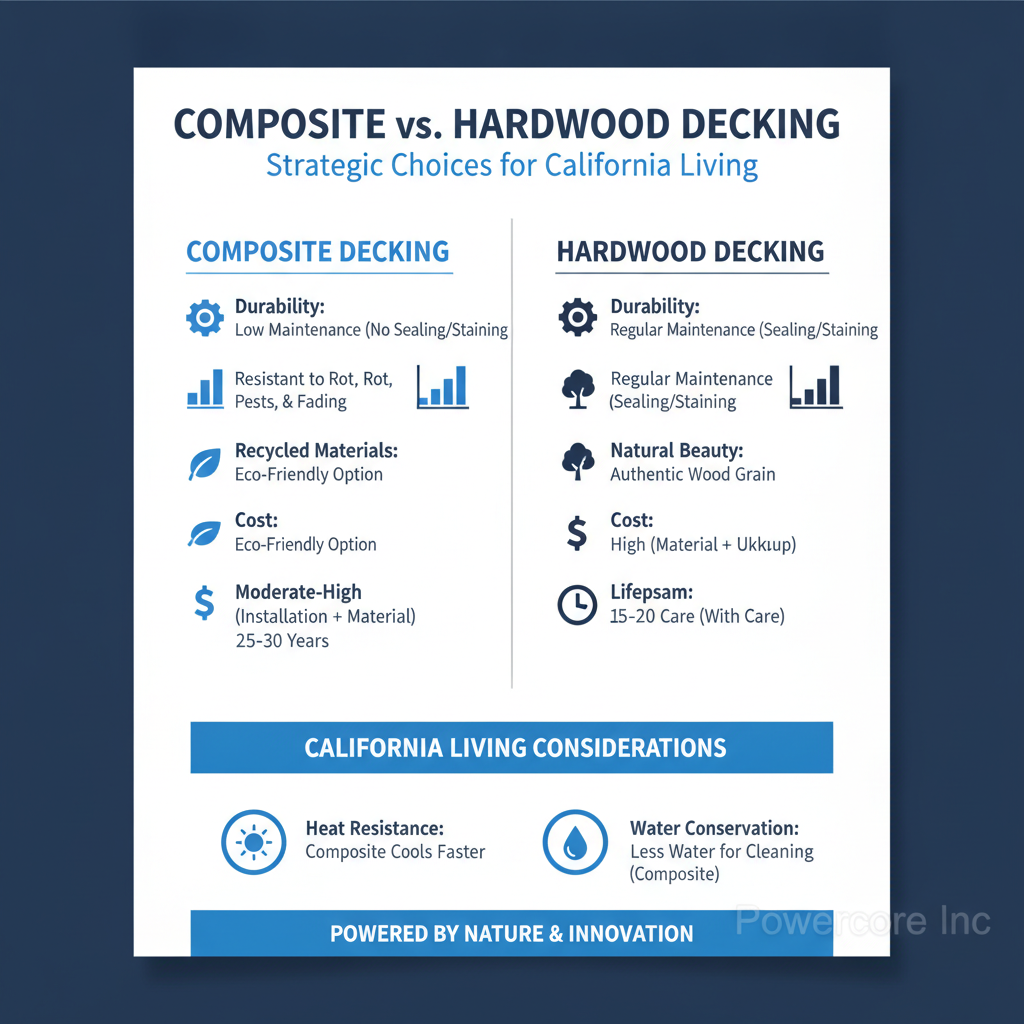
Sustainability & Environmental Impact in California
California's commitment to environmental stewardship means that the ecological footprint of your decking choice is an important consideration.
Hardwood Sustainability
The environmental impact of hardwood depends entirely on its source. Opting for locally sourced Redwood (if available) or hardwoods certified by the Forest Stewardship Council (FSC) ensures that the wood comes from responsibly managed forests. This helps combat illegal logging and deforestation. However, the carbon footprint of transporting exotic hardwoods from distant continents can be significant.
Composite Sustainability
Composite decking often boasts strong environmental credentials. Many manufacturers use a high percentage of recycled plastics (such as milk jugs and grocery bags) and reclaimed wood fibers, diverting waste from landfills. The manufacturing process itself can be energy-intensive, but the extended lifespan and lack of chemical treatments (like stains and sealants) contribute to a lower long-term environmental impact. Powercore Inc can help you source composite decking from manufacturers committed to sustainable practices.
Maintenance & Longevity in California's Climate
The relentless California sun, occasional heavy rains, and potential for wildfires demand materials that can stand up to the elements.
Hardwood Maintenance in California
For hardwood, proactive maintenance is key to longevity. This includes:
- Annual Cleaning: Power washing (carefully) or scrubbing to remove dirt, mildew, and grime.
- Sealing/Staining: Applying a UV-protective sealer or stain every 1-3 years (depending on product and sun exposure) to prevent fading, cracking, and splintering.
- Inspections & Repairs: Regularly checking for loose boards, screws, or signs of pest infestation. Replacing damaged boards promptly.
- Fire Safety: In WUI zones, ensure your hardwood deck meets local fire codes. This might involve using specific species, fire-retardant treatments, or maintaining clear defensible space around the deck.
Composite Maintenance in California
Composite decking offers a significant advantage in terms of maintenance:
- Simple Cleaning: Regular sweeping and occasional washing with soap and water are usually sufficient. For tougher stains, manufacturer-recommended cleaners can be used.
- No Sealing/Staining: The capstock provides inherent protection, eliminating the need for these labor-intensive tasks.
- Fade Resistance: High-quality capped composites are engineered to resist fading from the intense California sun, maintaining their color for decades.
- Pest & Rot Immunity: You won't have to worry about termites or wood rot, common issues for traditional wood decks in California.
- Heat Management: While low maintenance, be mindful of darker colors in direct sun. Consider lighter shades or shade structures if heat retention is a concern for your outdoor living.
Installation Considerations & Permitting in California
Regardless of material, proper installation is paramount to a deck's safety, longevity, and compliance with California building codes. This is where partnering with an experienced, licensed contractor like Powercore Inc makes all the difference.
Installation Complexity
- Hardwood: Installing dense tropical hardwoods can be challenging, requiring pre-drilling and specialized fasteners to prevent splitting. Accurate spacing is crucial for drainage and aesthetic appeal.
- Composite: While seemingly simpler, composite decking requires precise gapping for expansion and contraction. Many systems use hidden fasteners for a clean look, which adds to installation time and expertise.
An improperly installed deck, whether hardwood or composite, can lead to structural issues, voided warranties, and safety hazards down the line. Powercore Inc's team of skilled craftsmen ensures every deck is built to the highest standards.
California Permitting and Building Codes
Any deck project in California that involves structural changes, a significant footprint, or is elevated above a certain height (e.g., typically 30 inches) will require a building permit. Navigating these regulations can be complex:
- Local Jurisdictions: Requirements vary by city and county.
- Structural Requirements: Load-bearing capacity, ledger board attachments, footing depths, and railing heights are all regulated.
- Fire Codes: Especially critical in WUI zones, where specific materials, clearances, and construction methods might be mandated to reduce wildfire risk.
- Accessibility: ADA compliance might be a factor for certain public or multi-family dwelling projects.
Powercore Inc handles all necessary permitting and ensures that your decking project adheres to all California building codes and local regulations, providing peace of mind and protecting your investment.
Making the Strategic Choice for Your California Home
The decision between composite and hardwood decking ultimately comes down to a careful evaluation of your priorities, lifestyle, and long-term vision for your outdoor space.
- Consider Your Lifestyle: If you crave low maintenance and want to spend your weekends enjoying your deck rather than working on it, composite is likely your best bet. If you enjoy the hands-on aspect of home maintenance and value the authentic feel of natural wood, hardwood might be more appealing.
- Evaluate Your Budget: While initial costs can be similar, the long-term maintenance savings of composite can make it a more cost-effective choice over decades. Consider the total cost of ownership, not just the upfront price.
- Define Your Aesthetic: Do you envision a rustic, classic look that ages with character, or a sleek, consistent, modern aesthetic? Both materials offer a wide range of styles and colors to complement California's diverse architectural landscape.
- Assess Your Location & Environment: For homes in high-fire-risk WUI zones, materials with superior fire ratings (like certain composites or PVC) might be a safer and more compliant choice. For areas with extreme sun, fade-resistant materials are crucial.
- Think Long-Term Value: Both options, when properly installed and maintained, can add significant value to your home. However, the 'set it and forget it' nature of composite often appeals to future buyers.
Conclusion: Building Your California Dream Deck with Powercore Inc
Whether you lean towards the timeless elegance of hardwood or the modern convenience of composite, your decking choice is a pivotal one for your California home. Both materials offer distinct advantages and, when selected strategically, can create an outdoor living space that enhances your property's beauty, functionality, and value for decades.
At Powercore Inc, we pride ourselves on being California's trusted partner for comprehensive home improvement solutions, including expert decking and outdoor living installations. Our dual licensing as a General B and C-10 Electrical Contractor means we bring a holistic understanding to your project, ensuring structural integrity, aesthetic appeal, and seamless integration with your home's existing systems.
Ready to transform your outdoor space? Don't navigate the complexities of materials, permits, and installation alone. Let the experts at Powercore Inc guide you to the perfect decking solution for your California home. Call us today for a consultation at 916-699-8778 and take the first step towards building the deck of your dreams.