

The Golden State's Outdoor Appeal: Why Pergolas Reign Supreme
California living is synonymous with embracing the outdoors. From the sun-drenched beaches of San Diego to the scenic vineyards of Napa Valley, and the vibrant urban landscapes of Los Angeles to the serene foothills of the Sierra Nevada, Golden State residents cherish their outdoor spaces. A beautifully designed pergola is often the crowning jewel of a California backyard, transforming an ordinary patio into an extraordinary outdoor living room, dining area, or serene retreat.
Pergolas offer a unique blend of aesthetic appeal and functional benefits. They provide a graceful architectural element, define outdoor zones, and offer filtered shade, creating a comfortable environment even on the warmest days. Many homeowners envision their pergolas adorned with climbing vines, integrated lighting, or perhaps even an outdoor kitchen, making them the ultimate extension of their homes. However, before you dive headfirst into designing your dream outdoor oasis, there’s a crucial step that often gets overlooked: understanding California pergola permit requirements. Skipping this vital planning stage can lead to costly delays, fines, or even the dreaded demolition order. This guide will walk you through everything you need to know to ensure your California pergola project is not only beautiful but also fully compliant.
Decoding the "P" Word: Why Pergola Permits Are Essential in California
The term "permit" often conjures images of bureaucratic red tape and frustrating delays. While the process requires attention to detail, permits exist for very good reasons. When it comes to building a pergola in California, securing the necessary permits is not just a legal formality; it's a critical step that protects your investment, ensures safety, and maintains property value.
- Safety and Structural Integrity: California is no stranger to seismic activity and strong winds. Building codes, enforced through the permitting process, are designed to ensure that structures like pergolas are built to withstand these forces. A poorly constructed pergola can pose a significant safety risk to your family and guests. Permits require adherence to the California Building Code (CBC), which sets standards for materials, construction methods, and foundation requirements.
- Legal Compliance and Future Protection: Building without a permit, when one is required, can lead to serious legal repercussions. Local building departments can issue stop-work orders, impose substantial fines, and even mandate the removal of the unpermitted structure. Furthermore, an unpermitted structure can complicate the sale of your home, as buyers and lenders often require all structures to be fully compliant with local codes.
- Property Value and Insurance: A properly permitted and constructed pergola adds tangible value to your property. It demonstrates a commitment to quality and compliance. Conversely, an unpermitted structure can actually diminish your home's value and may even void parts of your homeowner's insurance policy in the event of damage or an accident related to the pergola.
- Neighborly Relations and Community Standards: Permits also help ensure that your construction project adheres to local zoning ordinances, setback requirements, and aesthetic guidelines, preventing potential disputes with neighbors and maintaining the character of your community.
When Does Your California Pergola Need a Permit? Key Factors
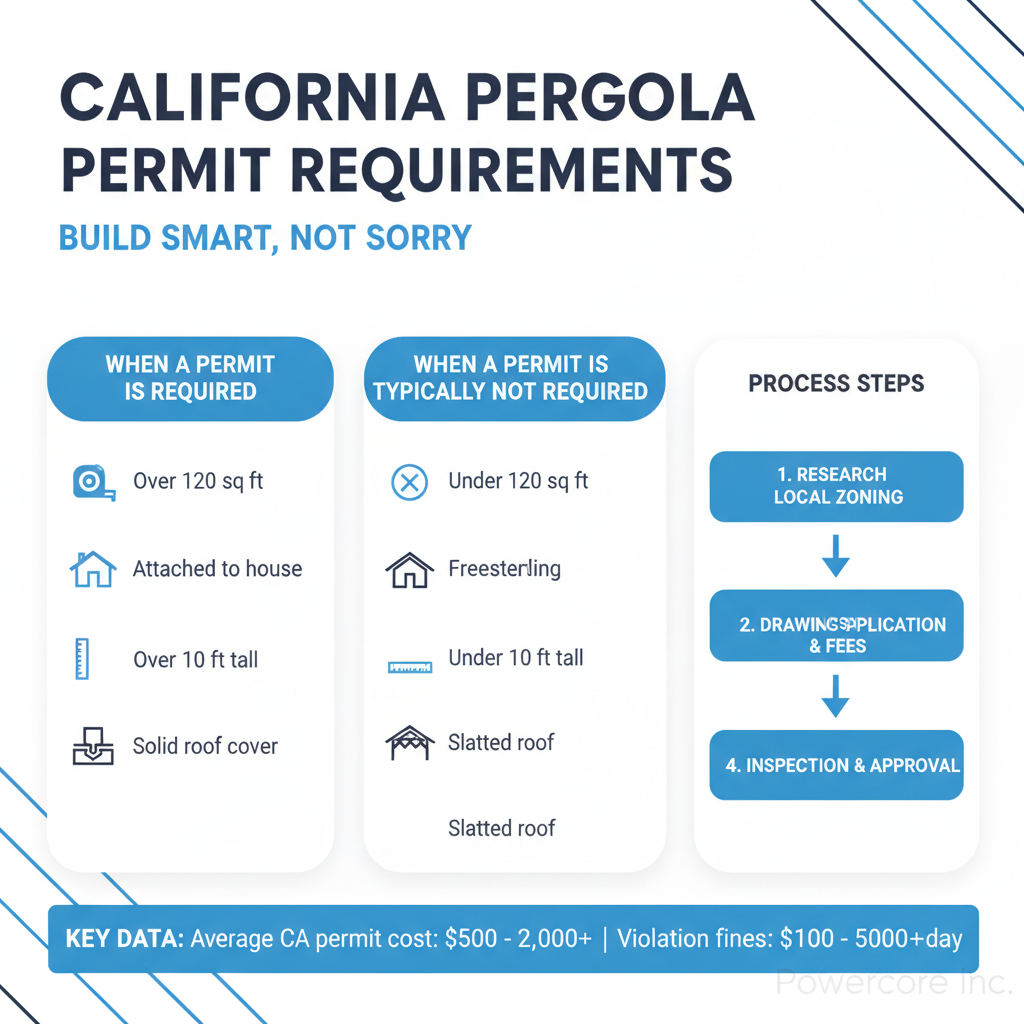
The question of whether a permit is required for your pergola is not always straightforward. While there are general guidelines, specific requirements often vary by city and county within California. It's crucial to consult your local building department for the most accurate information. However, several common factors typically trigger the need for a permit:
Size and Footprint: The 120 Sq. Ft. Rule and Beyond
Many jurisdictions across California, following the International Residential Code (IRC) adopted by the California Building Code (CBC), allow certain detached accessory structures, like pergolas, to be built without a permit if they are under a specific size threshold. The most common threshold is 120 square feet. If your pergola's footprint exceeds this size, it will almost certainly require a permit. However, this is a general guideline, and some cities may have stricter or slightly different limits. For instance, some areas might consider any structure over 100 sq ft or even 50 sq ft as requiring a permit, especially if it's considered a permanent structure.
Height Matters: Going Vertical with Your Outdoor Structure
The height of your pergola is another critical factor. While smaller, lower pergolas might fall under an exemption, taller structures typically require a permit. Common height limits for permit-exempt pergolas range from 10 to 12 feet. If your pergola's highest point, including any decorative elements or attached features, exceeds this threshold, you'll likely need a permit. This is due to concerns about structural stability, wind loads, and potential impacts on neighboring properties (e.g., blocking views).
Attachment to Existing Structures: Freestanding vs. Attached
This is a significant differentiator. A freestanding pergola, independent of your home or any other structure, often has more lenient permit requirements, especially if it meets the size and height exemptions. However, an attached pergola, which is structurally connected to your house, almost always requires a permit. Attaching a structure to your home impacts the primary dwelling's structural integrity, potentially affecting load-bearing walls, roofing, and flashing. This necessitates a thorough review by the building department to ensure proper engineering and construction practices.
Electrical and Plumbing Integration: Powering Your Pergola
The moment you introduce electrical wiring (for lighting, fans, outlets, or entertainment systems) or plumbing (for an outdoor sink or misters) into your pergola project, a permit becomes mandatory, regardless of the structure's size or height. This is a critical safety consideration, as improper electrical or plumbing installations can pose fire hazards, electrocution risks, or water damage. Powercore Inc, as a dual-licensed General B and C-10 Electrical Contractor, possesses the expertise to handle all electrical aspects of your pergola project, ensuring all wiring and fixtures are installed safely and to code, simplifying this complex permitting requirement for you.
Location, Location, Location: Setbacks and Easements
Your property's zoning regulations dictate where you can build on your lot. Setback requirements specify the minimum distance your pergola must be from property lines, streets, and other structures. Building within an easement (a strip of land reserved for utility access or other specific purposes) is generally prohibited or requires special permission. Even if your pergola is small and detached, violating setback rules or building in an easement will necessitate a permit and likely lead to a denied application or required relocation. Fire safety setbacks from your home or property lines are also common, especially in high fire-severity zones prevalent across California.
Material and Construction: Weight and Wind Loads
While most pergolas feature open lattice roofs, some designs incorporate heavier roofing materials or more substantial framing. The weight of these materials, combined with potential wind loads, can impact the structural requirements for foundations and framing. If your pergola design deviates significantly from a lightweight, open structure, or if it's constructed from heavy materials like solid wood beams or metal, it's more likely to require a permit for structural review.
Navigating California's Permit Landscape: State vs. Local Nuances
California operates under a unified set of building codes, primarily the California Building Code (CBC), which is based on the International Building Code (IBC) and International Residential Code (IRC). However, this is just the baseline. Individual cities and counties throughout California have the authority to adopt local amendments to the state code. This means that while the general principles might be consistent, the specific permit requirements, application processes, and fees can vary significantly from one jurisdiction to another.
- State Baseline (CBC): The CBC provides minimum standards for construction, structural integrity, fire safety, and accessibility. It's the foundation upon which all local codes are built.
- Local Amendments: A city like Los Angeles, for example, might have specific requirements regarding materials, fire-resistant construction, or design aesthetics due to its population density, seismic activity, and unique environmental factors. San Francisco might have different historical preservation overlays affecting outdoor structures. Sacramento or Roseville might have distinct rules for residential developments. It's not uncommon for a permit-exempt structure in one county to require a permit just across the county line.
- Homeowners' Associations (HOAs): Beyond government regulations, if your property is part of a Homeowners' Association, you'll have an additional layer of approval to navigate. HOAs often have their own architectural guidelines, design standards, and approval processes for any exterior modifications, including pergolas. It's crucial to consult your HOA's Covenants, Conditions, and Restrictions (CC&Rs) and submit your plans for their approval before even approaching the city or county. An HOA denial can halt your project, even if it's perfectly compliant with municipal codes.
This intricate landscape underscores the importance of local research. Before you put shovel to soil or even finalize your design, always contact your specific city's or county's planning and building department. Many jurisdictions have user-friendly websites with permit checklists, FAQs, and even online portals for permit applications. A quick phone call or visit can save you immense time and potential headaches down the line.
The California Pergola Permit Application Process: A Step-by-Step Guide
While the specifics may vary, the general steps for obtaining a pergola permit in California typically follow this sequence:
- Research Local Requirements: As emphasized, this is your first and most critical step. Visit your city or county's building department website or call their office. Ask about specific requirements for pergolas, setback rules, design guidelines, and the application forms needed.
- Prepare Your Plans: You'll need detailed plans illustrating your proposed pergola. This typically includes:
- Site Plan: An overhead view of your property showing your house, property lines, existing structures, and the proposed location of the pergola, including dimensions and distances to property lines (setbacks).
- Structural Drawings: Detailed architectural drawings showing the pergola's dimensions (height, length, width), foundation type, framing materials, connection details, and roof structure. If attaching to your home, details on how it connects to the house structure are crucial.
- Elevation Views: Drawings showing what the pergola will look like from different angles.
- Material Specifications: A list of the materials you intend to use.
- Electrical/Plumbing Plans (if applicable): If your pergola includes lighting, outlets, or water features, you'll need separate electrical and/or plumbing schematics detailing the wiring, conduit, fixtures, and connection points, designed by a licensed professional like Powercore Inc's C-10 electricians.
- Complete the Application Form: Fill out the permit application form accurately and completely. Be prepared to provide property owner information, contractor details (if applicable), and a detailed description of the project.
- Submit Your Application and Pay Fees: Submit your completed application forms and plans to the building department. You will also pay the associated permit fees at this stage. Fees are usually calculated based on the project's valuation or a flat fee for simpler structures.
- Plan Review: The building department will review your plans to ensure they comply with all applicable building codes, zoning ordinances, and local regulations. This process can take anywhere from a few days to several weeks, depending on the complexity of your project and the department's workload. They may request revisions or additional information.
- Receive Permit: Once your plans are approved, you'll be issued a permit. This permit must be posted visibly on your property during construction.
- Schedule Inspections: As construction progresses, various inspections will be required at different stages (e.g., foundation, framing, electrical rough-in, final). It's your responsibility (or your contractor's) to schedule these inspections at the appropriate times. Do NOT cover up work that needs to be inspected.
- Final Approval: After all inspections are passed, the building department will issue a final approval, signifying that your pergola has been built safely and according to code.
The Cost of Compliance: What to Expect for Permits in California
Permit fees in California are not insignificant, but they represent a necessary investment in the safety and legality of your project. The exact cost will vary widely based on several factors:
- Jurisdiction: Permit fees are set by individual cities and counties. Larger metropolitan areas like Los Angeles or the Bay Area often have higher fees than smaller, rural communities.
- Project Valuation: Many permit fees are calculated as a percentage of the estimated construction cost of your pergola. The higher the estimated value of your project, the higher the permit fees.
- Complexity: A simple, detached pergola might have a relatively low flat fee, while an attached pergola with extensive electrical work, complex engineering, or special design features will incur higher fees.
- Review Fees: Some departments charge separate fees for plan review, particularly if engineering or architectural review is required.
- Impact Fees: In some areas, new construction or significant additions might trigger development or impact fees, though these are less common for simple pergolas.
Generally, you can expect permit fees for a medium-sized pergola in California to range from a few hundred dollars to over a thousand, especially if it includes electrical work or requires engineering plans. These costs do not include the potential expenses for professional design services (architects, structural engineers) if your project is complex or if you're not comfortable drawing the plans yourself.
While these costs might seem like an extra expense, consider them an insurance policy. The financial penalties for building without a required permit – including fines, legal fees, the cost of remediation, or even demolition and reconstruction – far outweigh the upfront permit fees. Investing in proper permits from the outset is always the more cost-effective and stress-free approach in the long run.
The Perils of Permitting Neglect: Why Skipping is a Costly Mistake
It can be tempting to bypass the permit process to save time or money, but the risks associated with building an unpermitted pergola in California are substantial and can lead to significant financial and legal headaches:
- Stop-Work Orders and Fines: If your unpermitted construction is discovered, the local building department will issue a stop-work order. You'll be unable to continue work until you apply for and receive the necessary permits. Additionally, you'll likely face substantial fines, which can quickly accumulate.
- Mandatory Remediation or Demolition: In many cases, you'll be required to expose parts of the structure for inspection (which means tearing down completed work) or even completely demolish the unpermitted pergola and rebuild it to code, often incurring further fines and costs.
- Resale Complications: An unpermitted structure can become a major stumbling block when selling your home. Buyers' agents and appraisers will flag the unpermitted work, potentially leading to a reduced offer, a demand for you to retroactively permit the structure (a difficult and often more expensive process), or even the collapse of the sale. Lenders are particularly wary of unpermitted additions as they may impact property value and legality.
- Insurance Issues: Your homeowner's insurance policy may not cover damages or liabilities arising from an unpermitted structure. If your pergola collapses or causes injury, and it was built without a permit, your insurance claim could be denied, leaving you personally liable.
- Safety Risks: Beyond the legal and financial implications, an unpermitted pergola built without professional oversight may not meet structural safety standards, posing a real physical risk to anyone beneath it.
Partnering with Powercore Inc: Your California Pergola Permit Experts
Navigating the complex world of California pergola permit requirements can feel daunting, but you don't have to do it alone. Powercore Inc, a California dual-licensed General B and C-10 Electrical Contractor based in Roseville, CA, is your ideal partner for ensuring a seamless and compliant outdoor living project.
With CSLB #1134334 (General B) and #1098175 (C-10 Electrical), Powercore Inc offers a unique advantage. Our comprehensive services include not only expert decking and outdoor living construction but also specialized electrical integration. This means whether your pergola needs complex lighting, outdoor entertainment system wiring, or simply a few well-placed outlets, our certified electricians can handle all aspects of the electrical work, ensuring it meets California's stringent electrical codes and passes all necessary inspections. This integrated approach simplifies the permitting process, as you're working with a single, highly qualified contractor capable of managing all facets of your project from design to final approval.
Our team understands the nuances of California's diverse municipal codes across the entire state. We can assist with:
- Initial Permit Consultation: Determining if your specific pergola project requires a permit in your local jurisdiction.
- Plan Preparation: Assisting with or reviewing site plans and structural drawings to meet local building department requirements.
- Application Submission: Guiding you through the permit application process.
- Code Compliance: Ensuring all construction, especially electrical work, adheres to the latest California Building and Electrical Codes.
- Inspection Coordination: Scheduling and preparing for necessary inspections throughout the project lifecycle.
By partnering with Powercore Inc, you leverage our expertise to streamline the permit process, avoid costly mistakes, and ultimately build a safe, beautiful, and fully compliant pergola that enhances your California outdoor living experience for years to come.
Tips for a Seamless California Pergola Project
To ensure your pergola project in the Golden State is a success, keep these tips in mind:
- Start Early: Don't wait until you've bought materials or started construction to investigate permits. Begin your permit research and application process well in advance of your desired start date.
- Be Thorough: Provide all requested documentation, plans, and details. Incomplete applications are the leading cause of delays.
- Communicate with Authorities: If you have questions or concerns during the process, don't hesitate to reach out to your local building department. They are there to help ensure compliance.
- Hire Licensed Professionals: This is paramount. A licensed contractor like Powercore Inc (CSLB #1134334 & #1098175) is familiar with local codes, understands the permit process, and is accountable for the quality and legality of their work. They can significantly de-stress the entire project.
- Document Everything: Keep copies of all submitted plans, permits, inspection reports, and communications with the building department and your contractor.
Conclusion
A pergola can dramatically enhance your California outdoor living space, offering beauty, shade, and a dedicated area for relaxation and entertainment. However, bringing this vision to life requires careful planning, especially when it comes to understanding and adhering to California pergola permit requirements. While the process may seem complex, it's a vital step that ensures safety, protects your investment, and avoids future legal or financial headaches.
By taking the time to research local regulations, prepare accurate plans, and work with experienced professionals, you can navigate the permit process with confidence. Don't let the thought of permits deter you from creating your dream outdoor oasis. With the right approach, your California pergola will be a compliant, beautiful, and enduring addition to your home.
Ready to design and build your compliant California pergola? Contact Powercore Inc today for expert guidance on your outdoor living project, from initial concept to final permit approval. Our dual-licensed team is equipped to handle all aspects of your pergola construction, including any necessary electrical work, ensuring a smooth and successful build. Call us at 916-699-8778 to schedule your consultation!