

Navigating California's Energy Landscape with Smart Backup Power
California homeowners face a unique set of energy challenges: escalating electricity rates, the looming threat of Public Safety Power Shutoffs (PSPS) due to wildfires, and an aging grid struggling to keep up with demand. While the dream of complete energy independence is appealing, a full whole-home backup system can be a significant investment, often powering non-essential items during an outage. This is where a strategic critical load panel setup emerges as the intelligent, cost-effective, and highly resilient solution for the Golden State.
At Powercore Inc, your trusted Roseville-based, dual-licensed General B & C-10 Electrical Contractor, we understand the critical need for reliable power. We specialize in designing and installing custom backup power solutions that prioritize your essential needs, ensuring comfort, safety, and peace of mind when the grid goes dark. Serving all of California, from bustling urban centers to serene rural landscapes, we empower homeowners to take control of their energy future.
What Exactly is a Critical Load Panel?
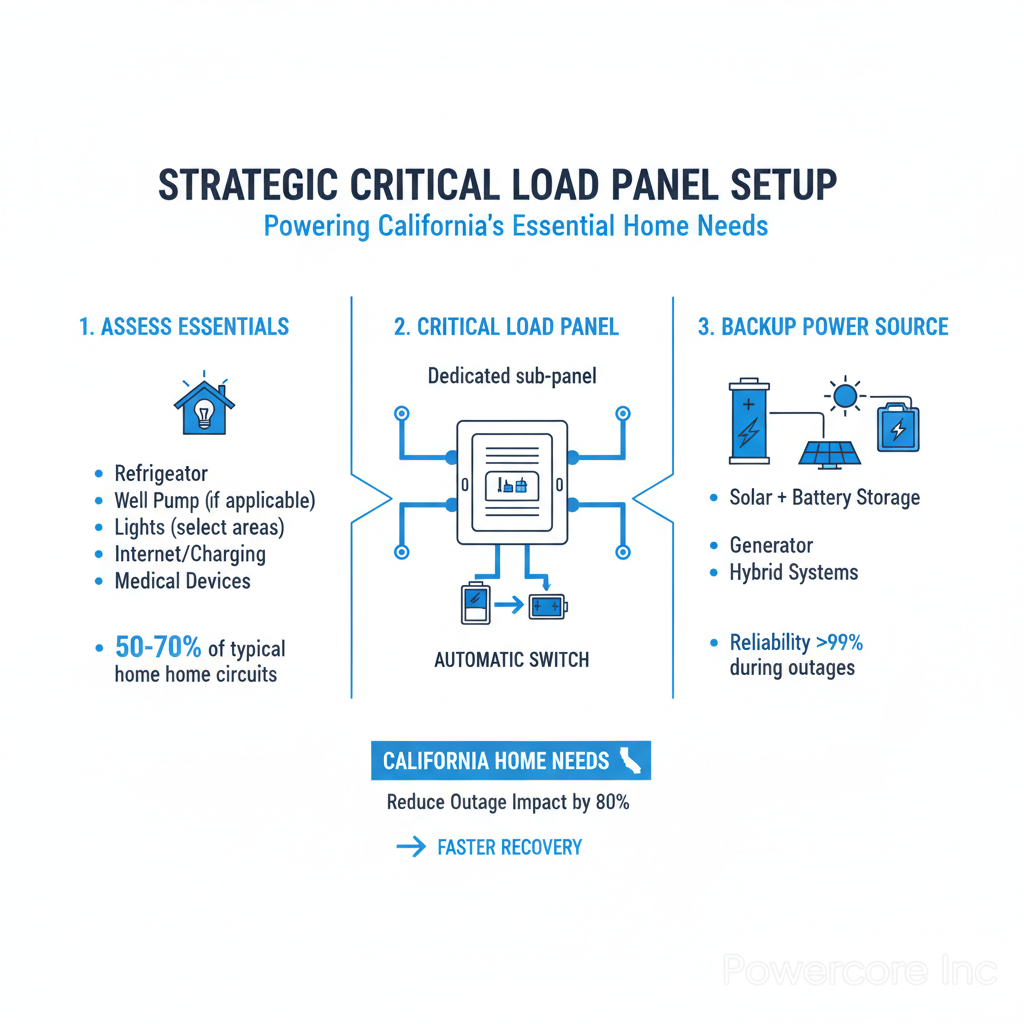
Imagine a scenario where the power goes out, but your refrigerator hums on, your internet stays connected, and your essential lighting remains bright. This isn't magic; it's the result of a critical load panel setup. In essence, a critical load panel (sometimes called an essential load panel or emergency subpanel) is a dedicated electrical subpanel that contains only the circuits for your most vital appliances and systems.
Unlike a whole-home backup system that attempts to power every single outlet and light fixture, a critical load panel is designed to be selective. When the main power grid fails, your backup power source (such as solar and battery storage or a generator) automatically switches to power only the circuits connected to this critical load panel. This targeted approach offers several key advantages, particularly in California's challenging energy environment.
How It Works with Your Backup System
- Main Service Panel: This is where all the electricity from the grid first enters your home and is distributed to all your circuits.
- Critical Load Panel: Electricians carefully identify and re-route essential circuits from your main panel to this new subpanel.
- Backup Power Source: Whether it's a home battery (charged by residential solar panels) or a generator, this unit is connected directly to the critical load panel via an automatic transfer switch (ATS).
- Automatic Transfer Switch (ATS): This intelligent device monitors grid power. When an outage occurs, it safely disconnects your home from the utility grid and seamlessly transfers power from your backup source to your critical load panel. When grid power returns, the ATS reverses the process.
This configuration ensures that your valuable backup energy is conserved and directed precisely where it's needed, maximizing the duration of your backup power during an extended outage.
Why a Critical Load Panel is Strategic for California Homeowners
For residents across California, from the Bay Area to San Diego, a critical load panel setup isn't just a convenience; it's a strategic investment in energy security and financial prudence. Here's why this approach is gaining traction:
Targeted Resilience and Extended Backup Duration
During a PSPS event or unexpected outage, your immediate concern is keeping essential systems operational. A critical load panel allows you to direct power only to what truly matters: your refrigerator to prevent food spoilage, lighting for safety, internet and communication devices, medical equipment, and perhaps a fan or a heating zone for comfort. By not powering non-essential items, you significantly extend the runtime of your battery or the fuel supply of your generator, ensuring you can weather longer outages with confidence.
Cost Efficiency and Optimized Investment
The primary financial advantage of a critical load panel is that it requires a smaller, less expensive battery bank or generator compared to a whole-home solution. Less capacity means a lower upfront investment for your backup system. In California's competitive energy market, optimizing every dollar is key. This approach ensures your investment is focused on providing maximum utility for your most critical needs, rather than overspending on excess capacity that may rarely be utilized.
Smart Energy Management and Reduced Grid Reliance
Beyond just backup, a well-designed critical load system, especially when paired with solar and battery storage, contributes to smarter overall energy management. You become less vulnerable to California's volatile utility rates and Time-of-Use (TOU) charges. With a battery, you can store excess solar power during the day and discharge it to your critical loads (or even back to the grid, depending on your NEM agreement) during peak rate hours, further reducing your reliance on expensive utility electricity.
Future-Proofing Your California Home
As California continues to evolve its energy policies and climate challenges intensify, homes with robust, strategic backup power solutions will be better positioned for the future. A critical load panel setup demonstrates foresight and an understanding of modern energy demands, adding significant value and peace of mind to your property.
Identifying Your Home's Critical Loads
The first and most crucial step in designing your critical load panel setup is to carefully identify which circuits in your home are truly essential during a power outage. This isn't a one-size-fits-all list; it depends entirely on your household's unique needs, priorities, and lifestyle. A thorough assessment by an experienced C-10 Electrical Contractor like Powercore Inc is vital to ensure nothing important is overlooked.
Common Critical Load Categories
-
Food Preservation:
- Refrigerator
- Freezer
-
Lighting:
- Key indoor lighting circuits (kitchen, living areas, bedrooms)
- Outdoor security lighting
-
Communication & Entertainment:
- Internet modem/router
- Charging outlets for phones, laptops
- Television (if essential for news/information)
-
Health & Safety:
- Medical equipment (CPAP machines, oxygen concentrators, etc.)
- Well pump (if on private well)
- Garage door opener
- Security system
- Carbon monoxide/smoke detectors (though many have battery backup)
-
Comfort (Seasonal & Limited):
- A single HVAC fan or a specific zone (for extreme temperatures)
- Water heater (gas ignition or small electric models)
- A specific outlet for a space heater or fan
-
Water Heating:
- Gas water heater ignition (minimal power)
- Small electric tankless or standard electric water heaters (can be power-intensive, requiring careful consideration)
-
Other:
- Sump pump (if applicable)
- Certain kitchen outlets (for small appliances like a coffee maker or microwave, used sparingly)
Prioritization and Load Analysis
When planning your critical load panel setup, it's crucial to differentiate between 'must-haves' and 'nice-to-haves.' For instance, while a whole-house air conditioner might seem critical during a California heatwave, its energy demand is often too high for extended battery backup. Prioritizing a single zone AC or strategic fans might be a more realistic and sustainable approach.
Our expert team at Powercore Inc will conduct a detailed load analysis, taking into account the wattage and run-time of each potential critical appliance. This analysis is fundamental to properly size your backup battery or generator and ensure it can meet your needs for the desired duration. We'll help you make informed decisions based on real-world energy consumption data.
Special Considerations: EV Charging and More
For many California homeowners, EV charging is becoming a daily necessity. While powering an EV charger might be too demanding for a typical critical load panel during an extended outage, it's possible to integrate a lower-level charging circuit or plan for charging during specific, non-peak times if your backup system has sufficient capacity and can be configured with smart load management. This is a conversation we often have with our clients, exploring the balance between essential home loads and vehicle charging needs.
Components of a Robust Critical Load Backup System
A truly effective critical load panel setup relies on a combination of high-quality components, all seamlessly integrated. Understanding these elements is key to appreciating the sophistication and reliability of a modern backup power solution.
The Critical Load Panel: The Heart of the System
As discussed, this dedicated subpanel is the central distribution point for your essential circuits during an outage. Its size and number of breakers will be determined by your identified critical loads. Powercore Inc ensures proper sizing and professional installation, adhering to all California electrical codes and safety standards.
Power Source Options for California Homes
-
Solar + Battery Storage: The California Ideal
This is the most popular and environmentally friendly choice for California homes. Solar panels generate clean energy during the day, which can power your home and charge a battery storage system. When the sun sets or the grid goes down, the battery seamlessly takes over, providing silent, emission-free power to your critical loads. Battery storage systems, often paired with residential solar, are particularly attractive due to state incentives like the Self-Generation Incentive Program (SGIP) and federal tax credits. For more details on federal incentives, you can refer to the IRS Residential Clean Energy Credit. -
Generators (Propane/Natural Gas): Reliable Redundancy
Automatic standby generators offer a powerful and reliable backup solution, especially for homes with higher critical load demands or those anticipating very long outages. They run on natural gas or propane and automatically kick on when grid power is lost. While they produce emissions and noise, they offer extended runtimes as long as fuel is available. Some systems can even be integrated with solar + battery for a hybrid approach, where the battery handles shorter outages and the generator provides power for longer durations or heavy loads.
Automatic Transfer Switch (ATS): The Seamless Transitioner
The ATS is a non-negotiable component for any automatic backup system. It's the brain that detects a power outage, safely disconnects your home from the utility grid (preventing back-feeding and protecting utility workers), and transfers the electrical load to your backup source. When grid power is restored, it switches back and allows your backup system to shut down or recharge. This entire process is typically so fast that you might not even notice the transition.
Inverters and Charge Controllers (for Solar + Battery Systems)
If you opt for solar and battery storage, an inverter is essential. It converts the DC (direct current) electricity from your solar panels and battery into AC (alternating current) electricity that your home appliances use. Charge controllers regulate the power flowing from your solar panels to your battery, preventing overcharging and optimizing battery life. Modern hybrid inverters often combine these functions, simplifying the system.
The Powercore Inc Installation Process
Installing a critical load panel setup is a complex electrical undertaking that requires specialized expertise and adherence to strict safety and building codes. As a dual-licensed General B & C-10 Electrical Contractor, Powercore Inc is uniquely qualified to handle every aspect of your project, from initial design to final commissioning, across all of California.
Step 1: Initial Assessment and Load Analysis
Our process begins with a comprehensive on-site consultation. We'll assess your current electrical system, discuss your specific energy concerns, and most importantly, work with you to meticulously identify your critical loads. Using advanced tools, we'll analyze the power consumption of these essential items to accurately size the critical load panel and recommend the optimal backup power source (solar + battery, generator, or hybrid).
Step 2: System Design and Permitting
Based on our assessment, our engineers will design a customized critical load backup system tailored to your home and budget. This includes detailed electrical schematics, equipment specifications, and a precise layout for your critical load panel and backup components. Navigating California's stringent permitting requirements can be daunting, but Powercore Inc handles all the necessary paperwork and inspections with local authorities, ensuring your installation is fully compliant.
Step 3: Professional Installation
Our highly skilled and certified electricians will expertly install your system. This involves:
- Installing the critical load subpanel and rerouting selected circuits.
- Mounting solar panels (if applicable) and battery storage units.
- Connecting and wiring the automatic transfer switch.
- Integrating inverters, charge controllers, and all necessary electrical components.
- Ensuring all wiring meets or exceeds National Electrical Code (NEC) and California building standards.
Our General B license allows us to manage and integrate all construction elements, while our C-10 Electrical license guarantees expert and safe electrical work, providing a seamless, single-contractor experience.
Step 4: Testing and Commissioning
Upon completion of the physical installation, we rigorously test the entire system to ensure flawless operation. This includes simulating power outages to verify that the automatic transfer switch engages correctly, the backup source powers the critical loads as expected, and the system seamlessly returns to grid power. We'll walk you through your new system, explain its operation, and provide all necessary documentation and warranty information.
California Incentives and Savings for Critical Load Systems
Investing in a critical load panel setup, especially when paired with solar and battery storage, offers more than just peace of mind; it can also unlock significant financial benefits for California homeowners.
Federal Residential Clean Energy Credit
Often referred to as the Solar ITC, this federal tax credit allows homeowners to claim a percentage of the cost of new, qualified clean energy property for their home. This includes solar panels and battery storage systems with a capacity of at least 3 kWh. The current credit is 30% for systems placed in service through 2032. This substantial credit can significantly reduce the net cost of your system.
California-Specific Battery Storage Incentives
California has been a leader in promoting energy storage, primarily through the Self-Generation Incentive Program (SGIP). While eligibility and incentive levels can vary, SGIP has historically provided rebates for residential battery storage systems. These programs are designed to encourage homeowners to adopt technologies that enhance grid reliability and resilience. Powercore Inc stays up-to-date on all applicable state and local incentives to help you maximize your savings. We can guide you through the application process for any relevant programs.
Long-Term Energy Bill Savings
Beyond direct incentives, a critical load system integrated with solar and battery storage offers continuous savings on your electricity bills. By storing excess solar power and using it during peak utility rate hours, you effectively time-shift your energy consumption, avoiding the most expensive electricity from the grid. This strategy, known as arbitrage, is particularly effective with California's Time-of-Use (TOU) rate structures.
Advanced Considerations and Future-Proofing
As energy technology evolves, so too do the possibilities for enhancing your critical load panel setup. Powercore Inc helps you think beyond immediate needs to create a system that's ready for tomorrow.
Integrating EV Charging Strategically
With the rapid adoption of electric vehicles in California, many homeowners consider how to power their EV during an outage. While full-speed EV charging is a significant load, it's possible to integrate lower-level charging into a critical load system, especially if you have ample battery storage or a robust generator. Smart EV chargers can also be programmed to only draw power when your backup system has surplus capacity, ensuring your essential home loads remain prioritized. Our EV charging station experts can guide you through the best integration strategies.
Smart Home Integration for Dynamic Load Shedding
Modern critical load systems can be integrated with smart home platforms to enable dynamic load shedding. This means your system can automatically or manually prioritize certain critical loads over others, based on battery level or specific needs. For example, if your battery is running low, the system could automatically turn off a less critical circuit, like a secondary freezer, to conserve power for more vital appliances.
Scalability for Future Needs
When designing your critical load panel setup, it's wise to consider future expansion. Perhaps you anticipate adding more essential appliances or wish to upgrade to a larger battery bank later. Powercore Inc designs systems with scalability in mind, making it easier and more cost-effective to adapt your backup power solution as your household's needs evolve.
Choosing the Right Partner: Why Powercore Inc?
In a state as complex as California, selecting the right contractor for your critical load panel setup is paramount. Powercore Inc stands apart as a trusted and highly capable partner for several compelling reasons:
- Dual-Licensed Expertise: We hold both a General B (General Building Contractor) and a C-10 (Electrical Contractor) license from the California Contractors State License Board (CSLB #1134334 & #1098175). This unique combination means we can handle every aspect of your project, from the structural elements to the intricate electrical work, without the need for multiple contractors. This streamlines the process, reduces potential for miscommunication, and ensures seamless integration.
- California-Wide Service: From Redding to San Diego, our teams are equipped to serve homeowners across the entire state of California, understanding local regulations and climate considerations.
- Comprehensive Service Offering: While specializing in solar and battery storage, our broad range of services includes HVAC, roofing, ADUs, remodels, and more. This holistic understanding of home systems allows us to integrate your backup power solution efficiently into your home's overall infrastructure.
- Unwavering Commitment to Quality and Safety: At Powercore Inc, we adhere to the highest industry standards for workmanship and safety. Our installations are built to last, providing reliable performance for years to come.
- Tailored Solutions: We don't believe in one-size-fits-all. Every critical load panel setup we design is custom-engineered to meet the specific energy demands and financial goals of your household.
- Local Knowledge, Global Standards: As a Roseville-based company, we are deeply invested in our local communities while applying world-class expertise to every project.
We believe that true energy security comes from smart planning and expert execution. Powercore Inc is dedicated to empowering California homeowners with the resilience and independence they deserve. Learn more about who we are and our commitment to excellence.
Take Control of Your Energy Future with Powercore Inc
Don't let California's energy challenges leave you in the dark. A strategic critical load panel setup is your intelligent path to enhanced home resilience, cost savings, and ultimate peace of mind. By focusing your backup power on what truly matters, you ensure your home remains a sanctuary, even during extended outages.
Ready to design a backup power solution that's perfectly suited for your California home? Contact the experts at Powercore Inc today for a personalized consultation. Our team is ready to answer your questions and help you embark on your journey toward energy independence. Call us directly at 916-699-8778 or visit our contact page to schedule your assessment.