

Introduction: Securing Your California Home’s Power Future
California, a state synonymous with innovation and progress, is also increasingly familiar with the challenges of an evolving power landscape. From the ever-present threat of wildfires leading to Public Safety Power Shutoffs (PSPS) to an aging grid struggling to meet the demands of a growing population and widespread EV adoption, reliable power is no longer a given. For homeowners across the Golden State, from the bustling Bay Area to the serene Sierras, ensuring a continuous supply of electricity is paramount for comfort, safety, and modern living.
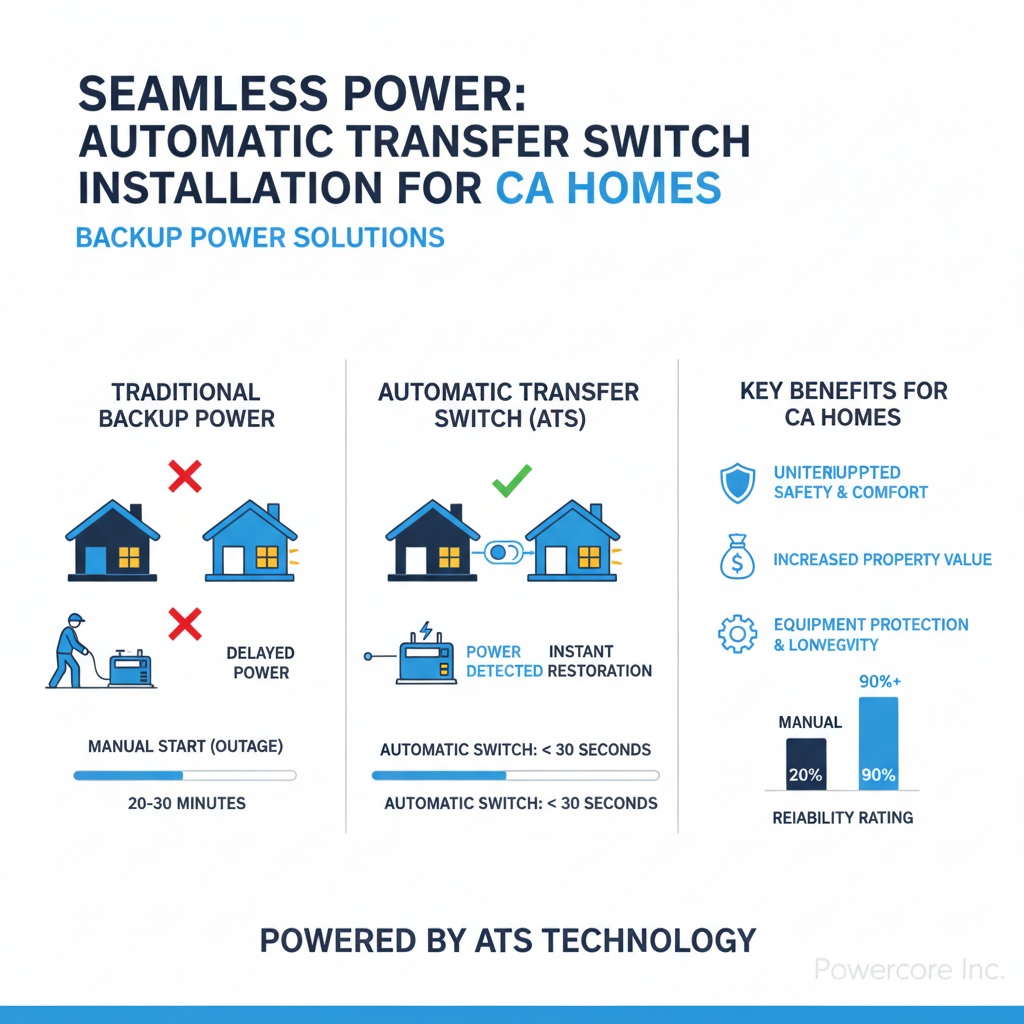
While generators and battery storage systems offer powerful solutions to combat outages, their true potential is unlocked by a critical, often unseen, component: the Automatic Transfer Switch (ATS). An ATS acts as the intelligent brain of your backup power system, seamlessly shifting your home's power source from the utility grid to your generator or battery bank the moment an outage occurs, and back again when grid power is restored. Without it, your sophisticated backup system is a manual operation, requiring you to physically intervene in the dark – a scenario few homeowners desire.
At Powercore Inc, a dual-licensed General B & C-10 Electrical Contractor based in Roseville, CA, we understand the unique energy needs and challenges faced by Californians. Serving the entire state, our mission is to empower homeowners with robust, reliable, and intelligently integrated energy solutions. This comprehensive guide will delve deep into the world of automatic transfer switch installation, explaining its vital role, exploring different types, detailing the installation process, and highlighting why professional expertise is non-negotiable for ensuring your California home remains seamlessly powered, no matter what the grid throws your way.
What is an Automatic Transfer Switch (ATS)?
At its core, an Automatic Transfer Switch (ATS) is an electrical device that automatically transfers the electrical load from a primary power source (the utility grid) to a secondary power source (such as a standby generator or a battery storage system) when the primary source fails. Conversely, it automatically switches the load back to the primary source once it detects that utility power has been restored.
How an ATS Works: The Seamless Transition
Imagine the scenario: the lights flicker, then go out. Without an ATS, you'd be fumbling in the dark, locating your portable generator, wheeling it out, starting it, and then running extension cords or manually flipping breakers. With an ATS, the process is entirely automated and happens in seconds:
- Power Loss Detection: The ATS constantly monitors the utility power supply. When it detects a loss of power, a significant voltage drop, or an interruption, it initiates the transfer sequence.
- Generator/Battery Startup: If connected to a generator, the ATS sends a signal to start the generator. For battery backup systems, it simply prepares to draw power.
- Load Transfer: Once the generator reaches its optimal operating speed and voltage, or the battery system is ready, the ATS safely disconnects your home from the utility grid and connects it to the backup power source. This prevents backfeeding electricity to the utility lines, a critical safety measure for utility workers.
- Restoration Detection: When the ATS detects that utility power has been stably restored, it initiates the reverse sequence.
- Load Retransfer: The ATS switches your home's electrical load back to the utility grid.
- Generator/Battery Shutdown: If a generator was used, the ATS signals it to cool down and then shut off. Battery systems seamlessly return to charging or standby mode.
The beauty of this system lies in its automation. Homeowners experience little to no interruption, with critical appliances like refrigerators, medical equipment, and lighting remaining operational. This hands-free operation is particularly invaluable during emergencies or when residents are away from home.
Key Components of an ATS
- Controller: The brain of the ATS, monitoring power sources and managing the transfer logic.
- Transfer Switch Mechanism: The actual electrical switch that physically moves the connections between the utility and backup power.
- Sensing Circuits: Continuously monitor voltage and frequency of both power sources.
- Interlocks: Safety mechanisms that prevent both power sources from being connected to the home simultaneously, protecting against dangerous backfeeding.
Understanding these fundamentals is the first step toward appreciating the sophisticated protection an ATS provides, especially for California homeowners facing an increasingly unpredictable energy future.
Why an ATS is Crucial for California Homes
For California residents, an Automatic Transfer Switch isn't just a convenience; it's rapidly becoming an essential component of a resilient home energy strategy. The state's unique geographical and infrastructural challenges underscore the critical need for uninterrupted power.
California Grid Instability and PSPS Events
Wildfires have become an unfortunate annual reality across California. To mitigate fire risk, utility companies like PG&E, Southern California Edison (SCE), and SDG&E frequently implement Public Safety Power Shutoffs (PSPS). These pre-emptive outages, while intended to protect communities, can leave homes without power for days, disrupting daily life, compromising food safety, and impacting critical medical equipment.
- Extended Outages: PSPS events are not brief blips; they can last for hours or even multiple days, making manual generator operation impractical and exhausting.
- Unpredictability: While utilities attempt to provide notice, PSPS events can still catch homeowners off guard. An ATS ensures your backup system is ready to activate instantly.
- Aging Infrastructure: Beyond wildfires, California's vast and often aging electrical infrastructure is prone to failures due to extreme weather, equipment malfunction, or increased demand.
Peace of Mind, Safety, and Convenience
The benefits of an ATS extend far beyond simply having power during an outage:
- Uninterrupted Comfort: Keep your HVAC system running, ensuring your home remains cool during heatwaves or warm during cold snaps. Maintain refrigeration to prevent food spoilage, a significant financial saving during extended outages.
- Safety and Security: Maintain lighting to prevent falls and enhance security. Keep security systems and garage door openers operational. For families with medical equipment requiring continuous power, an ATS is a lifeline.
- Home-Based Work and Education: With more Californians working and learning from home, continuous internet and power are non-negotiable. An ATS ensures productivity isn't halted by grid failures.
- Enhanced Property Value: A professionally installed, fully automated backup power system, including an ATS, is a significant selling point for any California home, signaling resilience and preparedness to potential buyers.
Integration with Modern Energy Solutions
California is a leader in solar and battery storage adoption. An ATS is crucial for integrating these technologies seamlessly into a comprehensive home energy system:
- Solar + Battery Backup: If you have a solar system with battery storage (like a Tesla Powerwall or Enphase IQ Battery), an ATS ensures that your home can automatically switch to battery power when the grid goes down, preventing your solar panels from shutting off (as required by law for safety during outages) and maximizing your energy independence.
- EV Charging: As more Californians embrace electric vehicles, the demand on home electrical systems grows. An ATS can be configured to prioritize critical loads during an outage, ensuring your backup power is used efficiently, or even to enable smart EV charging from your backup system if capacity allows.
Ultimately, an ATS transforms your backup power source from a cumbersome emergency measure into a sophisticated, automated system that truly future-proofs your California home against the uncertainties of the modern grid. It ensures that when the power goes out, your life doesn't have to stop.
Types of Automatic Transfer Switches
While the fundamental purpose of an ATS remains consistent, there are several types designed to meet different needs and electrical configurations. Choosing the right one for your California home depends on your backup power source, electrical service, and desired functionality.
1. Service Entrance Rated vs. Non-Service Entrance Rated
-
Service Entrance Rated ATS: These switches combine the functions of a main service disconnect and an ATS. They are installed where the main electrical service enters your home, typically replacing your existing main breaker panel or meter-main combination. This type simplifies wiring by serving as the central point for utility power, backup power, and your home's main electrical panel. They are often preferred for whole-home backup solutions, especially when installing a large standby generator, as they streamline the installation and reduce the need for additional components. For California homes, where space and aesthetic integration are often considerations, a service entrance rated ATS can provide a cleaner, more compact installation.
-
Non-Service Entrance Rated ATS: These switches are installed after the main service disconnect, usually next to your existing electrical panel. They do not contain the main circuit breaker. This type is suitable for homes where the main electrical panel is relatively new or where only a portion of the home's circuits will be backed up (a “managed load” approach). While requiring slightly more complex wiring to integrate with the existing main panel, they offer flexibility for specific backup needs.
2. Open Transition vs. Closed Transition vs. Programmed Transition
-
Open Transition (Break-Before-Make): This is the most common and cost-effective type. When switching power sources, there's a brief, momentary interruption (a few cycles) where your home is disconnected from both the utility and the backup source. This “break-before-make” action is safe and suitable for most residential applications. You might notice a brief flicker in lights or a momentary reset of sensitive electronics, but for most appliances, this transition is negligible.
-
Closed Transition (Make-Before-Break): This type allows for a seamless, “make-before-break” transfer, meaning your home is momentarily connected to both power sources in parallel during the switch. This eliminates any power interruption. While highly desirable for critical applications where even a momentary flicker is unacceptable (e.g., hospitals, data centers), closed transition ATS units are significantly more complex, expensive, and have stricter utility interconnection requirements. They are rarely used in residential settings in California.
-
Programmed Transition: A hybrid approach that delays the re-transfer back to utility power, allowing the utility grid to stabilize fully before reconnecting. This can be beneficial in areas with unstable grid power and helps protect sensitive equipment from potential surges or sags when utility power first returns. This type is also less common in residential applications but offers an added layer of protection.
3. Manual vs. Automatic Transfer Switches
While our focus is on automatic switches, it's worth noting the distinction:
- Manual Transfer Switch (MTS): Requires a person to physically operate a switch to transfer power. This is typically used with portable generators for critical circuits only and involves more homeowner interaction during an outage.
- Automatic Transfer Switch (ATS): The focus of this guide, providing fully automated, hands-free operation.
4. Smart Load Management ATSs
Modern ATS units, especially those integrated with whole-home energy management systems or smart electrical panels, offer advanced load management capabilities. These “smart ATSs” can:
- Prioritize Circuits: During an outage, they can automatically shed non-essential loads (e.g., EV charger, clothes dryer) to ensure critical circuits (e.g., refrigerator, medical equipment, lights) receive power for longer.
- Optimize Battery Usage: When paired with battery storage, a smart ATS can work with the battery management system to optimize discharge rates and extend backup duration.
- Remote Monitoring: Allow homeowners to monitor their power status and system performance via a smartphone app, providing peace of mind even when away from home.
The selection of an ATS is a critical decision that impacts the safety, reliability, and functionality of your entire backup power system. Given the complexities of electrical systems and local California codes, consulting with a qualified C-10 Electrical Contractor like Powercore Inc is essential to ensure you choose the ideal ATS for your specific needs and property.
The Installation Process: A Step-by-Step Guide
Automatic transfer switch installation is a complex electrical project that demands precision, adherence to safety standards, and compliance with local and state regulations. It is emphatically not a DIY task. For homeowners across California, partnering with a licensed and experienced electrical contractor like Powercore Inc is the only way to ensure a safe, reliable, and compliant installation.
1. Initial Assessment and Load Calculation
The first and most crucial step is a thorough assessment of your home's electrical needs. This involves:
- Energy Audit: A Powercore Inc expert will evaluate your current energy consumption and identify which appliances and circuits you want to back up during an outage.
- Load Calculation: Precisely calculating the total electrical load (in kilowatts or amps) that your backup power source (generator or battery) will need to handle. This determines the appropriate size and type of ATS required.
- Site Evaluation: Assessing the ideal location for the ATS, considering proximity to the main electrical panel, generator/battery, utility meter, and local code requirements for clearances and accessibility.
2. Permitting and California Regulations
Navigating California's stringent permitting and electrical codes is a critical part of the process:
- Local AHJ Requirements: Powercore Inc handles securing all necessary permits from your local Authority Having Jurisdiction (AHJ). This often includes electrical permits and sometimes building permits, especially for new generator pads or significant electrical modifications.
- NEC and CEC Compliance: All installations must strictly adhere to the National Electrical Code (NEC) and the California Electrical Code (CEC), which includes specific requirements for wiring, grounding, overcurrent protection, and proper labeling of transfer switches.
- Utility Interconnection: If your system involves solar and battery storage that can feed power back to the grid (even during normal operation), specific interconnection agreements and inspections with your local utility (PG&E, SCE, SDG&E) may be required.
3. System Design and Component Selection
Based on the assessment, our engineers will design a custom solution:
- ATS Selection: Choosing the correct type and size of ATS (e.g., service entrance rated, open transition, with or without load management features) to perfectly match your backup power source and home's electrical service.
- Wiring Diagram: Developing a detailed wiring diagram that illustrates the connections between the utility meter, ATS, main electrical panel, and the generator/battery system.
- Ancillary Equipment: Specifying any additional components such as sub-panels, surge protectors, or communication cables.
4. Site Preparation and Physical Installation
With permits in hand, the physical work begins:
- Mounting the ATS: The ATS unit is securely mounted in its designated location, typically near the main electrical panel or utility meter, adhering to all clearance requirements.
- Conduit and Wiring: New conduits are run to safely route the heavy-gauge electrical wiring between the utility service, the ATS, the main electrical panel, and the generator/battery system. This wiring must be correctly sized to handle the full electrical load.
- Grounding and Bonding: Proper grounding and bonding are absolutely critical for safety and system performance, ensuring that fault currents are safely directed away from your home and its occupants.
5. Electrical Connections and Interfacing
This is where the expertise of a C-10 Electrical Contractor truly shines:
- Utility Connection: Safely connecting the ATS to the incoming utility power lines. This step often requires coordination with the utility company and strict safety protocols.
- Backup Power Connection: Wiring the generator or battery storage system to the ATS. For generators, this includes both the power lines and the low-voltage control wiring that allows the ATS to start and stop the generator.
- Home Panel Connection: Integrating the ATS with your home's main electrical panel, ensuring that selected circuits (or the entire home) can receive power from either source.
6. Testing, Commissioning, and Client Education
Once all connections are made:
- System Testing: Rigorous testing is performed to ensure the ATS operates correctly, transferring power seamlessly between sources, detecting outages, and initiating startup/shutdown sequences as designed. This includes simulating power outages.
- Safety Checks: Comprehensive safety checks are conducted, including voltage, amperage, and continuity tests, to verify that the installation is safe and compliant.
- Client Handover: Powercore Inc provides detailed instructions on how to operate, monitor, and maintain your new backup power system. We answer all your questions, ensuring you are comfortable and confident with your investment.
Throughout this intricate process, Powercore Inc's licensed and insured professionals ensure every detail is handled with the highest standards of quality and safety, providing California homeowners with a reliable, long-lasting backup power solution.
DIY vs. Professional Installation: Why Expertise Matters in California
In the age of DIY tutorials, it might be tempting to consider tackling an automatic transfer switch installation yourself. However, when it comes to high-voltage electrical systems, particularly those dealing with multiple power sources and critical safety interlocks, professional installation by a licensed contractor is not just recommended—it's absolutely essential, especially in a state with strict electrical codes like California.
The Inherent Dangers of DIY Electrical Work
- Electrocution Risk: Working with main electrical panels and utility lines carries an extremely high risk of severe injury or fatality from electrocution. Professional electricians are trained in safety protocols and use specialized equipment to mitigate these dangers.
- Fire Hazard: Incorrect wiring, improper sizing of conductors, or loose connections can lead to overheating, short circuits, and electrical fires, putting your entire home and family at risk.
- Damage to Appliances: Faulty installation can result in improper voltage delivery, leading to damage to sensitive electronics and expensive appliances throughout your home.
- Backfeeding the Grid: One of the most critical safety concerns is “backfeeding” electricity onto the utility grid. This occurs when your backup power source is connected to the utility lines while they are being worked on, creating a deadly hazard for utility workers. ATS units are designed with interlocks to prevent this, but improper installation can bypass these safety features.
Benefits of Hiring a Licensed California Electrical Contractor
Choosing a reputable, dual-licensed firm like Powercore Inc offers unparalleled advantages:
-
Safety First: Licensed electricians are experts in electrical safety. They understand the intricacies of isolating power, making connections, and testing systems to prevent hazards to themselves and your home.
-
Code Compliance: California has some of the most rigorous building and electrical codes in the nation (CEC and local amendments). A licensed contractor ensures your ATS installation meets all federal, state, and local requirements, preventing costly rework, fines, and potential insurance claim issues. Powercore Inc, with our C-10 Electrical Contractor license (CSLB #1098175), is intimately familiar with these regulations across all of California.
-
Expertise and Experience: Powercore Inc's team brings years of specialized experience in designing and installing complex backup power systems. We understand different ATS types, load management strategies, and how to seamlessly integrate your ATS with solar, battery storage, and generators.
-
Proper Sizing and Selection: An expert will correctly calculate your home's electrical load and recommend the ideal ATS for your needs, ensuring optimal performance and longevity of your backup system.
-
Permitting and Inspections: We handle all the necessary paperwork, permits, and coordination with local authorities and utility companies, streamlining a process that can be daunting for homeowners.
-
Warranty and Insurance: Professional installations come with warranties on labor and equipment. Furthermore, a licensed contractor is insured, protecting you from liability in case of accidents or damage during the installation process.
-
System Longevity and Reliability: A professionally installed ATS is designed to perform flawlessly for years, providing reliable, automatic power transfer when you need it most. Incorrect DIY installations often lead to premature failures or intermittent issues.
For something as critical as your home's power security, cutting corners is simply not an option. Entrusting your automatic transfer switch installation to certified experts like Powercore Inc guarantees peace of mind and a system that truly delivers seamless, safe, and compliant backup power for your California home.
Cost of Automatic Transfer Switch Installation in California
Understanding the investment required for an automatic transfer switch installation is a key consideration for California homeowners. The cost can vary significantly based on several factors, but viewing it as an investment in safety, comfort, and preparedness rather than just an expense is crucial.
Factors Influencing ATS Installation Costs
-
Type and Size of ATS:
- Amperage: ATS units come in various amperages (e.g., 100A, 200A, 400A). A larger capacity switch, needed for whole-home backup or larger properties, will be more expensive.
- Features: Basic open-transition switches are less costly than smart ATS units with load management capabilities or service-entrance rated models.
-
Complexity of Installation:
- Existing Electrical System: Older homes with outdated panels may require significant upgrades to accommodate an ATS, increasing labor and material costs.
- Distance from Power Sources: The distance between the utility meter, main panel, ATS, and your generator or battery bank affects the amount of conduit and heavy-gauge wiring needed, directly impacting costs.
- Accessibility: Difficult-to-access installation locations can increase labor time.
-
Labor Costs:
- California's cost of living and specialized electrical labor rates contribute to installation expenses. The expertise of a licensed C-10 Electrical Contractor is essential but comes at a fair market rate.
- A typical ATS installation project, excluding the generator or battery itself, can take anywhere from one to three days, depending on complexity.
-
Permitting and Inspection Fees:
- Local AHJs in California charge fees for electrical permits and inspections. These are necessary to ensure compliance and safety and are typically included in a professional quote.
-
Associated Upgrades:
- Sometimes, a new generator pad, gas line extension for natural gas generators, or additional sub-panels are needed, adding to the overall project cost.
Estimated Cost Ranges in California
While specific quotes require an on-site assessment, homeowners in California can generally expect the following ranges for professional automatic transfer switch installation (excluding the cost of the generator or battery system itself):
- Basic ATS Installation (100-200A, Open Transition): $2,500 - $5,000
- Mid-Range ATS Installation (200-400A, Service Entrance Rated, some smart features): $4,500 - $8,000+
- Complex/Whole-Home ATS Installation (400A+, advanced load management, significant electrical modifications): $7,500 - $15,000+
These figures are estimates for the ATS unit and its installation labor, wiring, conduit, and permitting. They do not include the cost of a new generator (which can range from $3,000 to $15,000+) or a battery storage system (which can be $10,000 to $30,000+).
Return on Investment (ROI)
The ROI for an ATS goes beyond monetary value:
- Peace of Mind: Priceless, especially during California's unpredictable power outage events.
- Property Value: A professionally installed, fully automated backup power system enhances your home's appeal and resale value.
- Protection of Assets: Prevents food spoilage, protects sensitive electronics, and ensures critical systems (HVAC, medical devices) remain operational.
- Safety: Eliminates the need for dangerous manual interventions during an outage.
Powercore Inc provides transparent, detailed quotes after a thorough assessment of your property. We believe in providing solutions that offer true value and long-term reliability for our California clients.
Integrating Your ATS with Other Power Solutions
The true power of an Automatic Transfer Switch lies in its ability to seamlessly integrate with various backup energy sources, creating a robust and intelligent power ecosystem for your California home. As a dual-licensed contractor, Powercore Inc specializes in these comprehensive integrations.
1. Standby Generators
This is the most common pairing for an ATS. A standby generator (fueled by natural gas or propane) sits outside your home, ready to kick on the moment an outage occurs. The ATS is the critical link:
- Automated Start-up: The ATS signals the generator to start when grid power fails.
- Safe Connection: Once the generator is up to speed, the ATS safely transfers your home's load to it.
- Automatic Shut-down: When utility power is restored, the ATS switches back and signals the generator to shut down, often after a cool-down period.
- Whole-Home or Essential Circuit Backup: Depending on the generator and ATS size, the system can back up your entire home or just critical circuits, all managed effortlessly by the ATS.
2. Solar Panels and Battery Storage Systems
California homeowners are increasingly adopting solar power with battery backup to achieve greater energy independence. An ATS is indispensable in this setup:
- Grid-Tied vs. Off-Grid Functionality: Most residential solar systems are grid-tied and are legally required to shut down during a grid outage for safety (anti-islanding). A battery storage system, combined with an ATS, allows your solar panels to continue producing power and charge your batteries during an outage, or to directly power your home from the battery. The ATS effectively isolates your home from the grid, allowing the solar+battery system to operate in “island mode.”
- Prioritizing Power Sources: Advanced ATS units, often integrated into battery inverters (like those from Tesla, Enphase, or Generac), can intelligently prioritize power sources. For example, they might draw from batteries first, then from the grid when available, or only switch to generator power if batteries are depleted.
- Seamless Transition: When the grid goes down, the ATS ensures your home instantly switches to battery power, providing uninterrupted electricity from your stored solar energy.
Powercore Inc specializes in designing and installing these complex, integrated systems, leveraging our expertise in both solar and C-10 electrical contracting to create truly resilient home energy solutions.
3. Smart Home Energy Management Panels
The evolution of electrical panels includes smart load management systems (like those from SPAN, Eaton, or Schneider Electric). These panels often incorporate advanced ATS functionality or work in tandem with a dedicated ATS to provide granular control over your home's energy usage during an outage:
- Circuit-Level Control: Smart panels allow you to monitor and control individual circuits from an app, enabling you to decide which loads receive power during an outage to extend battery or generator run time.
- Dynamic Load Shedding: In an outage, a smart ATS or panel can automatically shed non-essential loads (e.g., secondary HVAC units, EV chargers) to preserve power for critical appliances, ensuring you get the most out of your backup capacity.
- Optimized Energy Flow: These systems can intelligently route power from solar, batteries, or generators to where it's needed most, maximizing efficiency and minimizing reliance on the grid when it's expensive or unavailable.
By integrating an ATS with these modern power solutions, California homeowners gain unprecedented control and reliability over their energy supply, transforming their properties into truly resilient and future-proof smart homes. Powercore Inc is at the forefront of implementing these cutting-edge energy management strategies.
California Regulations and Codes: Ensuring Compliance
California's commitment to safety and energy efficiency is reflected in its rigorous building and electrical codes. For automatic transfer switch installation, adherence to these regulations is not just a legal requirement but a critical component of ensuring the safety and long-term reliability of your backup power system.
National Electrical Code (NEC) and California Electrical Code (CEC)
- NEC Foundation: The primary standard for electrical installations in the United States is the National Electrical Code (NFPA 70). The NEC provides comprehensive guidelines for safe electrical design, installation, and inspection to protect persons and property from electrical hazards.
- CEC Adoption and Amendments: California adopts the NEC as the basis for its electrical code but often includes specific amendments and additions to create the California Electrical Code (CEC). These state-specific modifications may relate to energy efficiency (e.g., Title 24), wildfire safety, or other regional considerations.
- Key NEC/CEC Articles for ATS: Relevant articles include, but are not limited to, Article 700 (Emergency Systems), Article 701 (Legally Required Standby Systems), and Article 702 (Optional Standby Systems), which dictate requirements for transfer switches, wiring, overcurrent protection, and interlocks. For solar + battery systems, Articles 690 (Solar Photovoltaic) and 706 (Energy Storage Systems) are also critical.
Local Permitting Requirements and Inspections
- Authority Having Jurisdiction (AHJ): Every city and county in California has an AHJ (typically a building department) that enforces the CEC and local ordinances. Any significant electrical work, including ATS installation, requires a permit from the AHJ.
- Permit Process: Obtaining a permit involves submitting detailed plans, diagrams, and load calculations. Powercore Inc handles this entire process, ensuring all documentation is accurate and complete, saving you time and potential headaches.
- Required Inspections: Once the installation is complete, the AHJ will conduct inspections to verify that the work complies with all applicable codes. A passing inspection is crucial for the legality of your system and for insurance purposes.
Utility Interconnection Agreements
For systems that include solar and battery storage capable of feeding power back to the grid, even if only during normal operation, an interconnection agreement with your utility company (PG&E, SCE, SDG&E) is typically required. While the ATS primarily manages internal power flow during an outage, its proper function ensures that your system disconnects safely from the grid when necessary, protecting utility workers. Powercore Inc assists with navigating these utility requirements, ensuring a smooth and compliant integration.
The Importance of Licensed Contractors (CSLB)
The California Contractors State License Board (CSLB) is responsible for licensing and regulating contractors in the state. For electrical work, a C-10 Electrical Contractor license (like Powercore Inc's CSLB #1098175) signifies that the contractor has demonstrated the necessary qualifications, experience, and knowledge of electrical codes to perform complex electrical installations safely and legally. A General B license (CSLB #1134334), also held by Powercore Inc, indicates proficiency in general building construction, which can be essential for projects involving generator pads, structural modifications, or integrating with other home systems.
Attempting to bypass these regulations or hiring an unlicensed contractor can lead to serious legal repercussions, safety hazards, invalid insurance, and difficulty selling your home. Powercore Inc prides itself on its unwavering commitment to code compliance, delivering installations that are not only effective but also fully legal and safe for your California property.
Choosing the Right ATS for Your California Home
Selecting the optimal automatic transfer switch is a critical decision that impacts the overall effectiveness and reliability of your backup power system. With various types and features available, making an informed choice for your specific California home requires careful consideration.
1. Determine Your Power Needs
This is the foundational step. You need to identify what you absolutely cannot live without during an outage:
- Essential Circuits: Lights, refrigerator, freezer, well pump (if applicable), furnace fan, medical equipment, internet router.
- Whole-Home Backup: Do you want to power everything, including large appliances like air conditioning, electric ovens, or EV chargers?
- Future-Proofing: Consider potential future additions like an ADU, a swimming pool, or additional EV charging capacity. This impacts the overall amperage capacity needed for your ATS.
A professional load calculation performed by Powercore Inc will accurately determine the required amperage for your ATS and the appropriate size for your backup generator or battery system.
2. Consider Your Backup Power Source
- Standby Generator: If you're primarily using a natural gas or propane generator, ensure the ATS is compatible with its voltage, phase, and starting mechanisms.
- Solar + Battery Storage: If you have or plan to install solar with battery backup (e.g., Tesla Powerwall, Enphase IQ Battery), you'll need an ATS that can seamlessly integrate with the battery inverter and manage grid isolation for islanding operation. Many modern battery systems have integrated ATS functionality or require specific compatible transfer switches.
- Hybrid Systems: Some homeowners opt for a generator to back up their battery system during extended outages. Your ATS selection must accommodate the switching logic for these multi-source setups.
3. Evaluate ATS Features and Functionality
- Service Entrance Rated: For whole-home backup and simpler installations, a service-entrance rated ATS can be highly beneficial.
- Load Management: In California, where energy costs can be high and backup power finite, intelligent load management features are invaluable. These allow your ATS to prioritize critical loads and shed non-essential ones automatically or via an app, extending your backup duration.
- Remote Monitoring: The ability to monitor your power system status and receive alerts via a smartphone app offers tremendous peace of mind, especially during PSPS events or when you're away from home.
- Open vs. Closed Transition: For most residential applications, an open-transition ATS (with a momentary power flicker) is perfectly adequate and more cost-effective.
4. Budget and Long-Term Value
While cost is a factor, prioritize reliability, safety, and compliance. Investing in a high-quality ATS and professional installation by a licensed contractor like Powercore Inc ensures a system that performs flawlessly for decades, offering superior long-term value and avoiding costly repairs or safety hazards down the line. Remember, the cost of an ATS is a small fraction of the overall backup power system but is absolutely critical to its functionality.
5. Consult with an Expert
The most effective way to choose the right ATS is to consult with a qualified C-10 Electrical Contractor who understands California's unique energy landscape and codes. Powercore Inc offers comprehensive consultations to assess your needs, answer your questions, and recommend the ideal automatic transfer switch solution tailored specifically for your California home. Our expertise ensures you make an informed decision for reliable, uninterrupted power.
Conclusion: Powering Your California Future with Powercore Inc
In a state where energy reliability is increasingly challenged by environmental factors, grid demands, and an aging infrastructure, securing your home's power supply is no longer a luxury—it's a necessity. An automatic transfer switch stands as the intelligent cornerstone of any robust backup power solution, transforming generators and battery storage systems from manual interventions into seamless, automatic safeguards against the dark.
From the critical moments of a PSPS event to the daily peace of mind offered by uninterrupted power, a professionally installed ATS ensures your California home remains a haven of comfort, safety, and productivity. It's an investment in resilience, convenience, and the protection of your most valuable assets.
At Powercore Inc, we are more than just contractors; we are your trusted partners in building a more secure and sustainable energy future for your California home. As a dual-licensed General B & C-10 Electrical Contractor (CSLB #1134334 & #1098175), we bring unparalleled expertise, meticulous attention to detail, and a deep understanding of California's unique energy landscape and regulations to every automatic transfer switch installation. Serving all of California from our Roseville base, we are dedicated to delivering solutions that exceed expectations, from solar and battery storage to comprehensive electrical remodels and EV charging.
Don't leave your home's power security to chance. Experience the Powercore Inc difference—a commitment to quality, safety, and customer satisfaction that illuminates your home, no matter the circumstances. Take the first step towards uninterrupted power and a more resilient California home. Contact Powercore Inc today for a personalized consultation. Call us at 916-699-8778 to discuss your automatic transfer switch installation needs and empower your home with seamless, reliable electricity.