

Introduction: Powering California's Resilience
California homeowners face a unique energy landscape, marked by everything from Public Safety Power Shutoffs (PSPS) and rising utility rates to an increasing emphasis on sustainable living. In this dynamic environment, ensuring a reliable source of backup power is no longer a luxury but a strategic necessity. But when it comes to securing your home's energy future, a critical question emerges: which is the superior choice for your California property – a traditional generator or a modern battery backup system?
At Powercore Inc, your trusted dual-licensed General B & C-10 Electrical Contractor based in Roseville, CA, we understand that this decision extends beyond mere convenience. It's about securing your family's comfort, protecting critical assets, and aligning with California's commitment to a cleaner energy future. This comprehensive guide will dissect the nuances of generator vs. battery backup systems, helping you make an informed, strategic choice tailored to the Golden State's specific challenges and opportunities. We serve all of California, bringing expertise in everything from solar & battery storage to residential solar solutions, ensuring your home is equipped for ultimate energy resilience.
The Traditional Guardian: Generators for Backup Power
For decades, standby generators have been the go-to solution for homeowners seeking uninterrupted power. These robust machines typically run on natural gas, propane, or diesel, kicking in automatically when grid power fails. They offer a powerful, immediate response to outages, capable of powering entire homes for extended periods, limited only by fuel availability.
Advantages of Generators
- Long-Term Power Supply: As long as you have a continuous fuel source (like natural gas piped to your home or a large propane tank), a generator can run for days, even weeks, providing sustained power during prolonged outages.
- High Power Output: Generators are excellent at handling large electrical loads simultaneously, making them ideal for powering an entire home, including high-demand appliances like air conditioners, electric ovens, and well pumps.
- Proven Technology: Generators are a well-established technology with a long track record of reliability. Parts and service are widely available.
- Initial Cost: Often, the upfront installation cost of a generator can be lower than a comparable whole-home battery system, though fuel costs add up over time.
Disadvantages of Generators in California
- Fuel Dependency: Generators require a constant supply of fuel. During widespread emergencies or natural disasters, fuel delivery can be interrupted, or natural gas lines could be compromised, rendering your generator useless.
- Noise Pollution: Generators can be loud, often exceeding local noise ordinances, especially in densely populated areas. This can be a significant drawback for homeowners and neighbors alike.
- Emissions and Environmental Impact: Burning fossil fuels releases greenhouse gases and pollutants, contributing to air quality issues. In environmentally conscious California, this is a growing concern.
- Maintenance Requirements: Generators require regular maintenance, including oil changes, filter replacements, and periodic testing, to ensure they operate reliably when needed.
- Installation and Permitting: Proper installation involves fuel line connections, exhaust venting, and electrical transfer switches, requiring expert installation and adherence to strict California building codes and air quality regulations.
- Fuel Storage & Safety: Storing large quantities of propane or diesel on-site comes with inherent safety risks and compliance challenges.
For some, the traditional generator remains a viable option, particularly for remote properties or those with specific high-load requirements. However, California's evolving energy landscape and environmental priorities are pushing many homeowners to explore cleaner, quieter alternatives. For insights into integrating these systems, you might find our article on how to wire a generator to a house with solar panels helpful.
The Modern Innovator: Battery Storage Systems
Battery backup systems, particularly when paired with solar panels, represent the cutting edge of home energy resilience. These systems store excess electricity generated by your solar panels or drawn from the grid during off-peak hours. When the grid goes down, your home seamlessly switches to battery power, providing clean, silent, and immediate backup.
Advantages of Battery Backup Systems
- Clean and Silent Operation: Batteries operate silently and produce zero emissions, making them environmentally friendly and neighborhood-friendly. This is a major advantage in California's push for cleaner air.
- Seamless Integration with Solar: Battery storage perfectly complements residential solar installations, allowing you to capture and store your own clean energy. This enhances energy independence and maximizes your solar investment.
- Energy Independence & Grid Services: Beyond backup, batteries allow for energy arbitrage (charging when electricity is cheap, discharging when expensive) and can potentially participate in virtual power plants, contributing to grid stability.
- Low Maintenance: Battery systems require minimal maintenance compared to generators, primarily involving software updates and occasional performance checks.
- Financial Incentives: California offers significant battery storage incentives, such as the Self-Generation Incentive Program (SGIP), and federal tax credits (like the Residential Clean Energy Credit, visit IRS.gov for details) that can substantially reduce the upfront cost. For specific California programs, the California Public Utilities Commission (CPUC) website is a key resource.
- Scalability: Many battery systems are modular, allowing you to expand your storage capacity as your energy needs evolve.
- Enhanced Home Value: A solar-plus-storage system is a significant home upgrade that can increase property value and appeal to energy-conscious buyers.
Disadvantages of Battery Backup Systems
- Initial Cost: While incentives help, the upfront cost of a whole-home battery system can be higher than a generator, especially if you also need to install solar panels.
- Limited Run Time: Battery backup duration is limited by the system's storage capacity and your home's energy consumption. For prolonged, multi-day outages without solar recharging, careful energy management is required.
- Capacity Constraints: While increasingly powerful, battery systems may not always be able to power every single high-demand appliance simultaneously without careful load management. Powercore Inc specializes in strategic critical load panel setups to ensure essential devices remain powered.
- Temperature Sensitivity: Battery performance can be affected by extreme temperatures, though modern systems are designed with advanced thermal management.
Generator vs. Battery Backup: At a Glance (California Edition)
To help visualize the key differences, consider this comparative overview:
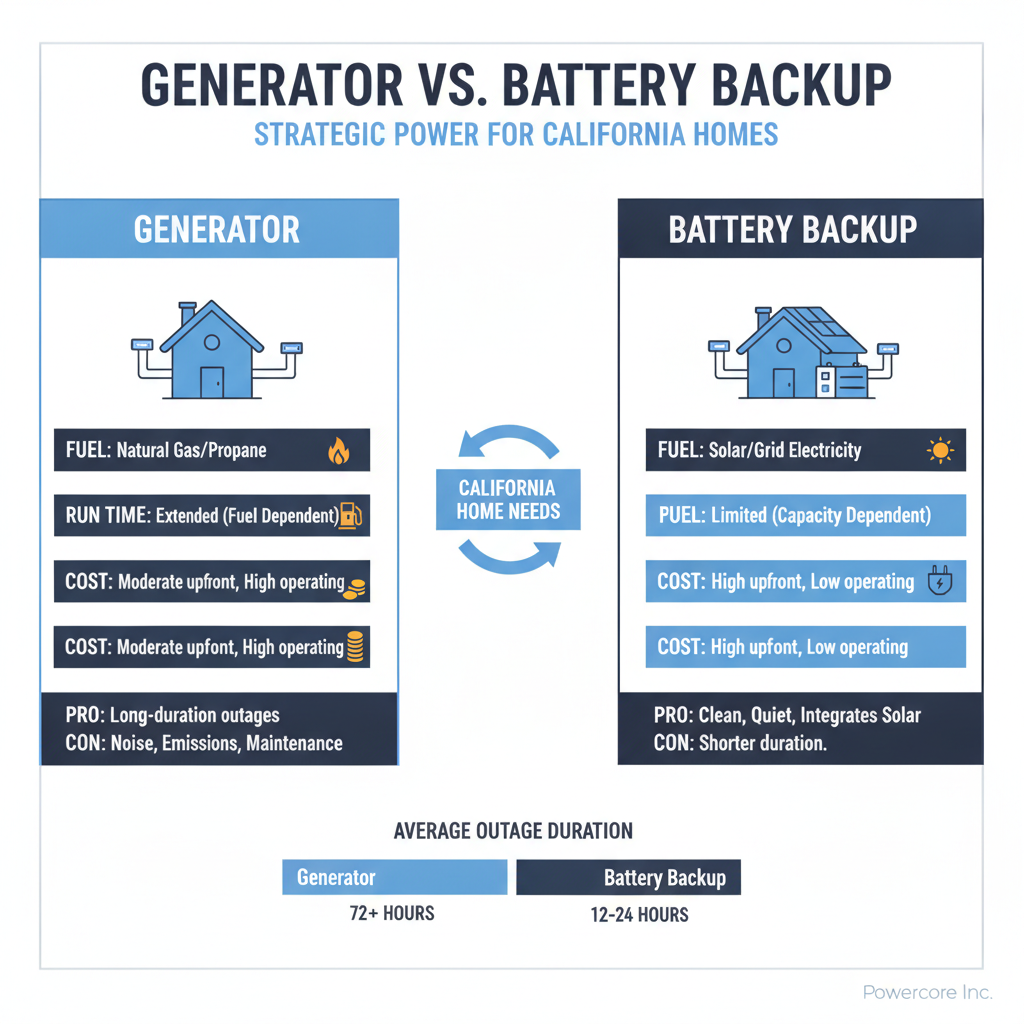
This comparison highlights that both systems have their place, but for California homeowners, the advantages of battery storage often align more closely with current energy trends and future goals.
Key Decision Factors for California Homeowners
Choosing between a generator and battery backup isn't a one-size-fits-all decision. Your ideal solution depends on several factors unique to your home, lifestyle, and priorities in California.
1. Energy Needs and Critical Loads
- Generator: If your primary concern is powering your entire home, including high-demand HVAC systems, electric vehicle chargers, and multiple large appliances for extended periods, a large generator might seem appealing due to its high power output.
- Battery Backup: For essential circuits – lights, refrigerator, internet, medical devices, and select high-demand items – battery systems offer sufficient power. With smart energy management, you can extend backup duration significantly. Powercore Inc helps design systems that prioritize your critical medical and household loads.
2. Sustainability and Environmental Impact
- Generator: Uses fossil fuels, contributing to emissions and noise. This can be a concern for homeowners committed to reducing their carbon footprint, especially in California's environmentally conscious communities.
- Battery Backup: Zero emissions, silent operation. When paired with solar, it provides truly clean, renewable backup power, aligning perfectly with California's climate goals.
3. Upfront Cost and Long-Term Value
- Generator: Generally lower upfront cost for the unit itself, but consider installation (fuel lines, transfer switch), ongoing fuel expenses, and regular maintenance.
- Battery Backup: Higher initial investment, especially with solar. However, significant California battery storage incentives, federal tax credits, and savings on utility bills (through solar and time-of-use optimization) can lead to substantial long-term savings and increased property value.
4. Noise and Aesthetics
- Generator: Can be quite loud, potentially disturbing neighbors and diminishing your outdoor living experience. Requires careful placement to mitigate noise.
- Battery Backup: Operates silently. Battery units are typically sleek and compact, suitable for garage or outdoor wall mounting, offering a more aesthetically pleasing and discreet solution.
5. Maintenance and Reliability
- Generator: Requires routine maintenance, including fuel checks, oil changes, and professional servicing to ensure readiness.
- Battery Backup: Minimal maintenance, primarily software updates and periodic checks, making them a 'set-it-and-forget-it' solution for many homeowners.
6. California-Specific Considerations: PSPS and Grid Instability
- Generator: Provides backup during PSPS events, but reliance on external fuel sources can be risky if supply lines are disrupted.
- Battery Backup: Offers superior resilience during PSPS, especially when combined with solar, allowing continuous recharging. They are also vital for overall grid stability, as discussed in our article on California PSPS Preparedness.
The Hybrid Approach: Combining the Best of Both Worlds
For some California homeowners seeking the absolute pinnacle of energy security, a hybrid system integrating both solar-plus-battery storage and a generator might be the ultimate strategic choice. This approach leverages the strengths of each technology:
- The battery handles most short-term outages and provides daily energy savings by optimizing solar production and time-of-use rates.
- The generator acts as a 'deep backup' for extended, multi-day outages, recharging the batteries or directly powering critical loads when solar production is insufficient or battery capacity is depleted.
This layered approach offers unparalleled peace of mind, ensuring your home remains powered under virtually any circumstance. Powercore Inc has the expertise to design and install these complex, integrated systems, optimizing their performance for your unique California property.
California's Unique Energy Landscape: Why Battery Backup is Gaining Traction
California is a pioneer in renewable energy and energy independence, and its policies and environmental pressures heavily influence backup power decisions. Here's why battery storage is increasingly becoming the strategic choice for many Golden State residents:
Public Safety Power Shutoffs (PSPS)
Driven by wildfire risks, PSPS events have become a regular occurrence, leaving thousands without power. Battery backup, especially with solar, provides a seamless, sustainable solution to ride out these planned outages without relying on external fuel. You generate and store your own power, staying off-grid until the utility restores service.
Time-of-Use (TOU) Rates and Net Metering
California utilities utilize complex TOU rate structures, where electricity costs more during peak demand hours. Battery storage allows homeowners to charge their batteries when electricity is cheap (e.g., overnight or with abundant solar during midday) and discharge them during expensive peak hours, significantly reducing utility bills. This intelligent energy management is a key differentiator from generators, which only provide power during outages.
State and Federal Incentives
California actively promotes battery storage through programs like SGIP, which provides rebates for installing energy storage systems. Combined with federal tax credits, these incentives make battery storage more accessible and financially attractive, further tipping the scales away from fossil fuel generators.
Environmental Leadership
As a state committed to aggressive climate goals, California homeowners are increasingly seeking solutions that align with their values. Battery storage offers a clean, sustainable alternative that reduces reliance on fossil fuels and contributes to a greener grid.
Why Choose Powercore Inc for Your Strategic Energy Solution
Navigating the complexities of backup power solutions in California requires expert guidance. Powercore Inc stands as your premier partner, offering unparalleled expertise as a dual-licensed California General B & C-10 Electrical Contractor (CSLB #1134334 and #1098175). Our comprehensive approach ensures that whether you opt for a generator, a battery backup, or a hybrid system, it is perfectly tailored to your home's needs and California's unique energy environment.
We don't just install systems; we design integrated energy solutions that encompass everything from solar and battery storage to HVAC, roofing, and even EV charging. Our team understands the local regulations, incentives, and utility requirements across all of California, ensuring a seamless and compliant installation. With Powercore Inc, you gain a trusted advisor committed to delivering strategic, reliable, and sustainable energy resilience for your home.
Conclusion: Powering Your California Future
The choice between a generator and a battery backup system is a significant one for any California homeowner. While generators offer robust, long-duration power, battery storage systems provide a cleaner, quieter, and more sustainable solution that aligns with California's energy future and offers significant long-term savings through smart energy management and incentives.
Ultimately, the best choice is the one that strategically meets your specific needs for resilience, sustainability, and budget. Don't leave your home's energy security to chance. Partner with Powercore Inc, your California energy experts, to design and install the perfect backup power solution for your property. Take the first step towards ultimate energy independence and peace of mind.
Ready to Secure Your Home's Power Future?
Contact Powercore Inc today for a personalized consultation. Our team is ready to assess your home's unique requirements and recommend the optimal backup power system. Call us at 916-699-8778 or visit our contact page to schedule an appointment. Let Powercore Inc power your California home with confidence and resilience.