

The Unwavering Need for Backup Power in California
California, a state synonymous with innovation and progress, is also increasingly familiar with power outages. From planned Public Safety Power Shutoffs (PSPS) due to wildfire risks to grid strain from extreme heatwaves and aging infrastructure, reliable access to electricity is no longer a given. For homeowners across the Golden State, the question isn't if they'll experience an outage, but when, and how prepared they'll be.
This evolving energy landscape has placed backup power solutions at the forefront of strategic home planning. When considering how to safeguard your home and family against disruptions, two primary options emerge: the traditional standby generator and the modern battery backup system. Each offers distinct advantages and disadvantages, especially when viewed through the unique lens of California's climate, energy policies, and homeowner priorities.
At Powercore Inc, a dual-licensed General B and C-10 Electrical Contractor serving all of California, we understand the complexities of this decision. Our mission is to empower homeowners with the knowledge to make informed choices that ensure comfort, safety, and energy independence. This comprehensive guide delves deep into the generator vs battery backup debate, providing a strategic comparison tailored for California residents.
Why California Demands Resilient Power Solutions
The reasons for investing in backup power are more compelling in California than ever before. Understanding these drivers is the first step in choosing the right solution:
- Public Safety Power Shutoffs (PSPS): Initiated by utilities to prevent wildfires during high-risk weather conditions, PSPS events can leave hundreds of thousands without power for days, often with little notice.
- Wildfire Season Intensification: Climate change has exacerbated the frequency and intensity of California's wildfire seasons, making PSPS a recurring reality for many communities.
- Grid Strain and Heatwaves: Record-breaking heatwaves push California's electrical grid to its limits, leading to Flex Alerts and, occasionally, rolling blackouts to prevent system collapse.
- Aging Infrastructure: Parts of California's grid are decades old, making them vulnerable to failure from weather events, increased demand, or even animal interference.
- Energy Independence and Security: Beyond outages, homeowners seek greater control over their energy supply, desiring protection from rising utility costs and a reduced reliance on a sometimes-unstable grid.
The Traditional Workhorse: Standby Generators
For decades, standby generators have been the go-to solution for whole-home backup power. These robust systems automatically kick in when grid power fails, providing electricity until utility service is restored.
How Standby Generators Work
A standby generator typically runs on natural gas or propane, though diesel models are also available. When the main power goes out, an automatic transfer switch (ATS) detects the interruption and signals the generator to start. Once the generator is up to speed and producing stable electricity, the ATS seamlessly switches your home's power source from the grid to the generator. When grid power returns, the process reverses, and the generator shuts down.
Advantages of Generators for California Homes
High Power Output: Generators are excellent for powering an entire home, including large appliances like air conditioners, electric ovens, and well pumps, simultaneously. This is particularly valuable during California's intense summer heat.
Extended Runtime: As long as there's a continuous fuel supply (natural gas line or a sufficiently large propane tank), a generator can run for days, even weeks, offering unparalleled peace of mind during prolonged outages.
Proven Technology: Generators are a mature technology with a long track record of reliability. Parts and service are widely available.
Instant Automatic Backup: With an ATS, the transition to generator power is nearly instantaneous, preventing disruption to your daily life.
Disadvantages and Considerations for California Homeowners
Noise Pollution: Generators can be quite loud, which can be an issue in densely populated California neighborhoods and may be subject to local noise ordinances.
Emissions: Running on fossil fuels, generators produce exhaust emissions. California has strict air quality regulations, and while residential generators are permitted, their environmental impact is a factor for many eco-conscious homeowners.
Fuel Dependency: Propane tanks require regular refilling, which can be challenging during widespread outages. Natural gas lines offer continuous fuel but are susceptible to disruption in major disasters like earthquakes.
Maintenance: Generators require regular maintenance, including oil changes, filter replacements, and periodic testing, similar to a car engine. This adds to the long-term cost of ownership.
Upfront & Operational Costs: While installation costs can be significant, the ongoing expense of fuel, especially propane or diesel, can add up quickly during extended use.
No Grid Interaction: Generators typically operate in isolation from the grid and do not offer opportunities for energy savings (like Time-of-Use optimization) or participation in demand response programs.
The Modern Solution: Battery Backup Systems
Battery backup systems, often integrated with solar panels, represent the cutting edge of home energy resilience. They store excess electricity, providing silent, emission-free power during outages and offering smart energy management capabilities.
How Battery Backup Works
A home battery system typically charges from either your home's solar panels or directly from the grid. When an outage occurs, an inverter (often a hybrid inverter) seamlessly switches your home to battery power. The stored energy then powers your critical loads or even your entire home, depending on the system's capacity. If paired with solar, the panels can continue to charge the battery during the day, effectively extending your backup duration indefinitely.
Advantages of Battery Backup for California Homes
Silent Operation: Batteries operate completely silently, making them ideal for residential areas and avoiding noise complaints.
Zero Emissions: As they don't burn fossil fuels, batteries produce no local emissions, aligning perfectly with California's environmental goals and homeowner values.
Smart Energy Management: This is a major differentiator. Batteries can be programmed to charge during off-peak hours (when electricity is cheaper) and discharge during on-peak hours (when it's expensive), saving you money on your utility bills through Time-of-Use (TOU) rate optimization. They can also participate in demand response programs, earning you credits.
Seamless Integration with Solar: For California homeowners with solar, a battery system is a natural extension. It allows you to maximize your solar investment, especially under NEM 3.0, by storing excess daytime generation for nighttime use or backup. Powercore Inc specializes in these integrated solar + storage solutions.
Low Maintenance: Battery systems have very few moving parts, leading to minimal maintenance requirements compared to generators.
Scalable: Many battery systems are modular, allowing you to add more capacity if your energy needs grow over time.
Disadvantages and Considerations for California Homeowners
Initial Cost: The upfront investment for a robust battery backup system, especially one integrated with new solar, can be higher than a generator. However, incentives and long-term savings often offset this.
Finite Capacity: Without an accompanying solar system to recharge them, batteries have a finite amount of stored energy. Their runtime depends on your home's energy consumption and the battery's size. During prolonged cloudy periods, a solar+battery system's effectiveness can be reduced.
Power Output Limitations: While modern battery systems are powerful, some may not be able to simultaneously power every single high-demand appliance in your home, especially older or smaller systems. Strategic load management is key.
Installation Complexity: Integrating a battery system, particularly with existing solar, requires specialized electrical expertise. Powercore Inc's C-10 Electrical Contractor license ensures expert and compliant installation.
Generator vs. Battery Backup: A California Homeowner's Strategic Comparison
Choosing between these two powerful backup solutions requires a careful evaluation of your specific needs, priorities, and budget. Here's a direct comparison of key factors:
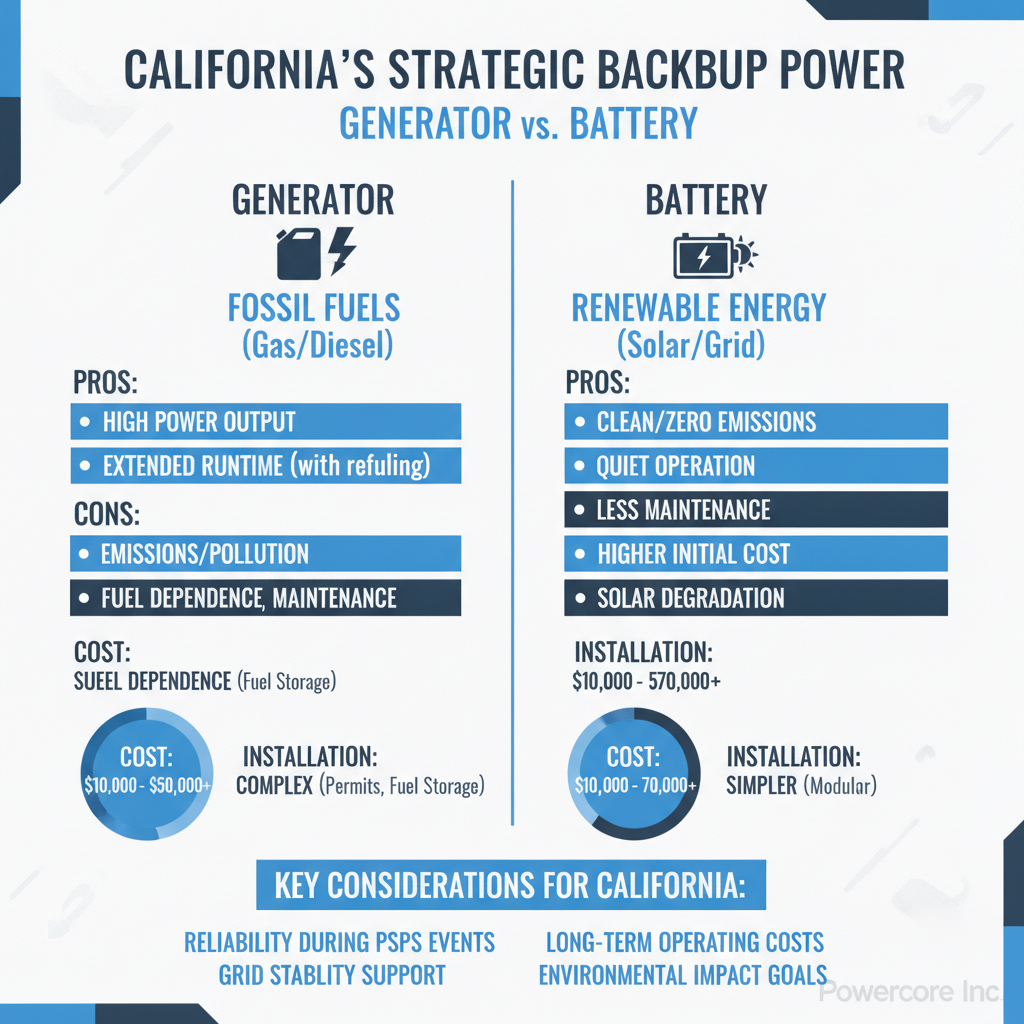
Cost Analysis (California Specific)
When evaluating costs, it's crucial to look beyond the initial purchase price to consider the total cost of ownership over the system's lifespan, especially in California:
Generators: Upfront installation ranges from $7,000 to $20,000+, depending on size, fuel type, and electrical work. Ongoing costs include fuel (natural gas is cheaper than propane, but both add up), and annual maintenance (typically $200-$500/year).
Battery Systems: A standalone battery system can range from $10,000 to $30,000+, with solar-integrated systems often adding $15,000-$35,000+ to a solar installation. However, significant incentives are available. The federal Investment Tax Credit (ITC) offers a 30% tax credit for solar + storage (when charged by solar). California's Self-Generation Incentive Program (SGIP) also provides rebates for battery storage, which can substantially reduce the net cost for eligible homeowners, particularly in high-fire-risk areas or for low-income households. Operational costs are minimal, limited to the cost of electricity used to charge the battery from the grid (if not fully solar-powered) or grid service fees.
Strategic Insight: While batteries often have a higher initial price tag, the combination of federal tax credits, SGIP rebates, and ongoing energy bill savings (TOU arbitrage, demand response) can significantly reduce the net cost and improve the long-term ROI, making them a financially competitive option for many California homeowners.
Environmental Impact
Generators: Contribute to air pollution through emissions of carbon monoxide, nitrogen oxides, and particulate matter. This is a significant concern in California, which has stringent air quality standards.
Battery Systems: Produce zero direct emissions during operation. When paired with solar, they represent a truly clean, renewable energy solution, aligning with California's aggressive decarbonization goals.
Noise and Community Impact
Generators: Can be as loud as a running lawnmower (around 60-70 dB at 23 feet), potentially disturbing neighbors, especially during extended outages. Local noise ordinances in many California cities might restrict generator operation times.
Battery Systems: Operate silently, making them ideal for all residential settings without any community impact.
Maintenance and Longevity
Generators: Require annual professional maintenance, fuel checks, and periodic testing to ensure readiness. Lifespan is typically 10-20 years, depending on usage.
Battery Systems: Generally low maintenance. Most come with warranties of 10-15 years, with anticipated lifespans often exceeding that as technology improves. Software updates are common for optimized performance.
Beyond the Binary: Hybrid and Advanced Solutions
For some California homes, a single solution might not be enough, or a combined approach offers the best of both worlds:
Solar Plus Battery: The California Gold Standard
This integrated system is increasingly becoming the preferred solution for homeowners in California. Solar panels generate electricity, which powers your home and charges the battery. During an outage, the battery takes over, and the solar panels continue to recharge it, providing indefinite backup power during sunny periods. Under NEM 3.0, batteries are crucial for maximizing the value of solar by enabling self-consumption and time-shifting energy usage.
Generator Plus Battery: The Ultimate Resilience
For homes with extremely high energy demands or those in areas prone to very long outages (e.g., remote properties), combining a smaller battery system with a generator can offer ultimate resilience. The battery handles short outages silently and efficiently, while the generator acts as a 'super-charger' or a long-term backup for the battery during extended emergencies, or when solar production is insufficient. This hybrid approach allows for quiet daily operation and powerful, long-duration backup when needed most.
EV Charging and Vehicle-to-Home (V2H)
As EV adoption surges in California, the concept of Vehicle-to-Home (V2H) is gaining traction. Future EVs with V2H capabilities could essentially become massive mobile batteries, capable of powering your home during an outage. Integrating EV charging solutions now, with an eye towards V2H compatibility, is a strategic move for forward-thinking California homeowners. Powercore Inc offers expert EV charging installations to prepare your home for this future.
Making the Right Choice for Your California Home
The best backup power solution isn't one-size-fits-all. It depends on several factors unique to your situation:
Energy Needs: What do you need to power? Critical appliances only, or your entire home?
Outage Frequency & Duration: Are you in an area with frequent, short PSPS events, or rare, long-duration outages?
Budget & ROI: Consider upfront costs versus long-term savings and incentives.
Environmental Priorities: Is reducing your carbon footprint a significant factor?
Existing Infrastructure: Do you already have solar panels? Is natural gas available?
Space & Permitting: Both systems require dedicated space and adherence to local zoning and electrical codes.
Given California's complex energy landscape and regulatory environment, consulting with a qualified and experienced contractor is paramount. Powercore Inc, with its dual General B and C-10 Electrical Contractor licenses (CSLB #1134334 & #1098175), possesses the comprehensive expertise to assess your needs, navigate permitting, and install the ideal backup power solution for your home.
Why Powercore Inc is Your Trusted California Partner
Choosing a backup power system is a significant investment in your home's future. You need a partner who understands California's unique challenges and opportunities. Powercore Inc stands out as the premier choice:
Dual-Licensed Expertise: Our General B and C-10 Electrical licenses mean we are qualified to handle every aspect of your project, from structural considerations for mounting equipment to complex electrical integrations, ensuring a safe, compliant, and efficient installation.
Comprehensive Solutions: From solar and battery storage to EV charging, HVAC, and full home remodels, we offer a holistic approach to home energy and resilience. We can design and install a system that integrates seamlessly with your existing or future home improvements.
California-Specific Knowledge: We are deeply familiar with California's energy policies, incentive programs (like SGIP), and local permitting requirements across the state, ensuring you maximize your benefits and avoid pitfalls.
Customer-Centric Approach: We pride ourselves on transparent communication, exceptional craftsmanship, and tailored solutions that meet the specific needs and budget of each homeowner.
Future-Proof Your California Home with Powercore Inc
The decision between a generator and a battery backup system for your California home is more than just a purchase; it's an investment in resilience, independence, and peace of mind. While generators offer robust, long-duration power, battery systems, especially when paired with solar, provide silent, clean, and intelligent energy management that aligns perfectly with California's energy future.
Don't wait for the next power outage to realize the importance of a reliable backup system. Empower your home with a strategic energy solution designed for California's unique demands. Contact Powercore Inc today for a personalized consultation. Our experts are ready to help you navigate the options and design the perfect backup power system for your home and lifestyle. Call us at 916-699-8778 to secure your energy future.