

Navigating California's Unpredictable Power Landscape
California homeowners face a unique set of challenges when it comes to power reliability. From the threat of Public Safety Power Shutoffs (PSPS) during wildfire season to an aging grid grappling with increasing demand and fluctuating energy costs, maintaining a consistent power supply is no longer a given. While whole-home backup solutions offer comprehensive protection, a strategic approach often involves focusing on what truly matters during an outage: your critical loads.
This is where a California critical load panel setup becomes an indispensable component of a resilient home energy system. It's not just about having backup power; it's about intelligently managing that power to maximize efficiency, extend runtimes, and ensure your most essential appliances and systems remain operational when the grid goes down. For homeowners across California, from the bustling Bay Area to the serene deserts and coastal communities, understanding and implementing this strategic solution is key to true energy independence.
At Powercore Inc, a dual-licensed General B and C-10 Electrical Contractor based in Roseville, CA, we specialize in designing and installing robust backup power solutions tailored to California's unique demands. We're here to guide you through the intricacies of critical load panel setups, ensuring your home is prepared for whatever the future holds.
What is a Critical Load Panel, and Why is it Essential?
Imagine your home's electrical system as a vast network. Your main electrical panel is the central hub, distributing power to every light switch, outlet, and appliance. A critical load panel, also known as a subpanel for essential loads, acts as a dedicated bypass circuit for your backup power source.
Here's how it works:
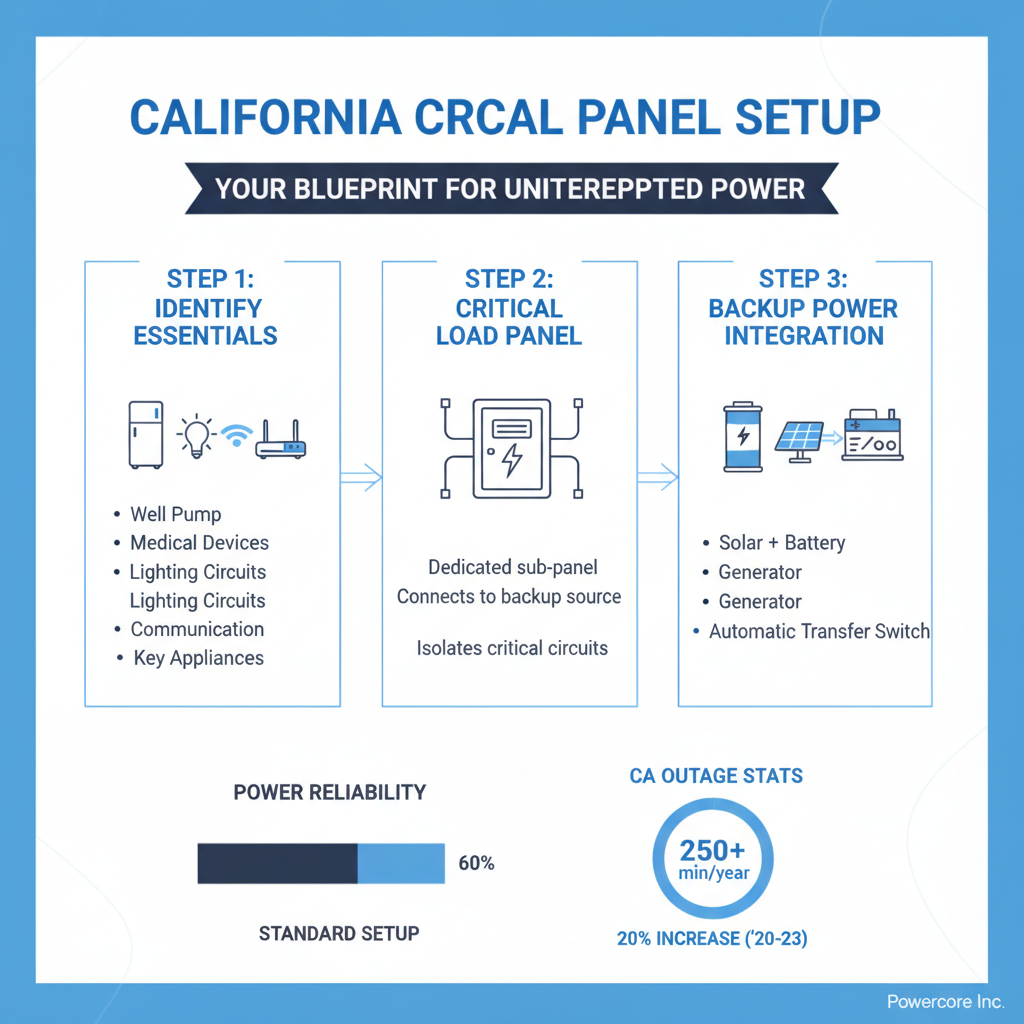
- Isolation of Essentials: Instead of trying to power your entire home during an outage, a critical load panel isolates and powers only your pre-selected essential circuits.
- Backup Power Connection: Your backup power source (whether it's a solar battery like a Tesla Powerwall, an Enphase IQ Battery, or a generator) connects to this critical load panel, often via an automatic transfer switch (ATS).
- Efficient Resource Management: By only powering critical circuits, your backup system can operate for significantly longer periods, conserving precious battery energy or fuel.
In essence, a critical load panel setup allows you to prioritize what stays on during a power outage, transforming your backup system from a generic power source into a smart, targeted resilience solution. This distinction is crucial for maximizing the effectiveness and longevity of your backup power investment, especially in a state where outages can last for extended durations.
California's Power Challenges: Why a Critical Load Panel is a Must-Have
The need for reliable backup power in California has never been more pressing. Here are the key drivers:
Public Safety Power Shutoffs (PSPS)
Initiated by utility companies to mitigate wildfire risk, PSPS events can leave entire communities without power for days. A critical load panel ensures your most important systems – like refrigeration, communications, and medical equipment – remain active, providing vital comfort and safety.
Grid Instability and Aging Infrastructure
California's electrical grid is under immense strain from increasing demand, extreme weather events, and aging infrastructure. Unexpected outages are becoming more frequent, unpredictable, and often localized. A targeted critical load panel setup offers a robust defense against these disruptions.
Rising Energy Costs and Time-of-Use (TOU) Rates
While primarily a backup solution, a critical load panel integrated with solar and battery storage can also contribute to daily energy savings. By intelligently managing loads, you can optimize battery discharge during peak TOU periods, reducing reliance on expensive grid power. This proactive approach helps Californians navigate some of the highest electricity rates in the nation.
Electrification Trends and Increased Demand
As more California homes adopt electric vehicles (EVs), heat pump HVAC systems, and other electric appliances, the overall electrical load on homes increases. A critical load panel helps manage this expanded demand by ensuring only essential high-draw items are prioritized during an outage, preventing your backup system from being overwhelmed.
Components of a Strategic Critical Load Panel Setup
A well-designed critical load panel system involves several key components working in harmony:
Your Main Electrical Service Panel
This is where all power enters your home from the utility grid. Circuits for non-critical loads (e.g., clothes dryer, oven, water heater if not essential) typically remain connected here.
The Automatic Transfer Switch (ATS)
This intelligent device senses a grid outage and automatically switches your home's critical loads from utility power to your backup power source. When grid power returns, it seamlessly switches back. The ATS is crucial for hands-free operation and compliance with California's electrical codes.
The Critical Load Subpanel
This is the star of the show. Selected circuits from your main panel are rerouted and connected to this subpanel. When the ATS activates, only the circuits in this subpanel receive power from your battery storage or generator.
Your Backup Power Source
This could be:
- Solar & Battery Storage: The most popular and sustainable option in California, allowing you to generate and store your own clean energy.
- Standby Generator: Often fueled by natural gas or propane, providing extended runtimes for larger loads.
- Hybrid Systems: Combining solar, battery, and a generator for ultimate resilience.
Integrated Energy Management Systems
Modern critical load setups often include smart energy management systems that can monitor and even automatically shed non-essential loads within the critical load panel to prolong battery life. For example, if your battery runs low, it might temporarily shut off a less critical "essential" circuit like a guest bathroom fan, while keeping the refrigerator running.
Designing Your Critical Load Strategy: What to Prioritize
The most crucial step in a successful critical load panel setup is a thoughtful assessment of your home's specific needs during an outage. This isn't a one-size-fits-all solution; it's a personalized blueprint for resilience.
Identifying Your Essential Loads
Start by making a list of everything you absolutely cannot live without during a power outage. Common critical loads include:
- Refrigeration: To preserve food and medications.
- Lighting: Key areas, emergency lights.
- Communication & Entertainment: Wi-Fi router, TV (if desired), charging ports for phones.
- Medical Devices: CPAP machines, oxygen concentrators, or other essential health equipment.
- Heating/Cooling: Critical fan motors for furnaces or essential AC circuits, especially in extreme California temperatures.
- Water Supply: Well pumps or water heaters (if electric and essential for hygiene/comfort).
- Garage Door Opener: For vehicle access.
- Security Systems: Alarms, cameras.
Calculating Power Needs: Amperage and Wattage
Once you have your list, the next step is to determine the power requirements of these items. This involves looking at their amperage and wattage. Some appliances have significant surge (start-up) requirements that must be accounted for by your backup system. An expert assessment from Powercore Inc will accurately calculate these needs, ensuring your critical load panel and backup power source are perfectly matched.
Future-Proofing Your Setup
Consider future additions. Are you planning to install an EV charger, a heat pump water heater, or an ADU? While these might not be "critical" for short outages, planning for their potential integration into a backup scenario (even as managed loads) can save significant costs down the line. A flexible critical load panel design can accommodate future expansion.
The Installation Process: What to Expect with Powercore Inc
Installing a critical load panel setup is a complex electrical project that requires licensed professionals. Here’s what you can expect when you partner with Powercore Inc:
Initial Consultation & Site Assessment
Our process begins with a thorough discussion of your energy goals, budget, and critical load priorities. We'll then conduct a detailed on-site assessment of your existing electrical infrastructure, main panel capacity, and potential locations for the critical load panel and backup power source. This ensures a design that is perfectly tailored to your California home's unique layout and needs.
Custom Design & Permitting
Based on our assessment, we'll develop a customized critical load panel design that optimizes your backup power usage. We handle all necessary permitting with your local Authority Having Jurisdiction (AHJ) and ensure compliance with California's stringent electrical codes, including those enforced by the California Contractors State License Board (CSLB).
Professional Installation & Integration
As a dual-licensed General B and C-10 Electrical Contractor (CSLB #1134334 & #1098175), Powercore Inc brings unparalleled expertise to your installation. Our certified electricians will:
- Carefully reroute selected critical circuits from your main panel to the new subpanel.
- Install the automatic transfer switch.
- Integrate your chosen backup power source (solar batteries, generator, etc.).
- Ensure all wiring is up to code, safe, and aesthetically pleasing.
Testing, Commissioning, and Client Education
After installation, we rigorously test the entire system to ensure seamless operation during grid outages. We'll commission your system and walk you through its functionality, ensuring you understand how to monitor and manage your critical loads effectively. Our goal is not just to install a system but to empower you with the knowledge to utilize it confidently.
Cost Considerations for California Homeowners
The cost of a critical load panel setup in California can vary widely depending on several factors:
- Scope of Critical Loads: The number of circuits to be rerouted and the total power demand.
- Backup Power Source: The type and size of battery storage (e.g., Tesla Powerwall, Enphase, Generac) or generator chosen. The critical load panel itself is a component of a larger backup system.
- Installation Complexity: Ease of access to electrical panels, distance for new wiring runs, and existing electrical infrastructure.
- Permitting Fees: Local jurisdiction fees.
Generally, the installation of the critical load panel and ATS, excluding the backup power source, can range from a few thousand dollars up to $10,000+, depending on complexity. When integrated with a comprehensive solar and battery storage system, the overall investment will naturally be higher but offers far greater long-term benefits in terms of energy independence and savings.
Leveraging California's Incentives and Savings
California homeowners have access to several programs that can significantly offset the cost of backup power solutions:
- Federal Solar Investment Tax Credit (ITC): A substantial tax credit (currently 30%) for solar PV systems and associated battery storage.
- Self-Generation Incentive Program (SGIP): While highly competitive and often with limited availability, SGIP offers cash incentives for battery storage systems installed in California, particularly for homes in high fire-threat areas or those with medical baseline needs.
- Net Energy Metering (NEM): For solar owners, NEM 3.0 offers a different framework for exporting excess solar, making battery storage even more valuable for maximizing self-consumption and reducing reliance on the grid during peak hours.
Powercore Inc stays up-to-date on all relevant California incentives and regulations, helping you navigate these opportunities to maximize your investment.
Why Choose Powercore Inc for Your California Critical Load Panel Setup?
When it comes to safeguarding your home with a reliable critical load panel setup, expertise matters. Powercore Inc stands out as California's trusted partner for comprehensive energy solutions.
- Dual-Licensed Expertise: Our unique dual licensing (CSLB General B #1134334 and C-10 Electrical #1098175) means we possess a holistic understanding of home construction and advanced electrical systems. This allows us to seamlessly integrate your critical load panel with solar, battery storage, HVAC, and even broader home remodels, ensuring a cohesive and compliant solution.
- California-Wide Service: From our base in Roseville, CA, we proudly serve homeowners across the entire state, understanding the diverse energy challenges and regulations unique to different regions.
- Comprehensive Solutions: We don't just install panels; we provide integrated solutions. Whether you need solar, battery storage, EV charging, or a full home remodel to accommodate your new energy system, Powercore Inc is your single point of contact.
- Commitment to Quality & Safety: We adhere to the highest industry standards, using premium components and employing best practices to ensure your critical load panel setup is not only efficient but also safe and built to last.
Secure Your California Home with Intelligent Power Management
A critical load panel setup is more than just an electrical upgrade; it's an investment in your home's resilience, efficiency, and your family's peace of mind. In a state like California, where power stability is increasingly uncertain, strategically prioritizing your essential loads with an expert-designed and installed system is a smart, forward-thinking decision.
Don't let grid outages leave you in the dark. Take control of your home's energy future with a customized California critical load panel setup from Powercore Inc. Our team of experienced professionals is ready to assess your needs, design the perfect solution, and ensure a seamless installation process. Get started on your blueprint for uninterrupted power today.
Contact Powercore Inc at 916-699-8778 to schedule your consultation and learn how we can empower your California home.