

Introduction: Future-Proofing Your ADU in California
California homeowners are increasingly looking to Accessory Dwelling Units (ADUs) as a versatile solution for additional income, multi-generational living, or expanding property value. With the Golden State's continuous efforts to address housing shortages, ADU regulations are dynamic, often updated to streamline processes and encourage development. As we approach 2026, understanding not just the current rules but also the likely trajectory of California ADU rules 2026 and beyond is crucial for any homeowner planning a new build or conversion.
At Powercore Inc, a dual-licensed General B & C-10 Electrical Contractor based in Roseville, CA, we understand the complexities of navigating these regulations. Our expertise in comprehensive construction and electrical services positions us to help you design, build, and optimize an ADU that complies with current standards and is adaptable for future legislative changes. This guide will delve into the essential ADU size and zoning rules currently in effect, anticipate potential shifts for 2026, and provide strategic insights to ensure your ADU project is a smart, long-term investment.
The Enduring Appeal of California ADUs: Why They Matter
The popularity of ADUs in California isn't just a trend; it's a strategic response to evolving housing needs. From bustling urban centers to serene suburban landscapes, ADUs offer a multitude of benefits:
- Increased Property Value: Adding a legal, permitted ADU can significantly boost your home's market value, providing a strong return on investment.
- Rental Income: Many homeowners utilize ADUs to generate passive income, helping offset mortgage costs or provide a new revenue stream.
- Multi-Generational Living: ADUs provide independent living spaces for aging parents, adult children, or other family members, fostering proximity while maintaining privacy.
- Flexible Space: Beyond housing, an ADU can serve as a dedicated home office, an art studio, a private gym, or a guest suite, adapting to your family's changing needs over time.
- Affordable Housing Solution: By increasing housing density without requiring new land development, ADUs contribute to California's broader goal of creating more affordable housing options.
California's state legislature has progressively eased ADU restrictions since 2017, aiming to remove local barriers and accelerate construction. These legislative efforts have made ADUs more accessible than ever, but they also necessitate staying informed about the latest mandates and local interpretations.
Current Landscape: California ADU Rules in 2024-2025
While local jurisdictions retain some authority, state law dictates the fundamental framework for ADU development across California. Here’s a breakdown of the key statewide regulations you need to know:
ADU Types and Definitions
- Attached ADU: An ADU that is physically connected to the primary dwelling.
- Detached ADU: A standalone structure on the same lot as the primary dwelling.
- Converted ADU: An ADU created by converting existing space within the primary dwelling (e.g., a garage, basement, or attic).
- Junior ADU (JADU): A smaller ADU (up to 500 sq ft) located entirely within the primary dwelling, including an existing bedroom, with an efficiency kitchen and separate entrance. JADUs require owner-occupancy of either the primary dwelling or the JADU.
Statewide Size and Height Mandates
- Maximum Size:
- Detached ADU: Up to 1,200 square feet.
- Attached ADU: Up to 50% of the existing primary dwelling's floor area, or 1,200 square feet, whichever is less.
- No size limit based on lot size, meaning even small lots can accommodate a sizable ADU within these parameters.
- Minimum Size: All ADUs must be at least 150 square feet.
- Height: Generally, detached ADUs are allowed up to 16 feet in height, or up to 25 feet (or 2 stories) if near a multi-family or commercial zone, or up to 25 feet for an attached ADU, or the height of the main dwelling, whichever is less, in specific scenarios. Local ordinances might allow more, but cannot restrict below state minimums.
Setbacks and Location
- Rear and Side Setbacks: State law mandates a maximum 4-foot setback from the side and rear property lines for detached ADUs.
- Front Setback: Typically, local jurisdictions cannot impose front yard setbacks if the ADU is a conversion of an existing structure (like a garage). For new construction, front setbacks usually apply, but cannot be more restrictive than for the primary dwelling.
- Existing Structure Conversion: No setbacks are required for ADUs or JADUs created from existing legal structures, provided they maintain the structure's existing dimensions.
Parking Requirements
Parking requirements have been significantly relaxed:
- No parking is required if the ADU is within a half-mile walking distance of public transit.
- No parking is required if it's part of an existing structure conversion or if a car share vehicle is located within one block.
- When parking is required, it's typically one space per ADU or bedroom, whichever is less.
Utility Connections and Fees
For ADUs created by converting existing space, new utility connections or fees for those connections are generally prohibited. For new detached ADUs, separate connections may be required, but impact fees must be proportionate to the ADU's size and not exceed the fees for the primary dwelling.
Owner Occupancy and Short-Term Rentals
State law currently prohibits local agencies from requiring owner-occupancy for standard ADUs until 2025, after which local agencies may impose it. JADUs, however, always require owner-occupancy of either the primary dwelling or the JADU. Short-term rentals (less than 30 days) of ADUs are generally prohibited in most jurisdictions, especially in single-family zones, but local rules vary. It's essential to check your specific city or county ordinances.
Anticipating 2026: Potential Shifts and Strategic Planning
California's legislative landscape for ADUs is always evolving, driven by the ongoing housing crisis and environmental goals. While predicting exact changes for 2026 is challenging, we can identify key areas where legislation is likely to focus, helping you strategically plan your project now.
Continued Streamlining and Standardization
Expect further efforts to standardize ADU regulations across the state, minimizing local discretion that could create barriers. This might include clearer definitions, more consistent application processes, and possibly state-approved prototype plans to simplify design and permitting.
Enhanced Energy Efficiency and Sustainability Mandates
California is a leader in green building. It's highly probable that future ADU regulations will push for greater energy efficiency. This could mean:
- Solar Readiness or Mandates: New ADU construction may increasingly require residential solar panel installation or at least be 'solar-ready.' Integrating battery storage solutions with solar can further enhance energy independence and savings.
- Electrification: A move away from natural gas appliances towards all-electric systems (HVAC, water heaters, cooking) could become more prevalent or even mandatory.
- Water Conservation: Increased requirements for low-flow fixtures, greywater systems, or drought-tolerant landscaping for ADU projects.
Fire Safety and Resilience
Given California's wildfire challenges, expect heightened focus on fire-resistant materials and construction methods, especially in High Fire Hazard Severity Zones. This could impact choices for siding, roofing, and defensible space requirements around ADUs.
Affordable Housing Incentives
The state may introduce new incentives or grant programs for homeowners who commit to renting their ADUs at affordable rates, further encouraging development in specific income brackets.
EV Charging Infrastructure
With the rise of electric vehicles, it's conceivable that future ADU codes might include provisions for EV charging stations, either as a requirement or as an encouraged amenity, especially for rental units.
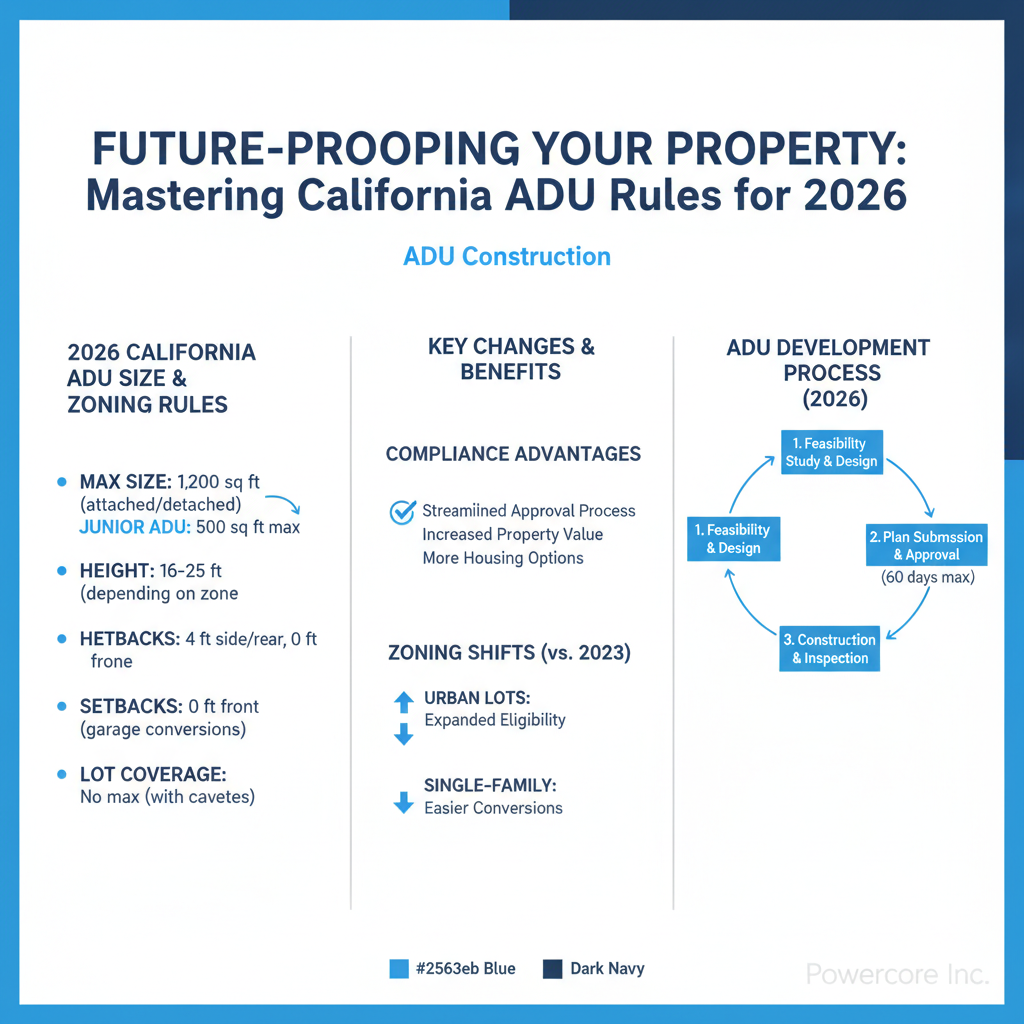
Key ADU Size & Zoning Considerations for Your Project
Understanding the specific limits and allowances is paramount. Here's a deeper dive into practical considerations:
Maximizing Space Within Limits
While the state allows up to 1,200 sq ft, your specific lot size, existing structures, and local overlays might influence the optimal size. Powercore Inc's remodels and new construction experts can help you assess your property's potential to maximize livable space while adhering to regulations. A well-designed ADU can feel spacious and functional even within smaller footprints.
Strategic Setback Planning
The 4-foot side and rear setback rule is a significant advantage. This allows for greater flexibility in placing a detached ADU, even on narrower lots. Careful planning of the ADU's footprint and orientation can optimize natural light, privacy, and access to outdoor areas like decking.
Navigating Height Restrictions
The ability to build up to 16 feet (or even 25 feet in certain zones) offers design flexibility. A two-story ADU can often achieve more square footage on a smaller footprint, separating sleeping and living areas, which is ideal for rental units or multi-generational living. Our team is adept at designing multi-story structures that comply with local height and safety codes.
Parking Flexibility
The relaxed parking rules are a huge benefit, especially in urban areas or properties close to public transit. Verify your property's eligibility for parking waivers with your local planning department to potentially free up valuable space for landscaping or other uses.
Utility Connections and Costs
Understanding whether your ADU will require separate utility connections or if it can share existing ones is critical for budgeting. Powercore Inc, with our C-10 Electrical license, can guide you through the electrical infrastructure requirements, ensuring safe and compliant power for your new unit. This also extends to HVAC systems, where efficient solutions like those found on our HVAC Climate Control service page can ensure comfort and cost-effectiveness.
Beyond the Basics: Enhancing Your ADU for Value & Sustainability
Building an ADU is more than just meeting code; it's about creating a high-quality, sustainable, and desirable living space. Powercore Inc specializes in integrating advanced solutions that future-proof your investment.
Integrated Solar and Battery Storage
Given California's energy landscape, incorporating solar and battery storage is an intelligent move. This not only reduces utility bills for you or your tenants but also increases the property's attractiveness and resilience. Future regulations may further incentivize or mandate such installations, making early adoption a strategic advantage. Our expertise in residential solar and storage ensures seamless integration, providing long-term savings and energy independence.
Efficient HVAC Systems
Climate control is key to comfort. Modern, energy-efficient HVAC systems are crucial for an ADU. Options like ductless mini-splits offer targeted heating and cooling, ideal for smaller spaces and individual temperature control, aligning with California's push for energy conservation.
Durable and Attractive Exteriors
The exterior of your ADU should complement your primary home while offering superior protection. High-quality siding and exterior materials, along with robust roofing, are essential for California's diverse climate, from intense sun to winter rains and potential wildfires.
Smart Interior Design and Finishes
Thoughtful interior remodeling makes an ADU feel like a true home. Efficient layouts, quality finishes, and clever storage solutions maximize functionality in smaller footprints, enhancing both livability and rental appeal. Consider durable, low-maintenance materials for longevity.
Outdoor Living Spaces
Extending the living area outdoors with well-designed decking and outdoor living spaces can significantly enhance an ADU's appeal and perceived size. This is particularly valuable in California, where outdoor living is a cherished lifestyle.
Navigating the Permit & Construction Process with Powercore Inc
The path from concept to completion for an ADU involves multiple steps, each requiring careful attention to detail and compliance with local and state regulations.
Design and Planning
This initial phase involves conceptualizing your ADU, developing architectural plans, and ensuring they meet all zoning, size, and setback requirements. This is where Powercore Inc's expertise shines. We help you explore design options that maximize your property's potential while adhering to current and anticipated ADU construction guidelines.
Permitting and Approvals
Obtaining the necessary permits from your local planning and building departments can be a complex and time-consuming process. Our team at Powercore Inc is well-versed in California's permitting requirements and can manage the application process, ensuring all documentation is accurate and submitted efficiently. We understand the nuances of the California Contractors State License Board (CSLB), where Powercore Inc holds licenses #1134334 (General B) and #1098175 (C-10 Electrical), ensuring your project is handled by qualified professionals. You can verify our credentials at cslb.ca.gov.
Construction and Project Management
Once permits are secured, the construction phase begins. As a dual-licensed contractor, Powercore Inc offers a unique advantage: seamless integration of general construction and electrical work. This means a more streamlined project, fewer subcontractors to manage, and consistent quality control from foundation to finish. Our comprehensive approach covers everything from framing and roofing to electrical installations, plumbing, and interior finishes.
Inspections and Final Occupancy
Throughout construction, various inspections are required to ensure compliance with building codes and safety standards. Powercore Inc coordinates these inspections and addresses any findings promptly, leading to a smooth final inspection and certificate of occupancy, allowing you to enjoy your new ADU.
Financial Aspects: Costs, ROI, and Incentives
Investing in an ADU is a significant financial decision, but it often yields substantial returns. Construction costs for ADUs in California can vary widely, typically ranging from $150,000 to over $400,000, depending on size, finishes, site conditions, and complexity. However, the potential for rental income (often $1,500 - $3,500+ per month in many parts of California) and increased property value usually makes it a highly attractive investment.
While specific state-level ADU construction incentives are limited, homeowners can explore options like the California Housing Finance Agency (CalHFA) ADU Grant Program, which offers up to $40,000 for pre-development costs for low-to-moderate income homeowners. Additionally, integrating solar and battery storage may qualify for the federal Residential Clean Energy Credit (formerly the Investment Tax Credit), offering significant savings on installation costs. Discuss potential incentives with your financial advisor to maximize your investment.
Conclusion: Your Strategic ADU Partner
The journey to building an ADU in California is an exciting one, offering immense potential for homeowners. By staying informed about current and anticipated California ADU rules 2026, you can ensure your project is not only compliant but also strategically positioned for long-term value and sustainability.
Powercore Inc is your trusted partner for navigating these complexities. With our General B and C-10 Electrical licenses, we offer a comprehensive, integrated approach to ADU construction, ensuring every aspect of your project – from design and permitting to electrical systems and finishing touches – is handled with expertise and precision. We serve all of California, bringing our commitment to quality and client satisfaction to every project.
Ready to explore the possibilities of an ADU for your property? Don't wait to future-proof your investment. Contact the experts at Powercore Inc today to discuss your vision and get started on a successful ADU project. Call us at 916-699-8778 or visit our contact page to schedule a consultation. Let Powercore Inc turn your ADU dream into a valuable reality.